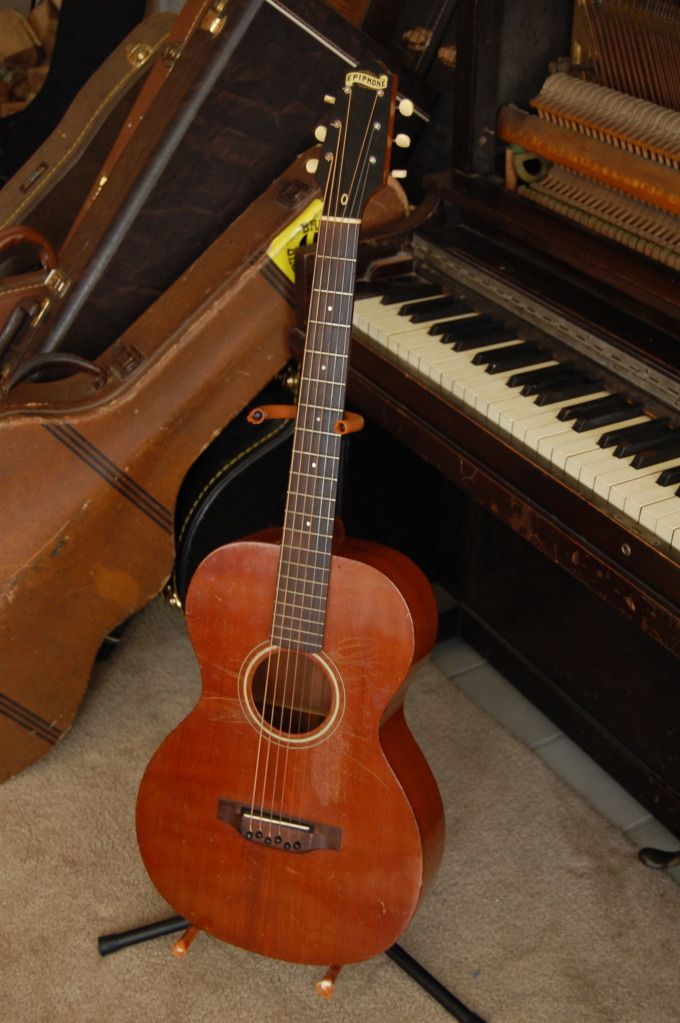
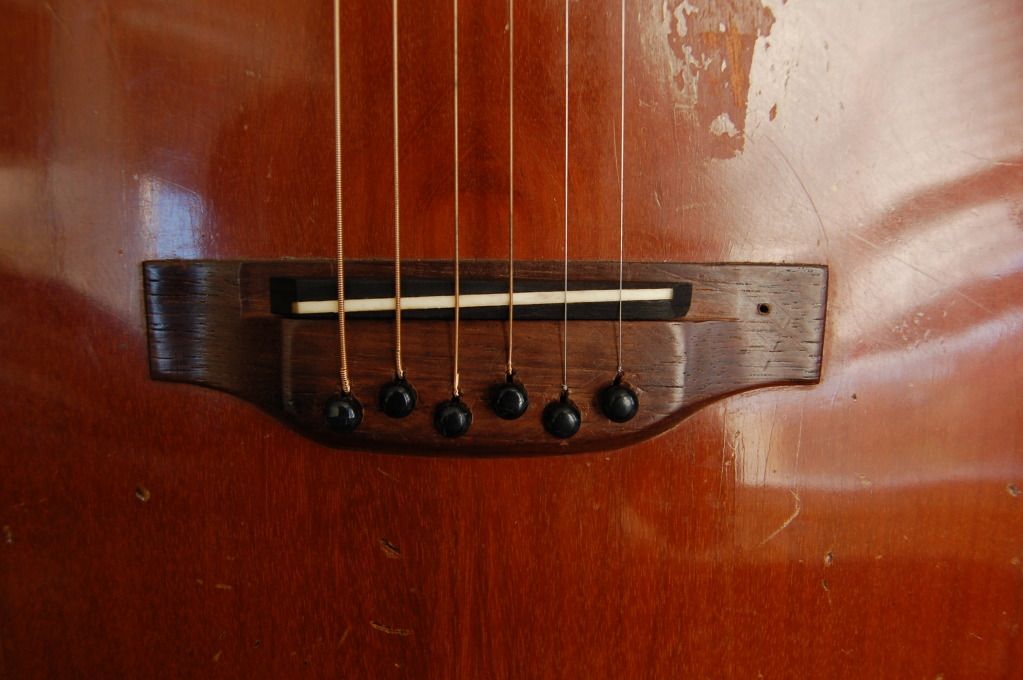
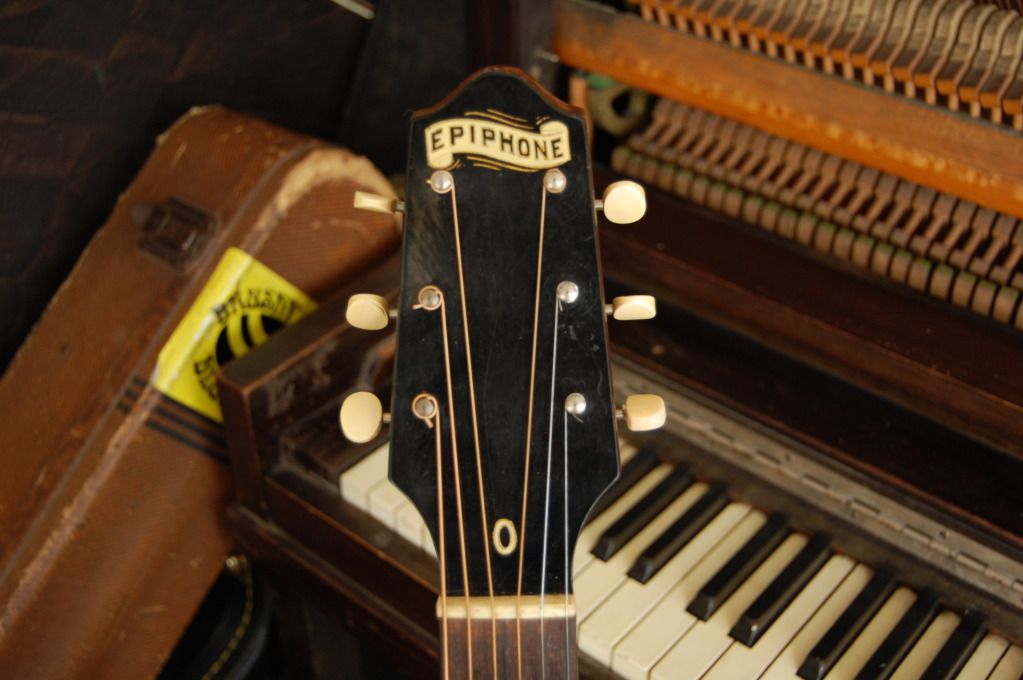
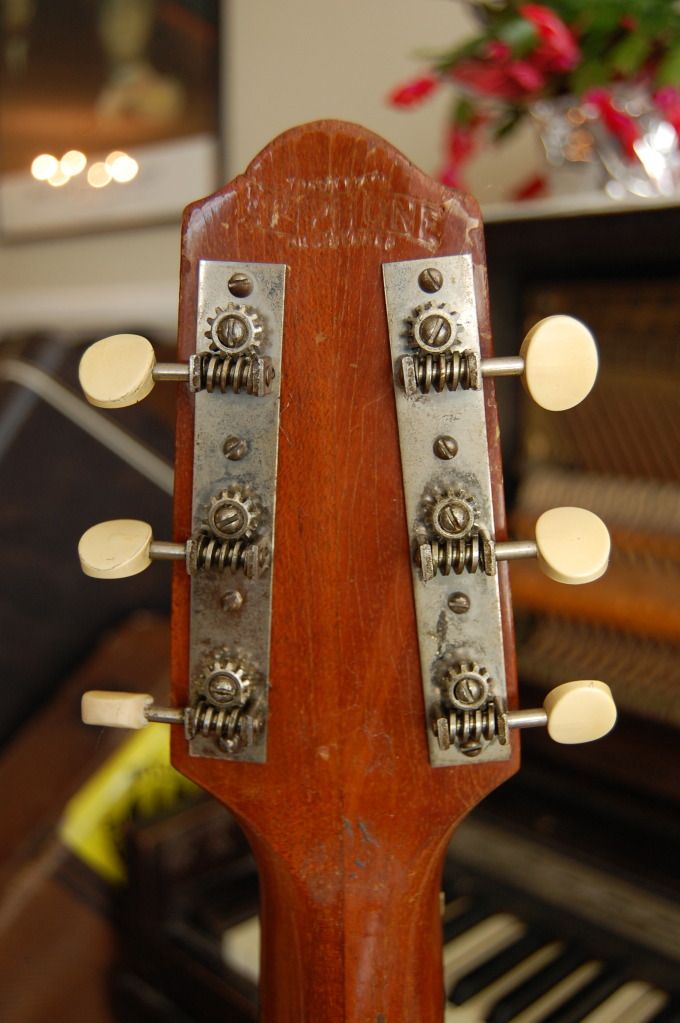
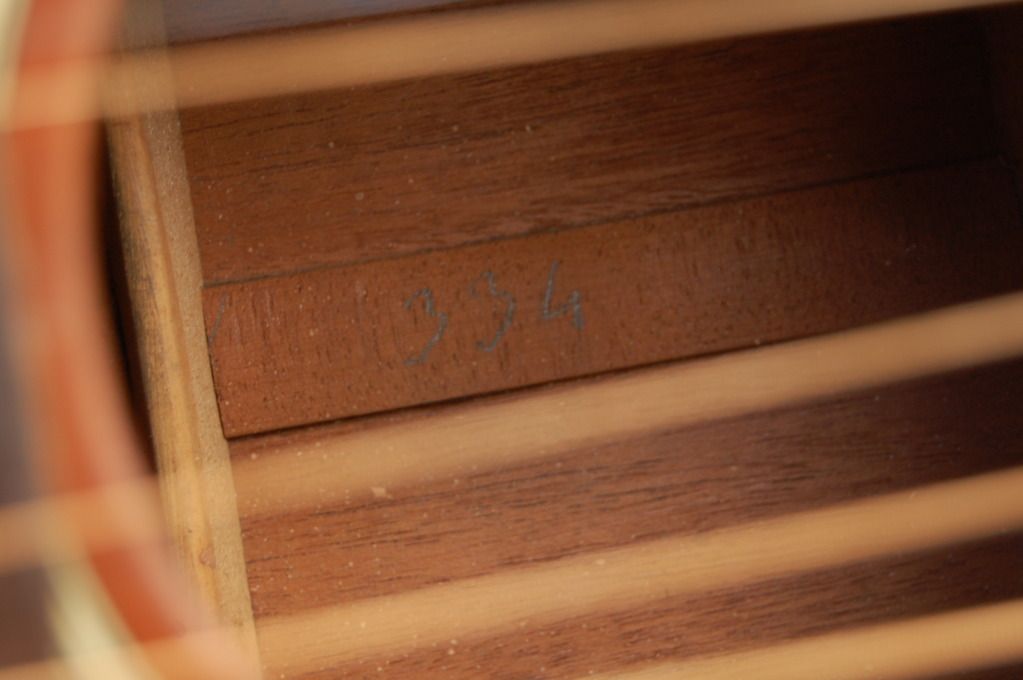
The first Trojan shipped in October of 1936 and was marked in the Gibson Shipping ledgers as "Trojan." This guitar has now been confirmed in the old Gibson ledgers as a Trojan shipped on November 26, 1936. A gentlemen posted about this guitar on the Gibson forum and was kind enough to send me a bunch of pictures.
The Gibson Trojan preceded the J-35 by a couple of months (October to December, 1936). This Gibson Trojan matches all the features for a 1937 J-35 with the exception of a couple of key things. The main difference is the lack of back binding. J-35s were introduced with a single layer of binding on the back which this guitar lacks.
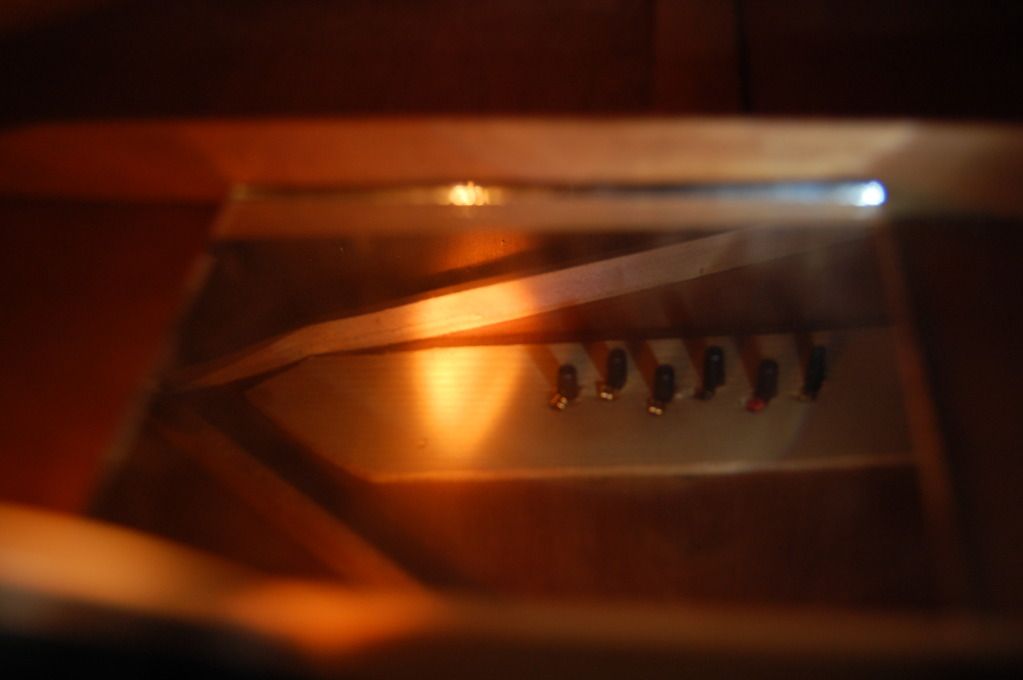
It also has 3 scalloped tone bars. The standard J-35 would most likely have had 3 unscalloped tone bars. I'm very curious about the tone of this guitar. I'm going to guess that this thing is awesome. Just wait until you scroll down and see the deep scallops. Amazing.
The Ebony nut is cool but not entirely out of line. It could have been Ebony or bone but either one would work. It's just another aspect of this guitar that makes it so darn cool.
This guitar was made for export as evidenced by the "Made In USA" stamp on the back of the head stock. This was fairly common at the time. My 1937 Gibson L-00 had the same stamp and Grover branded open back tuners. It also had the same pumpkin colored sunburst on the top but did have back binding.
I hope you enjoyed taking a look at this beauty. Many thanks to the owner for letting me post about it.
Gregory Alan Isakov muses over his guitar as he rolls a cigarette. It is the last day of September 2013 and Gregory was kind enough to chat a while about his beat but sweet 1967 Gibson J-50. The weather was nice and it was time for a post sound check smoke. We talk about how his guitar lay dormant in a barn in Colorado for about 40 years, just resting up for its second career.
John: Do you mind if I check it out? It looks like it has seen some miles. Gregory: Please. Yeah it's a '67. John: did you say he brought it to Vietnam? Gregory: Yeah and he brought it back. I used to work on his farm and we had always been really close. One night he said, "Well Gregory, I left you something in the barn." I thought it was weed since he smokes a lot of weed. He took me out to the barn and there was this big buffalo skull and a guitar case. I took the guitar to a friend in New York who got it set up for me.
Gregory's J-50 has had a neck reset, refret and had the adjustable bridge "fixed". The tuning keys are reproduction Kluson keystones. It has the slimmer, late 60s neck and the setup is spot on. It has nice mid to low range with that classic Gibson Americana rumble.
J: ... and you play this guitar pretty much exclusively? G: Well I have another guitar with me, it's a Stella. Actually, I almost bought another guitar last week. J: What was it? G: An ES-125. It was the nicest one I've ever played. Most of the mid range was gone, it was just super warm with a really buttery high end. But the mids were gone. It played so well and it sang really well. J: What year was it? G: '52. It was $1800 which was pretty much all I had. I didn't buy it but I've been thinking about it all day. It's in Austin at Austin Vintage Guitars. It's like my favorite shop.
G: I don't love electrics, but I like electrics with just a little bite to 'em. The ES-125 has my favorite tone that I've found. J: So are you a Gibson guy or do you like all of them? G: No not really, my favorite guitar right now is the Stella. It was $35 and I got it in Buffalo, NY. It was in a big pile of old Stellas. The guy was like "how about $50 with a set up?" I said, "You're just going to WD-40 the tuners, I mean there's no truss rod on the thing." "Oh okay, $35." I really didn't even mind paying $50, he was a nice old guy with a great shop. I had told him I was just looking for a plywood guitar because I don't care to keep it in a case. My Gibson usually stays in the case but the Stella just goes in the van and everyone plays it. That's what I tell people who ask me about playing the guitar, I say just get a piece of junk and don't keep it in the case. You'll play it more often.
G: I won this [hand made] guitar in a songwriting festival a while back and they said it was worth like $15,000. I never play it.
J: Who made it?
G: It was the owner of Santa Cruz. He had made his own company and they only make about 100 guitars a year. I got it in 2009 and have never changed the strings. The thing is still too bright. Still.
J: I guess it's still a little green.
G: [while strumming a few chords] Gibsons have just like a nice dark tone, where the high end isn't in your face.
J: Yeah, they have a good mid range where the Martins have the big booming bass, harsh top end and scooped mids.
G: But the Martins have a good tight string tension which I like.
J: What gauge strings do you normally play?
G: I normally play lights since I play every day but when I record I use mediums.
J: There was a Silvertone that you were playing for a while right?
G: Yeah, a Hollywood. I love that guitar. It used to have an old pickup from the 60s in it, a little single coil.
J: Like a DeArmond?
G: Yeah it was a DeArmond, and it sounded great. I recorded a lot of our last record with it. But most of the record I just made was on this guitar [the Gibson] and the Stella.
The Weatherman
J: I heard that you recorded your last record all analog.
G: Well we did dump it onto Protools at the end but, yeah, we tracked it just in an old studio with a tape machine. It was just something I wanted to try. I don't know if it's the way I record, or if I've even found the way to make records. I feel like, five years old in that realm. It was fun to try since I've never been able to afford it before because that gear is just so expensive. So, we found this studio up in the mountains and did it in a few months. I usually don't go to studios because I don't like them and I don't like the time constraint - because I take forever. I like to find the perfect sound for something even if it's hardly audible. It gets expensive fast.
J: Are there drawbacks to analog recording that you kind of enjoy?
G: Yeah, oh yeah. It was amazing how once you play the song and you go into the control room and listen to it, you know that's the take. In Protools you think this [take] might sound fine in about a month, let's just keep working on it. But [with analog recording] there's none of that. Do we like it, or do we feel it, or does it make us feel something? Some of the stuff we'd spend hours and hours really perfecting and the next day we'd listen to it and not really feel anything. Then I'd play kind of a crappy take and it was the one.
J: What can you think of from The Weatherman that was like that? G: There were a couple songs that ended up that way, like "Second Chances". We made like 13 tracked versions of that song, 13! I could put out a double record of just that song. Different takes, tempos, feels but the one we kept was just really simple and live. Same with "Suitcase Full of Sparks" and "Living Proof" was live. There was this one song I wrote when I was 19 called "Honey It's All Right" and that was sort of like a throwback. I don't why I just thought we'd try it.
J: So "Amsterdam" and "St. Valentine" weren't like that? G: They were too, they were very simple. On our previous record called This Empty Northern Hemisphere we had songs that were 90 tracks but you would never know it. We had like 3 mics on every cello... J: and was "The Stable Song" like that? G: No, that was like probably 16 channels but this record was almost nothing. It hasn't lived long enough for me yet, and I haven't listened to it since we made it so I don't know if it's good. Sometimes [the records] have to live for a while before you can figure it out. I didn't have that kind of opportunity with it because I wrote it so close to when we needed to put something out. I had been working on another record for years before that, that I didn't like.
J: One thing I noticed about your songs, well, another website (indie-music.com) said about "Amsterdam" was that it was a "richly vintage delight." I thought that was a good way to put it. Dreamy, poetic. Do you write spoken word poetry as well? G: I write a lot of prose and stories and stuff. I like short stories, poems, I like this guy Billy Collins a lot. Elizabeth (my wife & photographer): Did you say Billy Collins? G: I love Billy Collins. It's really funny when I talk to my nerdy writer friends and they say he's like the Coldplay of writing. But I think that's why it's so good. E: I teach Billy Collins to my 9th graders. G: He's so good, you know that poem "Aimless Love"? It's the most beautiful love poem I've ever heard. He's talking about a field mouse that he found that was dead, it's on 9 Horses I think. I love that book.
G: [Billy Collins] has a similar approach to writing that I do where I don't want anything in there that isn't important for the piece of music. In Billy Collins's writing, every line in his poem is necessary and there's nothing extra; it's so bare.
J: What's the song on The Weatherman that's like a minute and a half? G: You mean "The Astronaut"? J: That's it, so awesome. Very stripped down and just ends when you wanted it to end. There's no fluff, there's no room for fluff. G: We did have this really long, really ornate introduction to that song with a big string line and it was really dark and cool with a Rhodes and lots of feedback. Then, the last week before the record came out we just cut that part out and started over with just the lyrics.
J: I really love that song. Thanks for taking the time to chat with me about your guitars and the new album. G: No problem.
Gregory lets me check out the aforementioned Stella parlor guitar before I leave the venue of his show for that night. It's got that great lo-fi, dark tone that only a $35 plywood guitar can produce.
Elizabeth and I return after dinner to the venue to hear these guitars in their element. The show shares many similarities with our chat - engaging, personal, relatable. Gregory and the band even unplug from the PA for a couple of songs letting us have a real taste of how this music sounded when they first wrote it - gathered in the kitchen of Gregory's home in Boulder, CO.
Visit Gregory's website for a full tour listing and purchase The Weatherman everywhere good music is sold.
These guitars baffled me for some time with their odd features. I tried to get my hands on one but I just couldn't find an early example. This 1958 Texan ended up coming to me.
What makes these so special
is the fact that they are an enduring example of Epiphone and Gibson history. The body and the neck on the early Texans were made in 2 different factories. When Epiphone sold to Gibson they shipped all the leftover parts to Philadelphia to Kalamazoo. Gibson began building guitars out of them using everything they could. This guitar uses two parts from Philadelphia and the rest from Kalamazoo.
The first part from Philadelphia is the mostly finished neck. The back of the neck shows off the 5 piece laminate construction and subtle V shape found on 1950s era Epiphones. It appears that Epiphone used Mahogany-Maple-Mahogany for the main neck structure and glued Walnut wings on the sides of the headstock. The thrust rod cover is direct from Epiphone as well housing the hex nut on the end of the rod. These covers must have run out early because many of the Philadelphia necked texans have a plastic cover that was most likely made by Gibson. It's rare to find these with the shaped brass cover.
The second part that Gibson decided to re-use from Philadelphia is the laminate, unkerfed lining. I had heard stories of solid lined Texans but I had never seen it up close. My 1954 Epiphone FT-210 Deluxe Cutaway has the same lining so it must have been in the parts shipment from Epiphone.
The tone
One major tonal difference in these Texans and a similar year J-45/50 is the fact that these necks are designed for a longer scale length. A longer scale length means that the strings have to be tighter in order to sound the same note. A higher string tension generally results in 2 things: a slightly stiffer feel and a bit more volume.
If you haven't played many late 50s J Gibsons then this difference will be unnoticeable. Even if you have played a lot of them the feel and tone is very familiar. The biggest difference in player experience is the smaller nut width and subtle V shaped neck. I found the neck to be very comfortable but a bit smaller than what I'm used too.
Is a buyout era Epiphone Texan for you?
If you interest in vintage guitars find its roots in history, design and the search for great tone then they definitely deserve a hard look. I joke with friends about how having an American made Epiphone is the quickest test for people who like guitars. The majority of players will see the name one the headstock and associate it with the current day market. That guy will keep on walking and buy him a Taylor. But every once in a while this guitar will stop someone in their tracks and make him question whether it was made in New York, Philadelphia or Kalamazoo.
Here's a very cool 1954 Epiphone FT-210 Deluxe Cutaway. This was Epiphone's competition to the Gibson J-200 and was actually 3/8" wider at 17 3/8" at the lower bout. This ladder braced, long scale flat-top featured flame Maple back and sides and beautiful inlays on the neck and headstock. The compensated Rosewood saddle would not have been my choice but is certainly an interesting addition by Epiphone.
Tone
This flat-top derives much of it's construction and aesthetics from Epiphone's line of archtop guitars. The arched back of laminated flame Maple lends a punchy response when plucked and strummed. The large, ladder braced top adds a dark and open timbre with medium volume.
The compensated Rosewood saddle attempts to improve intonation problems with straight saddles. This guitar currently needs a neck reset so I can't remark how much it helps. Theoretically, the compensation is a good idea. The Rosewood, however, doesn't seem to transfer vibrations to the top as well as a traditional bone saddle.
I hope you enjoyed the quick look at this rare guitar. Do you have any more information on this model? I'm all ears: Email me
In 1957 Gibson bought a failing manufacturer of musical instruments called Epiphone. This company had been their biggest rival until management issues started affecting it around the late 40s. In 1970 they moved the production of the Epiphone brand overseas and made budget instruments. But, for about 12 years Gibson manufactured guitars in their own factory with Epiphone on the headstock. The product line was just as high of quality or higher than their own brand. The Epiphone Frontier (FT-110) was the same build of the Dove but had a different style motif and headstock shape.
I don't normally look for 60s era Gibson acoustics but I fell for this one really bad. It has flame Maple back and sides, a scale length of 25.4" and of course, a lasso and cacti motif on the pickguard. The most surprising part of this one was of course, the TONE.
This is a big, rumbly strummer through and through. I was always told that the ADJ bridge was a tone killer but this one has a couple of secret weapons. First, the Maple back and sides. It's a harder wood and seems to reflect volume really well. Second, the longer scale length. This takes a little more string tension to get up to pitch resulting in a little more volume. The downside is that it is a bit more tiring on the fingers.
If you are a cowboy chord strumming songwriter then string tension is much less of an issue. What that person needs is a guitar that will make him/her pick it up and strum some chords. After a morning of fruitless writer's block the only thing left is to play your favorite song. A subtle twist of a melody or chord change is all it takes to get those creative juices flowing.
This one is real special. I found myself one day jumping in the guitar hauler (read mini van, so rock and roll) and driving to South Carolina. There was a man selling a 1952 Gibson J-45 and a 1963 Fender Bassman there and we had already agreed on a price.
When I arrived he asked me if I knew who Gene Vincent and His Blue Caps was. I had no idea I had stepped into the house of Rock and Roll Hall of Fame Member Bobby Jones. Rolling Stone Magazine bestowed the title of "The first rock and roll band in the world" on the Blue Caps. Bobby was the bass player for the Blue Caps for about 14 months ('58-'59) and toured the world playing rock and roll. Bobby's J-45 was stolen around '56 so Johnny sold him his '52. More on Bobby here
Gibson introduced the J-45 in 1942 sporting a solid Adirondack Spruce top and Honduran Mahogany back and sides. It had a scale length of 24.75", featured scalloped X bracing and the bridge was rectangular. In 1944 they switched to Sitka Spruce for the tops. In 1950 the "belly up" bridge was introduced with a slot saddle. The sides were solid Mahogany until 1952 and in 1953 the saddle changed to the drop in style. In 1955 the fretboard went from 19 frets to 20, the bracing went from tall/thin and scalloped to shorter and straight, and the pickguard became the larger style.
Since this guitar has the belly up bridge and the slotted saddle then it *should* have been made in 1952. The Factory Order Number prefix "Z" confirms this.
The aforementioned '63 Fender Bassman is still at the amp tech's place. I'm not sure if it is taking a long time to get parts or if he is playin' the hell outa that thing! Either way I am excited to get it back. Hopefully that will be soon.
It's here! The True Vintage Giveaway is on. Leave a comment and let me know, "what is your favorite vintage guitar?" It could be one you already have or one you hope to just hold at least once. Or just leave a comment. Be sure to leave some way for me to get in contact with you.
I will be giving this prewar Hohner Marine Band harmonica away for free. I'll ship it right to your door. I've been doing this blog for almost a year now (August 5th is the 1st anniversary). I'm glad that there are some other people out there that care about vintage instruments. I thought it would be nice to give back.
This harp is in new old stock condition. It would make a great collector or player if you are so inclined. It is in the key of G which is my favorite key. For more info on prewar Hohners then check out my previous post: Prewar Hohner Marine Band Harmonicas.
I've been on a big harmonica kick lately. A couple of years ago I happened upon an old Hohner Marine Band with a star in the circle on the back cover. The ends of the covers were bent in and there were some funky graphics on the box. After a bit of searching I came across this website: Pat Missin Prewar Hohner Marine Band Changes. Take a minute to educate yourself on vintage Hohners. While the star on the back is a cool piece of history that is long gone, the real deal on these old harps is the type of brass used for the reeds that is no longer available.
I'm having a bit of trouble finding some solid info on the specific brass alloy used for the reed plates. The basic understanding is that this type of brass was used for the reeds and reed plates until around the 50s. It was only made in a couple of factories world wide and eventually became not economical to make. Harmonicas only used a very small percentage of brass and the other consumers of raw brass went to a cheaper form. The prewar brass is thinner but more sturdy allowing for easier manipulation but also lasts longer. I could easily tell a difference when I got my first prewar Hohner in the way the reed plates reacted under hard and soft playing.
I'm currently building my collection (I've got about 12 now? I'm hoping to have around 30 of different keys and conditions). I want to make a fancy display for them and show them off at guitar shows. They may sell, they may not but I don't care. I think they are really neat pieces of history and undervalued. You can't get that kind of brass now anywhere. Your only chance is finding a good condition Marine Band or Old Standby. Plus, the boxes are very aesthetically pleasing and would look nice on your desk next to your vintage Gibson J-45. At least they look nice next to mine.
Pre-Gibson Epiphones have weighed heavy on my mind lately. I bought this one off the Craigslist in my parent's hometown of Galatin, TN from a bluegrasser. He didn't have much use for a guitar like this. I didn't even haggle!
This is a C. 1930 Epiphone Model 0. If it is the first one that you have seen then that makes two of us. It is constructed of solid Mahogany throughout and features X-bracing with a single tone bar, 13 frets to the body and a deep V shaped neck. It has a light build and is very resonant. The bridge design is interesting but works very well. It makes sense to be able to move the saddle around to adjust for intonation.
Dating an early Epiphone flat-top
...can be difficult. To be honest, I don't know the exact build year but I have had some help narrowing it down. It doesn't have a label but does have a hand written serial number. There are a pair of fellers that are cataloging pre-Gibson Epiphone flat-tops and working on a good way to date them. They've contacted me regarding a couple of other Epis that I've had and I am excited to hear that they are working on publishing their findings.
It seems like only super guitar nerds (like myself) end up liking these guitars. I think that it is a shame that they aren't held in high regard by the general guitar public because they are of very high quality and rarity. Maybe the information gathered by these Epi fellows will spark some well deserved interest in New York and Philadelphia (pre-Gibson) Epiphones.
How does this guitar record?
I have a friend who is working on his first full length album. He has a 1951 Gibson J-50 that I am fond of and is kind enough to bring it over every once in a while to drink beer and play the blues. This Epiphone is a good sidekick for his recording because it can do the fingerpicking (without picks) much better than a larger guitar. Since you don't have to use picks to get great tone from her then you also don't get the pick slap or click.
 RSS Feed
 Twitter