Showing posts with label ebay. Show all posts

A Banner Gibson J-45 Cloaked in Rare Flame Maple

0 comments


The word "rare" gets tossed around a lot on Craigslist and eBay so I contemplated not using it in the title.  In my opinion, this one deserves it.  This is a 1943 Gibson J-45 made from a laminated flame Maple back, solid flame Maple rims and a bear claw Spruce top.  Well, at least one half of the top has some bear claw figure but it's mostly obscured by the sunburst.


Quality wood was difficult to come by during the war, especially Adirondack Spruce planks wide enough for tops.  The Gibson company had slimmed their product line down to just 6 models, only two of which were archtop style that commonly used Maple.  Because of the shortage of quality materials Gibson started using parts of guitars from the basement to piece a guitar together.  This is one of those examples.


The Maple is stained dark in an attempt to make it blend better with the Mahogany backed J-45s.  The neck on this guitar is a 5 piece Maple-Walnut lamination, also intended for use on an archtop guitar.  The bear claw figure on the top is very rare for a Gibson.  Undoubtedly this piece of Adirondack Spruce was originally tossed aside until there were no more unfigured Spruce planks left.  The bear claw figure is mostly covered by the burst but is still easily seen if you look close.  Gibson considered this figure a lower grade than the standard straight-grained Spruce.


This guitar was owned by Gladys Atkins from Porterville, Ca until her death about a decade ago.  It is unknown how it received such a great knock as to cause the headstock to break, or who did the repair.  All I know is that it is a very solid repair but boy, is it ugly!  I haven't decided what I want to do with the front.  I can't bring myself to refinish the entire front and lose the original banner.  I also don't feel confident that the lower half could be finished and blended very well with the top.  I intend to leave it as is for now at least.


The Tone

In short: loud, articulate and very unlike a typical J-45.  The Gibson J-45 model is know in part for its low-end growl and break up.  They aren't muddy like a D-28 can get in the low end.  They have this distinct overdriven low end.  This one substitutes the standard J-45 growl for articulation, note separation and sparkly top end.

This Maple J-45 still retains two tonal aspects common of the Mahogany backed J-45s.  The first is a very balanced mid-range.  It responds well across the figurative EQ curve and would record well.  The other is the Gibson thump, but it is different than the Mahogany thump.  The thump doesn't sound as bass heavy but is still pronounced.  


Gibson used solid rims on J-45s until about 1952.  At this time they started using laminated wood and discontinued using cloth side supports to protect against splitting.  Laminated wood isn't prone to splitting at the grain lines because they layer it with the grain running 90 degrees to the other layers.  I'm partial to solid rims myself, especially when they have nice flamey figure.


Vine?

I am attempting to use the new Vine app to show off the tone of these instruments.  I have neither access to a nice studio or the skills to use one so I think the informality of an iPhone app might be a good way to give a taste of what it sounds like without being terribly unprofessional.  I hope you will look for my account under True Vintage Guitar and take a look at some of the videos I post.


TVG


Harmony Bobkat Video Blog

0 comments
I picked up this Harmony Bobkat a couple of days ago.  I didn't feel like writing tonight but I wanted to get the word out about these so I made a quick video about it.  Check it out, comment, disagree, like it, share it.... participate.


I just wanted to show that while I could be playing much more expensive and technically "better" guitars, instead I am playing this one.  You don't have to pay 3 grand to get a solid vintage guitar.  Price does not translate into quality, playability or tone.  The price of a vintage guitar is only the result of supply and demand.  Most of the time the demand for a guitar and its overall tone/quality go hand in hand but there are always exceptions.  I believe this is one of them.


This girl is tearin' up this Bobkat!  Good stuff!


The One(s) That Got Away

0 comments
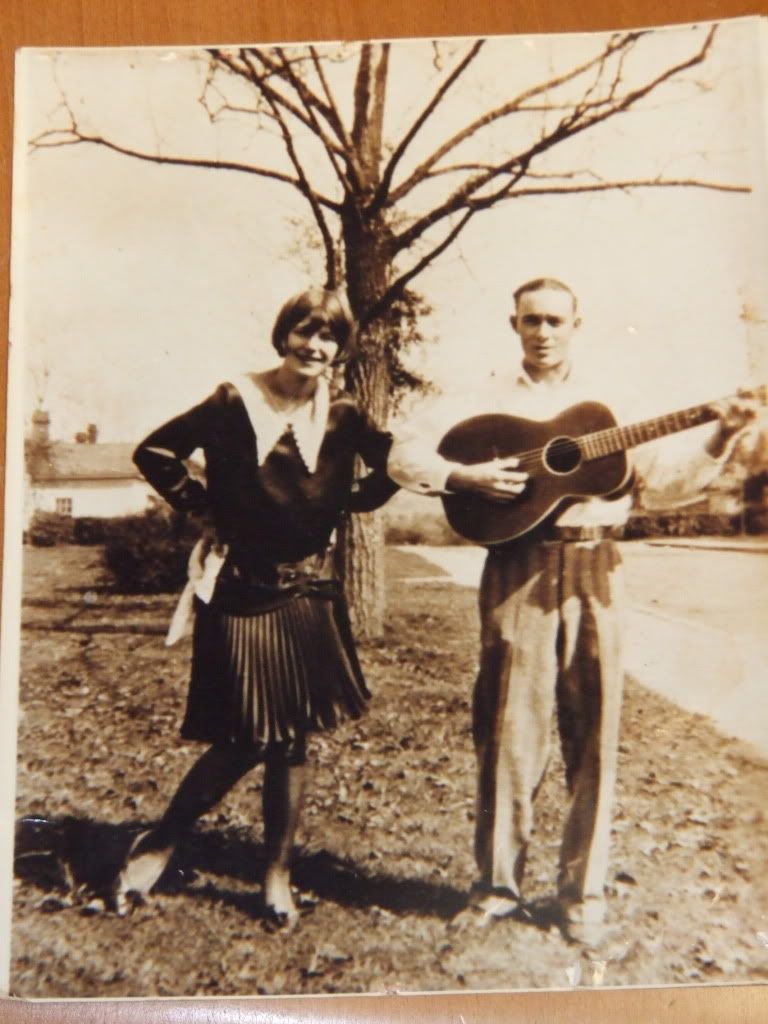
Half the fun of vintage guitars are their history and the path they took to get to me.  Some of the guitars I have bought came with pictures of the original owners and stories about how all those scratches came to be (most have to do with the owner drinking a lot).  Sadly, the sellers are rarely the ones that owned the guitar for so long.


I'm not always successful in my pursuit of vintage flat-tops.  Sometimes it will get snagged by someone else or the owner decides not to sell.  Here are a few of the ones that got away.


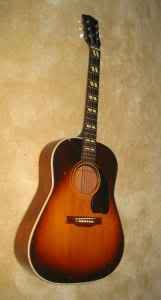
I was really upset about this one.  This is a mid forties Gibson Southern Jumbo.  The seller didn't really know what he wanted for it but invited me to come take a look.  It was in Knoxville, TN which is quite a drive from the school I was attending in Tuscaloosa (Roll Tide).  Long drives have rarely gotten in the way of a me and a guitar so I was planning to leave after my last class that day.  I called the seller back after class let out and it was sold.

This was the only picture I had of it but it was all I needed to know this was a real banner Southern Jumbo.  The split parallelogram inlays on the neck told me it was a SJ and not a J-45.  The belly down bridge combined with the lack of binding on the neck told me that this was most likely wartime (meaning is has the desirable banner on the headstock).  I should have skipped class!!


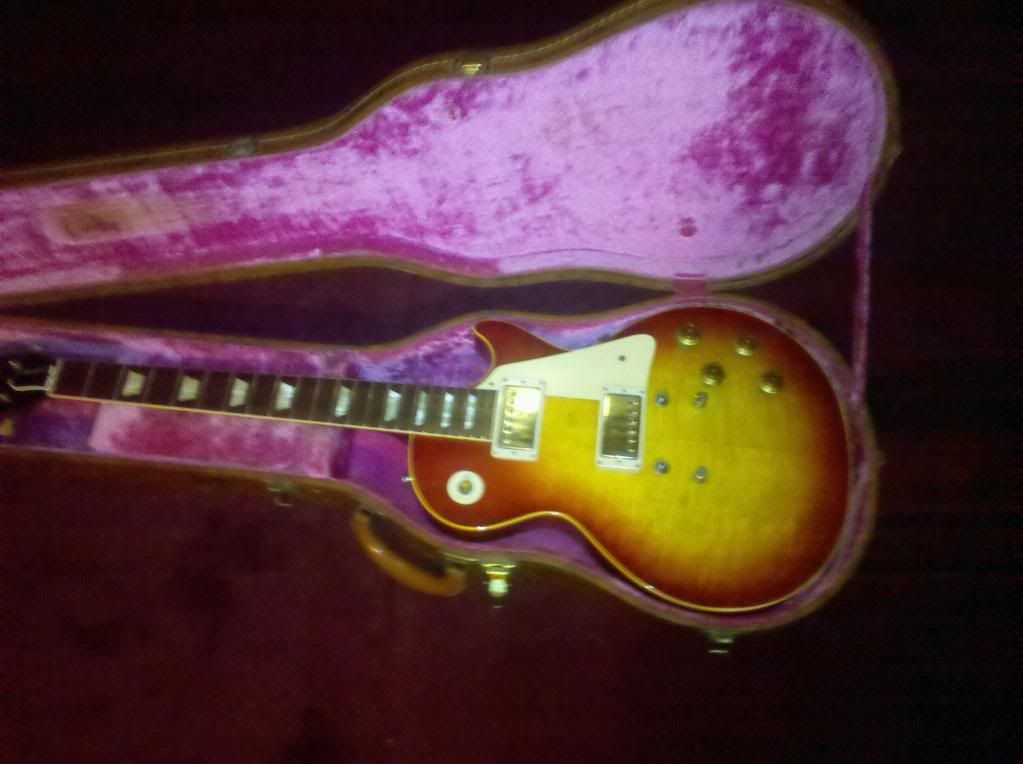
 Yes.  You are seeing this correctly.  This is a 1958 Gibson Les Paul with the original case.  This one was in northern Florida and I couldn't believe my eyes.  Most of the pictures you see of these floating around without a price tag of 200k+ are fakes.  This one was not.  I spoke with the owner and she said that she had already sold it by the time I even saw the ad.  She was working on taking the ad down and was having trouble.  Figures.


There was a musician who passed away in Cullman, AL in 2008.  His family was ready to sell off his collection of 10 instruments but they didn't know anything about any of them.  I had found a picture of this guy online that showed him holding a late 30s Gibson J-35:


I was a bit disappointed when I showed up to take a look at the collection.  It was pretty much all junk.  There was no J-35 or anything close.  There was a jacked up parts telecaster, a squire strat, a plywood parlor guitar.  That was the best of the lot and I was not really interested.  I thanked old lady that survived the man and on my way out the door she handed me this picture:


I turned to her and asked politely, "Where is this guitar?  We need to find it."  She didn't know anything about it.  Supposedly there was a blackface deluxe too but it wasn't there.  I figured that all this stuff had been picked over long ago and I was too late.  WRONG.  I was too ill-informed!  A year or two later I found this picture that I had taken:


With the help of my buddy Keith we came to the conclusion that this is that blackguard tele!!!  But how, you ask?  The neck is changed, the pickguard, hardware, all changed.   Take a look at the screws.  There are 5 old screws and one new one.  The holes are in the right place for a black guard Telecaster.  The body has been poorly refinished but I would be willing to bet that this was that telecaster- right before my eyes and I missed it!  Who knows what parts of the electronics were original.  Maybe none, maybe all.  I called the lady back and she said she had sold it a while back.  Still kicking myself.  The moment that you think you know what you are doing is when you find out that you really don't!


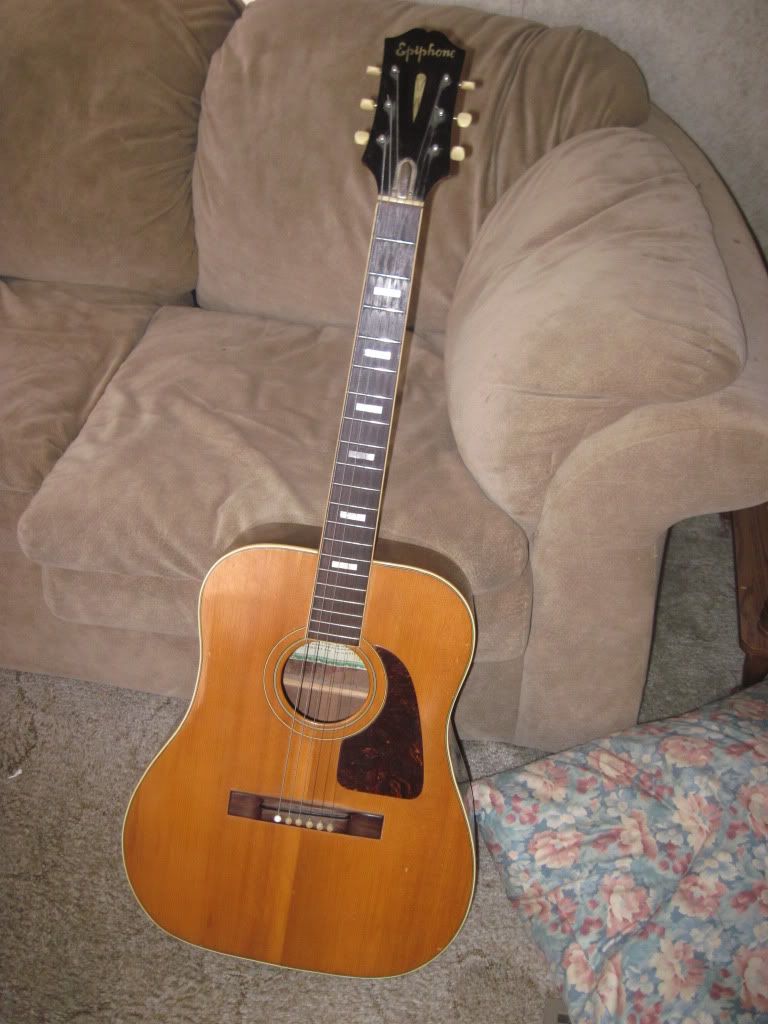
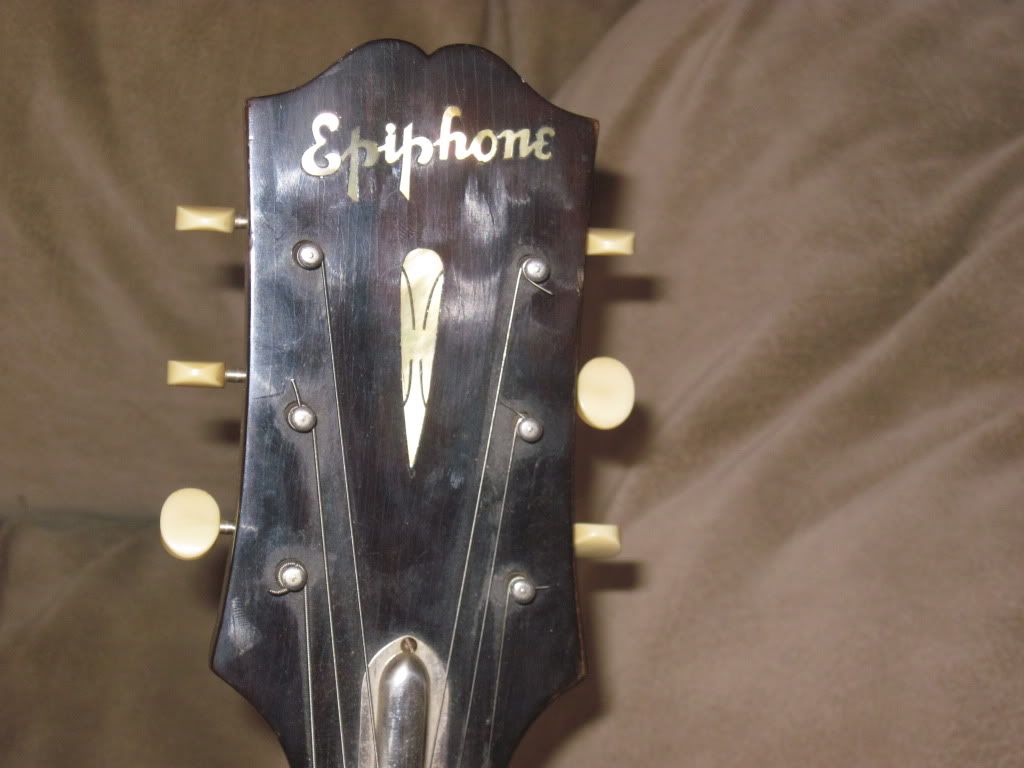
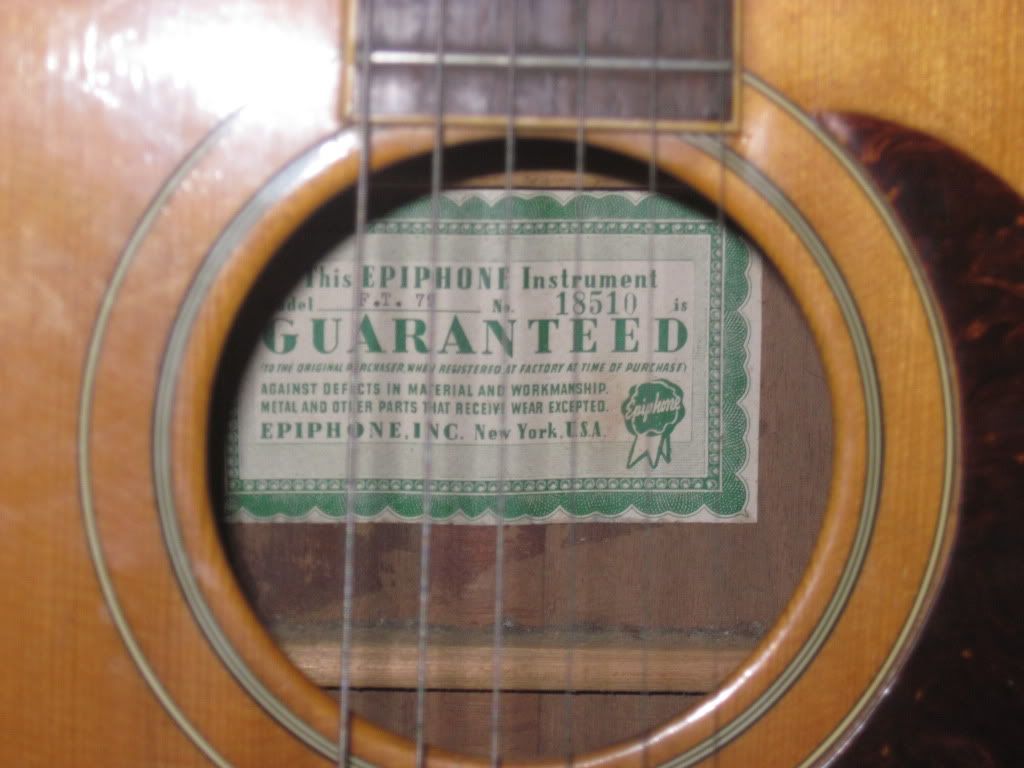
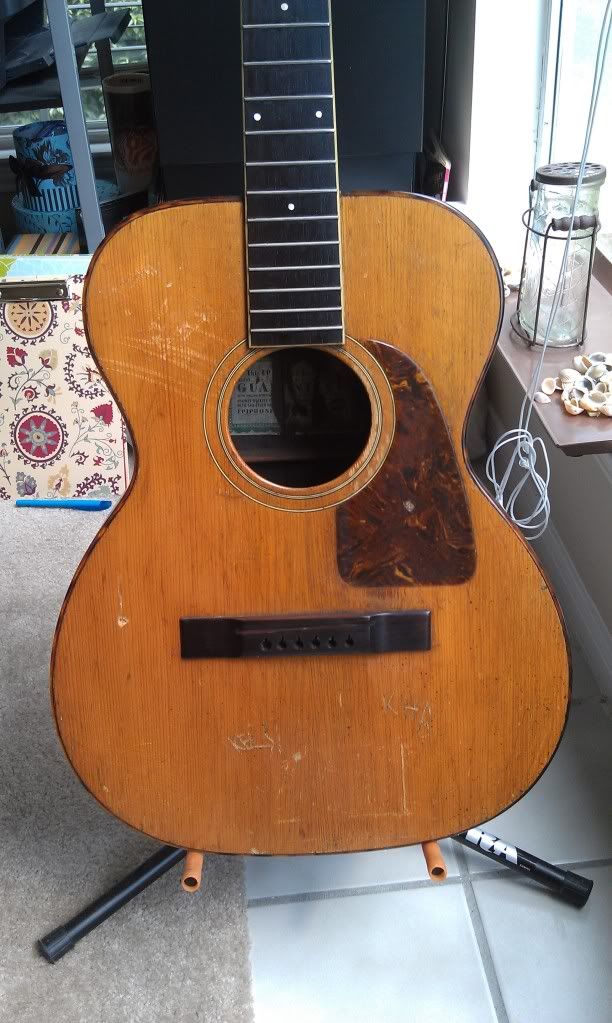
I would be impressed if you knew what this was just from the picture.  I sure didn't.  All I knew was that this was not your typical Asian made Epiphone.  This was a pre-Gibson buyout Epiphone flat top which have been aptly described as "rare as hen's teeth."  After a bit of research I found that this was the presursor to the Gibson-made Epiphone Texan.  This was a 1943 Epiphone F.T.-79.  Good luck finding another one of these at any price.


Having little knowledge of Epiphone flat-tops, I posted this picture on the Gibson guitar forum that I am a part of.   There was a guy on there that is a fellow vintage guitar guy that told me what it was and how uncommon they really are.  They are especially uncommon in this good of shape!


A buddy of mine agreed to come with me on the road trip but I decided to call the seller one more time before we left.  He had just sold it to a buyer in California.  I posted on the forum on how it had sold and the guys were giving their condolences when all of the sudden there was a new member on the forum.  It was the buyer in California!  He was a very cool guy and certainly deserved this fine, rare bird. 


Of course, there were a few scores that I didn't expect.  One of them was this little number:


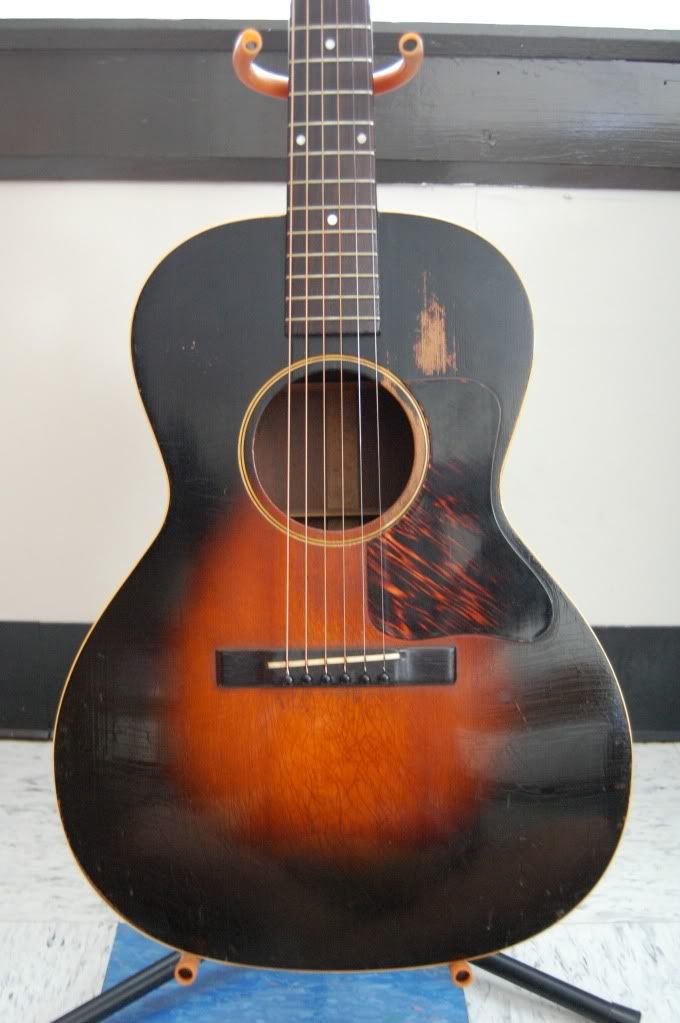
This Epiphone is from roughly the same time period (WWII).  It sort of fell into my lap.  It had been through a house fire and ownership by a someone who decided to carve her name into the top.  She apparently like stickers and glue as well.  Strangely enough her name was "Kelsey".  This happens to be my wife's first name.  Strange how that works out.

From the Bailey Brothers' VAULT: 1960 Gibson ES-355

0 comments
You have heard of it happening.  Most guitar shops will have somewhere that they keep the "good stuff."  You are standing in your favorite local guitar shop.  You overhear another customer say something like "have you gotten in anything good lately?" while he is standing next to Custom Shop Les Pauls, Gretsch White Falcons or CS black guard Teles and what not.  As if those were not good.


This customer is talking about the stuff in the back room, upstairs, or maybe even right behind the counter and out of sight of the average dude walking in to for the sole reason of playing "Stairway To Heaven" for everyone to hear.


You might be asking yourself "what do they have back there?"  This is one of the things they might have.  But probably not.


1960 Gibson ES-355 with the original brown Lifton case.


The ES-355 was officially introduced in 1959 but supposedly a couple were shipped in '58.  It is constructed of a laminated Maple body with a solid block down the center and a neck of their standard, Mahogany.  It also features 2 humbucking pickups- just like a 335.  Where it differs from the 35 is in the fretboard (Ebony instead of Rosewood) and all that sexy bling, binding and gold hardware.  Oh, and the factory Grover tuners (the good ones) and Bisgby tailpiece.


This example made it out of the factory with some cool features.  The serial number says that it was manufactured in 1960 so it must have been early in 1960 because it has the longer pickguard as well as 19 frets to the body (instead of 20).  In 1960 they shortened the pickguard so that it would not go past the bridge pickup.


The best part of these 355s is that they featured gold plated hardware.  PAF pickups were made in nickel and gold finishes.  Gibson used nickel hardware on most of their guitars and saved the gold hardware for the really fancy ones.  As a result, the gold covered PAFs lasted well into the early 60s.  This one features PAFs.  They sound damn good too.


Most of the 355s came with a feature that Gibson called "Varitone."  This was a switchable notch filter that cut certain frequencies using a range of different capacitors.  Many players/collectors think that Varitone "kills tone" and therefore it makes a vintage 355 less valuable.  I haven't messed around with a Varitone switch enough to form my own opinion but I do like the simplicity of not having it.  This guitar was spared of that switch.


Here is a shot of a real M-69 pickup ring.  You may be wondering to yourself why this little piece of plastic matters at all.  They are commonly faked and sold for a good bit of money.  If you buy one of those $200k+ '59 Les Pauls you are probably going to want to have all original parts.  But, these pickup rings were prone to crack and break.  Many were replaced throughout the years.  Now you have a market for  little pieces of plastic that apparently go for $500 or so.  Go figure.


This guitar had a little surprise for us when we decided to take out the neck pickup to check out the PAF.  We removed the pickuard in order to get a good look at the PAF (the bridge pickup's lead was too short!).  We had been discussing what kind of person would have bought this instrument new in 1960.  I was thinking a big band guy or a jazz guitarist.  Probably not the standard country western kind of thing that was popular at the time.


When we set the pickguard aside we noticed a name stamped on the underside of the pickguard.  Max Williamson.  I couldn't find anything about him online but maybe you have some information about him?  Here's to you, Max, and your good taste in fine instruments.


This guitar is available from Bailey Brothers Music Company in Birmingham, AL.  Thanks to Clay and Keith for letting me snap a couple of quick pictures of it.

TVG

Email Guitar- Look what we have here!

0 comments
I got an email from a reader with a couple of pictures attached.  Needless to say, I was pumped.


It's a Silvertone 1446!  It is always a great day when you find an old guitar in a closet, under the bed, wherever it was left years ago and forgotten.  This one seems to be original except for the decal pinstripes on the headstock.  I think they are cool but I would probably still attempt to remove them if I felt comfortable with it.  It even has the original case and seems to be in good shape.  

Damian sent these in to my email (tvguit@gmail.com) and said he had an amp with it too.  Way to go Damian!  Maybe he will send in some pictures of the amp?? Are you reading this Damian?  Don't leave us hangin' man!

50s Kay Kraftsman Jumbo.... The poor man's J-200

0 comments
I saw an old amp on Craigslist in Tuscaloosa the other day.  It was a Silvertone 1472 sporting about 10 watts or so and a 12" speaker.  I was heading to Tuscaloosa on business that day so I figured I would inquire about it.  Unfortunately I was about 10 minutes too late.

The seller was very nice and asked what else I was interested in.  I told him I like anything old and made in America.  He said he had an old Kay flat top that had a body made by Gibson.  I thought to myself, "I've heard that before."


The body was not made by Gibson but that didn't matter to me.  This is a mid 1950s Kay (Harmony) Jumbo (actual model? I dunno.  Maybe just Kraftsman).  It was made in Chicago and features a solid Spruce top, solid one piece flame Maple back and veneer sides.  It has 17" wide hips (a regular dreadnought is 16") and has ladder bracing.  It is original save for the Guild bridge added sometime long ago.  It even came with the original Kluson tuners!


I was drawn to this guitar for three reasons: the size, appointments and the FLAME MAPLE BACK!  This is an absolutely beautiful slab of maple.  They didn't even cut it in half and book match it.  It is just one solid piece of sexy Maple.


She came to me in pretty good shape except that the neck was falling out and there was no nut or saddle.  I was very excited to have another neck reset project.  My last one didn't go so well but I learned a lot from it.  You can read all you want about it but there is not substitute for just doing it.  I highly suggest it if you are so inclined and have a suitable subject (ie not Gibson).


This is a dovetail joint.  It requires skilled craftsmanship to make and fit the neck to the guitar at just the right angle.  It takes a lot more time and human attention than a bolt on neck.  Dovetail joints are not easily made by machines.  They are a sign of old world craftsmanship.  Do you own a Taylor?  Your guitar probably does not have one of these.


I was really excited to see no gaps when I was done!  These are crappy cell phone shots.  I forgot to take real pictures.  I didn't want any good evidence in case it went bad.


The wife was kind enough to let me turn the apartment into a repair shop.  It was a mess and still kind of is.  This is a shot of me cutting the me bone nut.  It was my first full nut made from scratch.  I was happy with the result since it was my first try.  I will definitely do some things differently next time.

This is an interesting guitar because it has a 26" scale length.  That is the distance from the saddle (the white piece on the bridge) to the nut (the white piece at the top of the neck).  The standard scale length for a Gibson is 24 3/4" and the standard Martin scale is 25 1/2".  This is significant in both the way it plays and sounds.  A longer scale means that the strings must be tighter in order to sound the note.  This  usually makes for a louder and more difficult to play instrument (on average).  The tighter the string is the more difficult it is to push the string down to the fret.  Needless to say, this thing is a hoss to play and sounds great!


Another interesting feature (or lack thereof) is the absence of a truss rod.  Maybe it was just an attempt to save money.  They accounted for this by making the neck a monster.  It is by far the biggest neck I have ever seen.  It really gives it that 40s and 50s feel.  The neck is straight as an arrow so I guess they called Time's bluff.
I really like the peghead overlay on this one.  They used a celluloid overlay and carved and painted the detail and logo with white and gold paint.  I was talking with a friend about this guitar and he made a good point about how the peghead is very underused and plain on most guitars.  I agreed and thought that this was one of the most beautiful headstocks I have ever seen.  

Enough talk.  Let's pick.


Field Trip: 1957 Fender Vibrolux

0 comments
A friend of mine called me the other day and said that he had just traded his old drum set for this 1957 Fender Vibrolux:


Needless to say, I was very excited.  Back in school I bought a small collection of vintage Fenders including a 1960 Champ, 1959 Princeton, 1960 Deluxe and a 1964 Vibro Champ.  Pete would come over and we would blues out with me on his Strat (and the Deluxe!) and him on the harmonica with the Champ.  TONE gentlemen, tone.

Until one time I was holding the strat and he had the harp mic in his hand and he tried to show me where on the fretboard I should play.  As he touched the strings and froze I instantly remembered how both of these awesome old tweed amps had the original 2 prong power chord.  "Dude, are you alright?' I said not sure if he was confused or shocked (literally). One second later he jumped back out of his frozen state and reminded himself never to do that again.  Please change the 2 prongs to 3.  Vintage isn't cool if you are dead.
But I did remember how wonderful that deluxe sounded after the tubes warmed up.  Here is a shot of my old tweed Deluxe (gone now along with the others):

That is candle wax from an old recording gig it played


Full shot of Pete's Vibrolux:


 Tweed doesn't always wear very well after this long.  I actually really dig the distressed look of an old amp.  The speaker has been replaced but it still sounded so sweet with my '64 Fender Duo-sonic.  We played a little jam of Hendrix's "The Wind Cries Mary" with him playing lead on the DS and me playing rhythm on his 1951 Gibson J-50.  Loads of tone.


The Vibrolux's were rated at 10 watts and had a 12" Jensen speaker.  They had 3 instrument inputs and a Depth, Speed, Tone and Volume knob.  They have a variable bias tremolo that really sounds sweet.  This particular unit had a GE 5y3 rectifier tube, a Sylvania 6v6 and an Emerson 6v6 power tubes and unknown 12Ax7 preamp tubes.


Luckily, the original 2 prong chord had been traded for a 3 prong recently.  You can see from this picture that the tweed Fender cabinets were finger jointed pine boxes.  This is a really cool way to join two pieces of wood and allowed for great transfer of tonal energy throughout the entire box.  Plus, it looks awesome.  Fortunately this one shows off it's finger joints!


Here is a video of Chris playing through a brand new Echoplex to the Vibrolux and a new Victoria (tweed bassman).


1953 Gibson J-45 nicknamed the "Workhorse"

0 comments

Introducing my favorite guitar ever made- the Gibson J-45.


This guitar came out of the Appalachian foothills of north Georgia.  It had been posted for months along with a 1936 Gibson L-00 and had not sold.  I snatched them both up as soon as I could get in contact with him.  Here is a shot of the L-00 (dorm room photo).


The first J-45s came out in 1942 when Gibson was producing only six models because of the war shortages.  It was a bare bones blues powerhouse that continues to be in production today with no end in sight.  The J-45 is one of Gibson's flagship models that is commonly referred to as "The Workhorse".  They were all made the Jumbo body size with X-bracing using hide glue to keep it all together.  During WWII, many substitutions were made including Maple backs and sides, Mahogany tops and the absence or presence of a truss rod.

This one features a Sitka Spruce top and Honduran Mahogany back, sides and neck.  Both the back and top are two piece, book matched quarter-sawn solid spruce an mahogany.  It has the pre-'55 style 19 fret neck, belly-up drop in saddle and finely scalloped tone bars.


But how does it sound??  With light strings, this one sings with rich, balanced lows and acutely defined highs.  The woody, Americana tone is undeniable when flatpicking chords or playing fingerstyle blues.  The action is medium to low with a little room on the saddle to come down.  The bridge pin holes have been lightly ramped to allow for good break angle over the saddle.

This example has all of the original parts (except for strings!).  The only repairs that done were a couple of reglued loose braces done by Jason Burns of Burns Instrument Repair at Homewood Musical Instrument Co. (Burns Banjos and Repair  Homewood Music).  Jason is an extremely talented open back banjo maker as well as a true-to-the-original repairman.  He used hide glue when regluing the braces.  Other than that, only simple set up work was required.  You can see that the plastic on the original Kluson tuners has gassed and shrunk over the years.  I should put new tuners on there but I really like the way the old ones look.  I am very very careful when tuning and luckily, it never needs much!

These are two pictures of the underside of the top of this guitar.  They show the two braces called "Tone Bars."  These braces have a huge influence on the tone and structural integrity of the guitar.  You may notice the tones bars are "scalloped."  This means they were shaped for strength in one way and tone in the other.  The beginning and end of the bars are tall while the middle is short.  This is where some would say we get in to the "religion" aspect of vintage instruments.  Many boutique luthiers and hand builders shave braces and tap tune their tops to focus the tone towards bass or treble response.  I'll let you be the judge on whether this has a big impact on tone.

One reason I like these old Gibson guitars is because they are very "lightly built."  This one is no exception.  What do I mean by lightly built?  Well, I guess it is a bit hard for me to explain.  It refers to the thinness of the braces and the overall weight of the materials used.  It would be better explained by holding an inspecting two guitars: one pre-1955 Gibson and one recent Epiphone Masterbilt.  Have you ever played a Masterbilt?  I love these guitars but they are heavy as lead!  They have big thick tops, backs and braces.  They are both built with all solid woods however they had two separate goals.  The former, to be the best sounding guitar possible with the materials, techniques and budgets that were available.  The latter, to avoid warrantee costs but also make a guitar out of all solid woods because that term sells guitars.  A lightly built guitar booms with vibrating resonance that you can feel in your gut when you strike an E chord.  A "tank" simply reflects the sound of the barely vibrating top off of the back and out the sound hole.  Maybe it would be better explained if we were sitting down with these two guitars and a glass of cool, straight Tennessee whisky.


Dating a vintage Gibson guitar can often be quite a process.  Someone that looks at these guitars a lot could notice a few indicators of what time period this one came from.  All years are model specific and should be taken with a grain of salt:


1.  Block "Gibson" Logo (1947-current).


2.  19 Fret neck, small "teardrop" pickguard and tall thin and scalloped tone bars (1942-1954)


3.  Upward belly, drop in saddle (1953-1955)


4.  Here's the kicker: the Factory Order Number and letter designation.  From 1952 to 1961 Gibson used the alphabet (backwards) to indicate what year the guitar was produced (only flattops, sometimes).  Why did they go backwards and randomly decide to quit in 1961?  Not sure.  Here is a breakdown of what it looks like through the years: (from the website Vintage Guitars Info)


1952= Z
1953= Y
1954= X
Etc. until 1961


Here are a couple more shots that highlight some cool aspects of this J-45:

Original Kluson keys have shrunk

Beautiful dark grain line in the Brazilian Rosewood fingerboard

This was before they stamped anything on the back of the headstock

There is some glare on the back.  Couldn't get a clear shot without some glare.

I have two more J-45s to blog about.  The '46 will be coming soon but the '43 is in Jason's shop and it may take a while.  Feel free to leave me some feedback or follow this blog for more cool guitars.


Follow my Instagram photos for up to date shots on the guitars I am currently looking at (you don't have to have a smarty pants phone to do it!):