Showing posts with label electric. Show all posts

1965 Fender Jaguar in Olympic White

0 comments

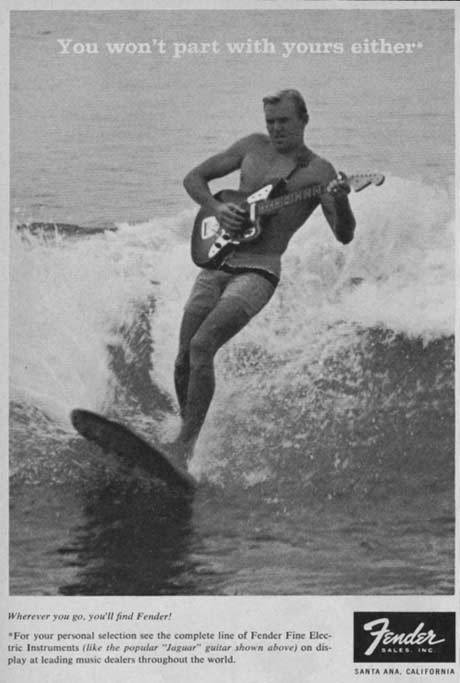
And I don't!  Want to part with mine, that is.  I will certainly not take it surfing, although I don't have to worry about that here in Birmingham, AL.  My 1965 Fender Jaguar will not be cruising the waves anytime soon.

The Jaguar was introduced in 1962 as Fender's new top-of-the line model.  It's shiny chrome plates, clawed single coils and abundance of switches were supposed to make it more desirable than the Telecaster, Stratocaster and Jazzmaster.  The public didn't quite see it that way and went on buying the strats and teles like it was going out of style.  People didn't really like the shorter 24" scale.  The Jaguar didn't sell as well as Fender hoped but became popular for a lot of different styles starting with of course, surf rock.


This 1965 Fender Jaguar was purchased by the parents of the original owner for their 16 year old son.  He had played a little bit and wanted a nice guitar for his birthday.  The price on the tag of Jaguars at the time was $491 which according to the inflation calculator is about $3526.59 in 2012 dollars.  The custom color was about a 5% upcharge.  The strap, I believe, was purchased sometime in the 70s judging by the style.  


I purchased the guitar from the wife of the owner who said that this was the original case.  This case was sold from '62 to '63 so it is doubtful that this was the original case.  USA sold Fenders came guitar specific cases as in each guitar was shipped in its own case.  Maybe the store had guitars hanging on the wall but didn't organize their cases very well so an earlier guitar sold with a newer case and vice versa.


The Jaguars had a similar circuit to the Jazzmaster in that it had a separate rhythm circuit on the bass horn.  With the slider switch down, the lower controls are activated.  The main volume and tone knob and three slider switches let you dial in the tone desired.  The three switches are: neck pickup, bridge pickup and bass cut, also known as the "strange switch."  When this switch is on it has a very trebly and jangly tone.


You'll notice the interesting looking "claws" on either side of the pickups.  This was to help with the hum problem that plagued the Strats, Teles and Jazzmasters.  The electronics cavities were also heavily shielded which did noticeably reduce hum.  The Jaguar pickups still retain that fender tone but I think are a little stronger, hence the bass cut switch.  I haven't had enough time with it yet but I don't think that this guitar really lends itself to blues but it does the surf/indie rock thing in spades.


The tremolo is very smooth and usable.  This "Floating Tremolo" type does a lot better job keeping the guitar in tune compared to the "Synchronized Tremolo" on the Stratocaster.  Smooth, long weeps of the tremolo are accurate and even easy.  I always felt like I was breaking the strat's tremolo when I really used it, which was not often.  I really enjoy the jaguar/jazzmaster style trem.


TVG

From the Bailey Brothers' VAULT: 1960 Gibson ES-355

0 comments
You have heard of it happening.  Most guitar shops will have somewhere that they keep the "good stuff."  You are standing in your favorite local guitar shop.  You overhear another customer say something like "have you gotten in anything good lately?" while he is standing next to Custom Shop Les Pauls, Gretsch White Falcons or CS black guard Teles and what not.  As if those were not good.


This customer is talking about the stuff in the back room, upstairs, or maybe even right behind the counter and out of sight of the average dude walking in to for the sole reason of playing "Stairway To Heaven" for everyone to hear.


You might be asking yourself "what do they have back there?"  This is one of the things they might have.  But probably not.


1960 Gibson ES-355 with the original brown Lifton case.


The ES-355 was officially introduced in 1959 but supposedly a couple were shipped in '58.  It is constructed of a laminated Maple body with a solid block down the center and a neck of their standard, Mahogany.  It also features 2 humbucking pickups- just like a 335.  Where it differs from the 35 is in the fretboard (Ebony instead of Rosewood) and all that sexy bling, binding and gold hardware.  Oh, and the factory Grover tuners (the good ones) and Bisgby tailpiece.


This example made it out of the factory with some cool features.  The serial number says that it was manufactured in 1960 so it must have been early in 1960 because it has the longer pickguard as well as 19 frets to the body (instead of 20).  In 1960 they shortened the pickguard so that it would not go past the bridge pickup.


The best part of these 355s is that they featured gold plated hardware.  PAF pickups were made in nickel and gold finishes.  Gibson used nickel hardware on most of their guitars and saved the gold hardware for the really fancy ones.  As a result, the gold covered PAFs lasted well into the early 60s.  This one features PAFs.  They sound damn good too.


Most of the 355s came with a feature that Gibson called "Varitone."  This was a switchable notch filter that cut certain frequencies using a range of different capacitors.  Many players/collectors think that Varitone "kills tone" and therefore it makes a vintage 355 less valuable.  I haven't messed around with a Varitone switch enough to form my own opinion but I do like the simplicity of not having it.  This guitar was spared of that switch.


Here is a shot of a real M-69 pickup ring.  You may be wondering to yourself why this little piece of plastic matters at all.  They are commonly faked and sold for a good bit of money.  If you buy one of those $200k+ '59 Les Pauls you are probably going to want to have all original parts.  But, these pickup rings were prone to crack and break.  Many were replaced throughout the years.  Now you have a market for  little pieces of plastic that apparently go for $500 or so.  Go figure.


This guitar had a little surprise for us when we decided to take out the neck pickup to check out the PAF.  We removed the pickuard in order to get a good look at the PAF (the bridge pickup's lead was too short!).  We had been discussing what kind of person would have bought this instrument new in 1960.  I was thinking a big band guy or a jazz guitarist.  Probably not the standard country western kind of thing that was popular at the time.


When we set the pickguard aside we noticed a name stamped on the underside of the pickguard.  Max Williamson.  I couldn't find anything about him online but maybe you have some information about him?  Here's to you, Max, and your good taste in fine instruments.


This guitar is available from Bailey Brothers Music Company in Birmingham, AL.  Thanks to Clay and Keith for letting me snap a couple of quick pictures of it.

TVG

1964 Fender Duo-Sonic

0 comments
Welcome to the True Vintage Guitar Blog.  My goal with this blog is to create content about the interesting guitars, instruments and other things that I find.  I am not a dealer or really even a collector, just a guy that likes old stuff.


My first post is dedicated to a 1964 Fender Duo-Sonic.  I was drawn to this instrument because of the funky styling, interesting transition features and eventually the unique tone that all the pickup combinations can produce.  But first, a few pictures.


I know what you are thinking, "Hey, that is a Duo-Sonic II!"  You would be correct, sort of.  This instrument would be considered just barely in the transitional period between the two models and also barely in the transition to the Fender take over by CBS in 1965.  It has all the features of the Duo-Sonic II such as the 24" scale length, thick tortoise shell guard and the metal plate under the jack and knobs.  The only thing making it a Duo-Sonic is the name on the headstock:


Either way, it is a heck of a little blues guitar but versatile as well.  It has two single coil pickups with two, 3 way slide selectors.  The middle position on both is "off" for that individual pickup.  If both switches are up or down you get both pickups on and in "phase".  If the two switches are opposites (up down or down up) you get a funky, plucky out-of-phase tone that I believe is hum canceling as well.  I won't lie, the out-of-phase setting is not always useful.  It is thin, plucky and very "nuanced."  Every once in a while the stars will align and  that weird out of phase tone is exactly what I need or was looking for.  You will have to decide for yourself whether it is useful to you or not.  Let me know what you think, I welcome your feedback!

Here are some features that are indicative of the transition (buy out) of Fender to CBS.  First, the less desirable veneer fingerboard:


Not as easy to see as I thought but this is the later style Rosewood fingerboard that was apparently easier and cheaper than the "slab" fingerboard.  Basically it is a thin rosewood veneer instead of a big fat hunk of Rosewood sitting on top of the Maple neck.  I think the difference in tone is subjective and you probably have your own opinion about it.  It is just cosmetic to me.

And here are the earlier style "clay dots":


Again, purely cosmetic but I really like the way they look.  

A couple of more pictures:

The Nitrocellulose has worn almost completely off the neck.


I really dig this styling. Absolutely iconic Fender but still unique.

And here is a couple of pictures of the neck pocket and guts (please excuse the poor phone camera quality):


August 1964

Check out that original color!


Hope you enjoyed a look at this old Fender.


Disclaimer:  I am not the definitive source for this information.  I have gathered it from a couple of years of being in to this stuff.  It may not all be correct and if it isn't, I would appreciate you letting me know.  Keep it positive though, please.  Also, my experience tends to lend itself more towards the vintage Gibson acoustic side, so I am pretty much a newb at this Fender stuff.


In addition, here is a funny little video of me the other day at Homewood Music playing the Didgeridoo with Bob Tedrow.  Turns out his Didg was tuned to B and so was this little diddy: