Showing posts with label mahogany. Show all posts

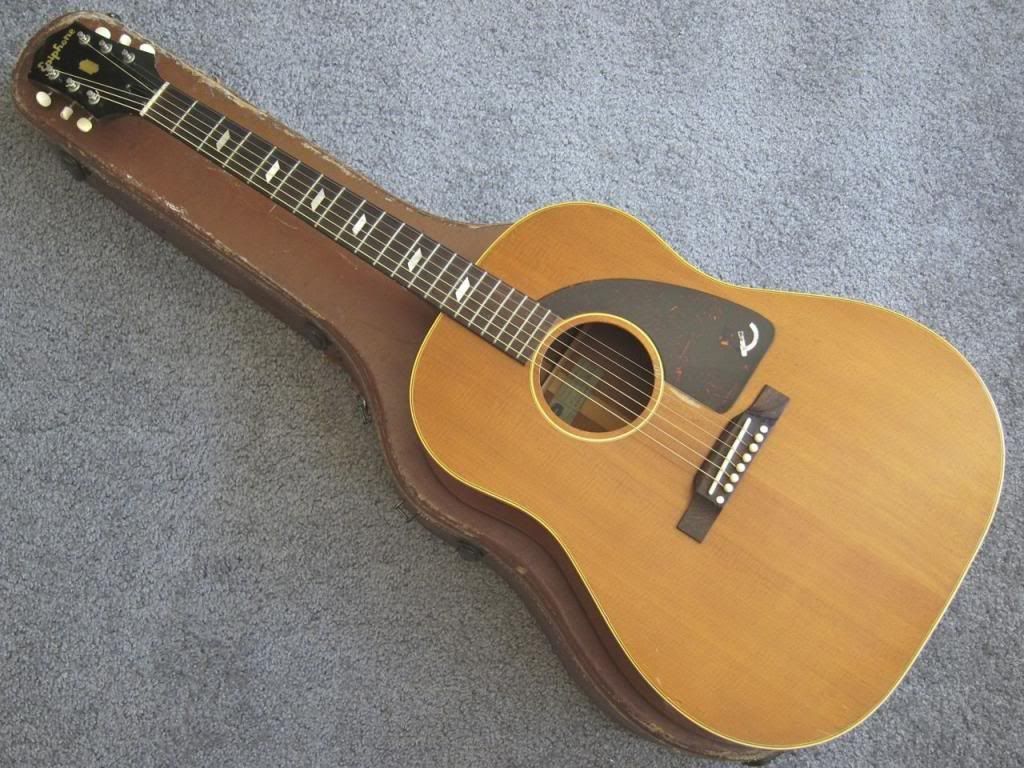
"Buyout" Period Epiphone Texans: Parts Guitars?

0 comments
By the dawn of the 1950s, the Epiphone company was struggling with problems in both the accounting and labor departments.  The company's product line hadn't kept up with the changing trends in guitars such as the new solid body electric (Gibson's Les Paul model?).  It had moved the production facilities from New York to Philadelphia in an attempt to avoid a problem with the labor union.  By 1957, the company's doom seemed imminent which forced its sale to their biggest competitor, Gibson, for the sum total of only $20,000.


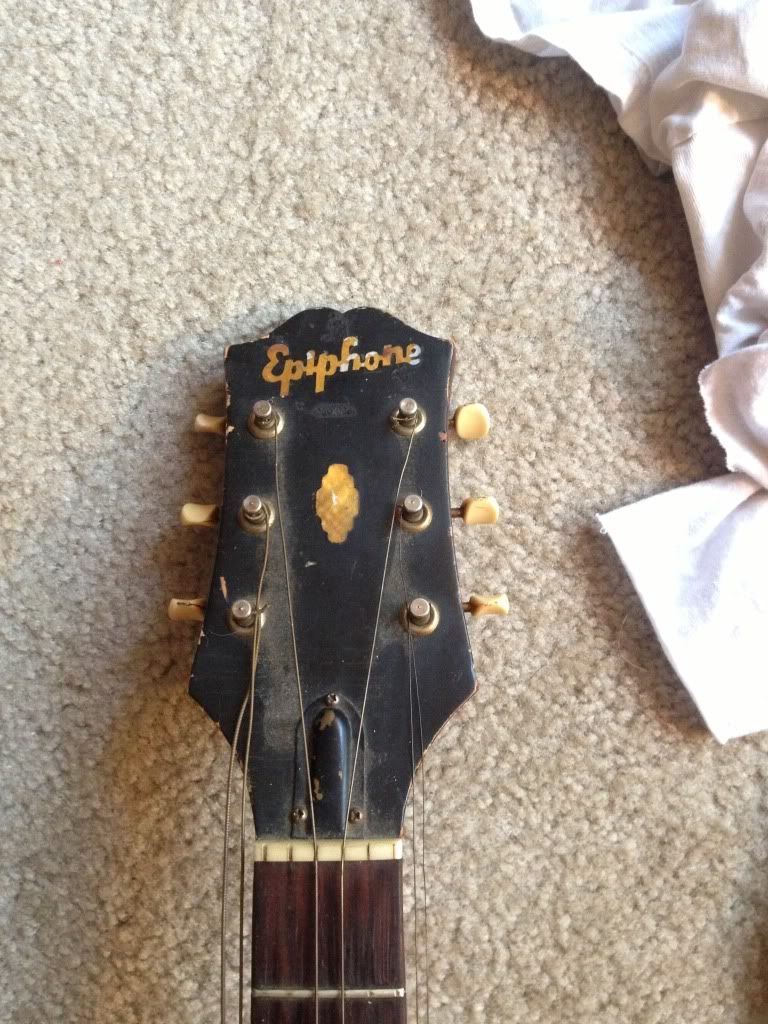
American made Epiphone guitars (both during and before the Gibson buyout) are fantastic instruments.  Their relative obscurity and high standard of quality is a recipe for a very inspiring guitar.  I recently came across an immediate post-buyout Texan that has me intrigued (1959 Epiphone Texan with strange features).  The description states:

"Gibson FON on the neck block indicating 1952 manufacture, starts with a "Z"; solid, un-kerfed linings (no one has ever seen this on any modern Gibson instrument); the word GUITAR rubber-stamped on the inside of the back, between the neck block and the first back brace; black paint on the heel underneath the clear coat, which has been seen many times on various Gibsons in the 1960's."

 1952?

The body is easily dated using Gibson's backwards letter prefix used from 1952-1961.  They started with Z in '52 and ended with Q in '61.  These letters were stamped on the interior neck block and were proceeded by a batch number (usually 4 digits) then a unique rack number (the Xth number in that rack).  This guitar received a Z indicating that it was made in 1952.

Easy, right?  Not quite.  The description also states that this guitar has solid lining (as opposed to kerfed).  Lining is what gives the body's joints (top to rims and rims to back) a solid gluing surface.  Usually this lining is kerfed, meaning that it has small cuts vertically to make it bend without needed to be soaked in hot water and bent over a hot pipe.

Kerfed Lining

Solid Lining

Gibson phased out solid lining in favor of the kerfed style from 1933-1934.  I have never seen any flat-top Gibson guitar that used solid lining after 1934.  I would venture to say that Gibson did not build guitars using this kind of lining after 1934.  This is my opinion based on my experience so feel free to prove me wrong.  Edit:  I just acquired one of these guitars.  The lining is made of laminated Poplar.  The only other place I have seen this is on my 1954 Epiphone FT-210 Deluxe Cutaway.  I'm assuming Gibson got leftover strips of lining from Epiphone and used it?  Not sure.

(Edit)  At least Gibson phased out the use of solid lining made of Mahogany in 1934.  After acquiring a buyout period Texan I determined that this "solid lining" wasn't really solid.  In fact, it is made of laminated strips of what looks like Poplar.  The only other place I have seen this is on my 1954 Epiphone FT-210 Deluxe Cutaway.  Perhaps Gibson also acquired strips of unused lining from Epiphone as well as necks?

Gibson "J" body surplus

In the early 50s Gibson was selling some of their jumbo bodies to National.  National would manufacture a neck and bolt it on to a Gibson body calling it the National 1155.  These are great guitars for the vintage player on a budget but I am told that the necks are a bit difficult to get used to.  You'll have to decide that for yourself.


Since National ordered a bunch of J bodies from Gibson, they had more bodies than necks.  When a bunch of Epiphone necks showed up at Gibson's doorstep in 1957, the answer was simple.  They went downstairs to the parts basement and grabbed a bunch of J sized bodies.  That is how I would explain this guitar having a Z (1952) factory order number.

(Edit) .....but I'd be wrong.  After acquiring one of these, the tops were definitely made post 1955 judging by the bracing.  My next theory would be that Gibson needed finished bodies to sell to National.  Since National was bolting on the necks, Gibson needed bodies with uncut neck blocks (instead of cut for a dovetail joint).

When the Epiphone necks showed up in 1958 they were already cut for a dovetail joint.  Since the dovetail extension on the neck and the neck block were cut by two different manufacturers they differed to the point that they wouldn't fit right.  Gibson would need to use a body with an uncut neck block and cut it to fit the Epiphone neck.


So you have one of these short headstock Texans?  Send me some shots of yours.  Here is @guitaristo's (Instagram) 1958 Epiphone Texan that has recently been sold.  The serial on the blue label was an A-XXX number but he can't remember what was on the neck block.  I wonder if it was an earlier FON?


Why do these features even matter?

Although these Texans look like weird J-45s they are certainly not.  The main difference in a standard Texan and J-45 is the scale length.  Epiphone was using a 25.5" scale length so the necks were manufactured to this spec.  Gibson's traditional scale length and that of the J-45 is 24.75".  This alone makes for a tone that is probably louder and more piano-like than a J-45.  It also doesn't bend strings as well and may wear out your fingers a bit quicker.

This '58 Texan has more than just the scale length to set it apart from a J-45.  The body was probably manufactured in '52 which means that it differs from a '57 by the bracing.  The pre-'55 J bodies were made with scalloped braces while the post-'55s had straight braces.
(Edit):  Wrong again, TVG.  While the FON prefix was Y, the tops were definitely made in the late 50s.  The bracing is short and straight (unscalloped).

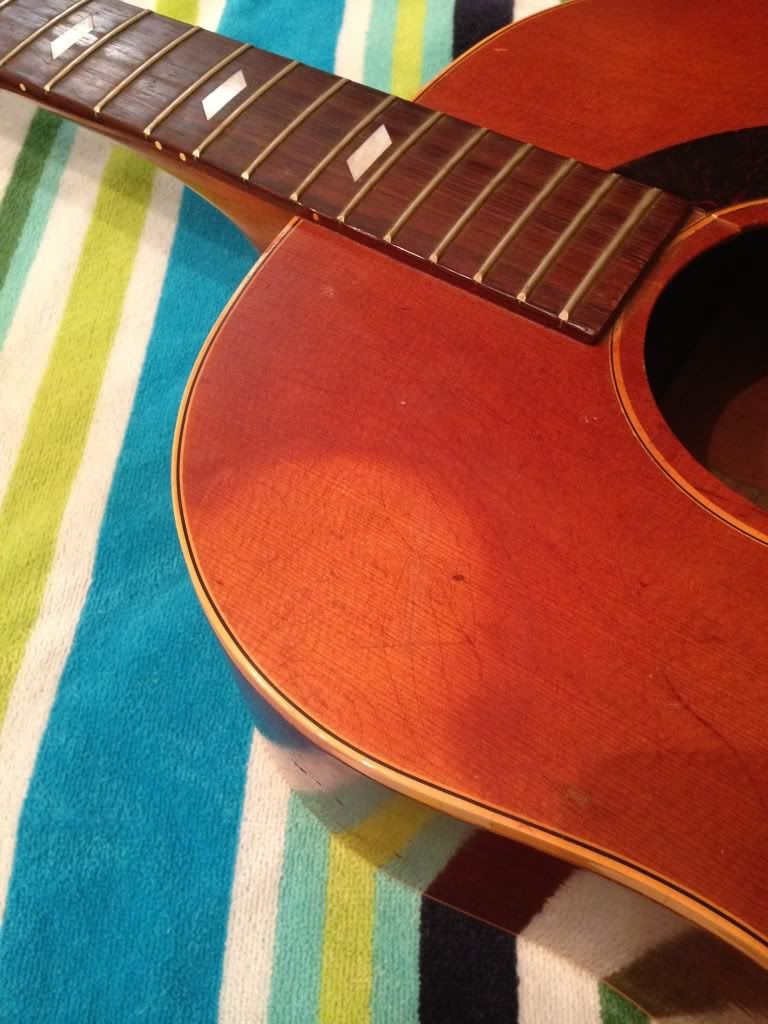
These buyout era features make for an interesting guitar.  Mine needs some braces reglued before it is playable again.  It was covered in 50 years of sweat and tar until I hit it with some Virtuoso cleaner.  Here are some shots of the clean up.


TVG


1944 Gibson J-45 "Only a Gibson is good enough"

0 comments
The banner on Gibson's wartime flat-tops appeared around June of 1942 and disappeared sometime in 1946.  It is still a but unclear why but we may know more about the banner after this book comes out: Kalamazoo Gals.  Maybe it had something to do with national pride during the war years since the Martin guitar company was still family owned and the original CF Martin was in fact, a German immigrant.  This is solely speculation though, It may have had nothing to do with Martin.


This guitar was probably made in 1944 but again, that is just a guess.  It bears no visible factory order number and may have never received one which is common for the late war years.  It was constructed of a two piece Spruce top and a solid, one piece flat-sawn Mahogany back.  The one piece back is of note because it is evidence that wood stock piles were low so "lower quality" wood was used.  The Mahogany should have been quarter sawn for appearance and strength however this process wastes more wood than the flat sawing method.  Also of note, the Kalamazoo Gals that built this guitar were told to put "back strips" on the interior of the guitar to help the two joined quarter sawn pieces of Mahogany.  Yet this guitar has a one piece back.


I mention this because the people that built this guitar were probably not men who had worked in the factory for many years.  More than likely they were "Rosie the Riveters" that filled the empty positions of men who had gone to support the war effort.  In John Thomas' book, "Kalamazoo Gals," an argument is made that these guitars were somewhat superior to other Gibsons because of the nature of the women who made them.  These women had been working with their hands all of their lives.  They may not have been making guitars but they were very skilled nonetheless.  Since the book is not out yet I cannot say that this is the exact point or argument made.  I am very excited about the book as you can imagine!


One thing that I have noticed as a pattern of the banner Gibsons is that they have a distinctive percussive "thump" that vibrates throughout the entire instrument when a string is struck.  My experience is limited since I have played only as many banners as you can count on two hands but it is certainly a pattern.  A friend once described the thump of this exact instrument to be akin to a "lapping", as if from the tongue.  I thought that was a great way to describe it since thump would indicate a bit bass heavy, which these guitars are not.  I am worthless when it comes to describing tone with words so just bear with me.


I have three banner J-45s: one spruce and mahogany, one all mahogany and one in the mail that is spruce and flame maple.  The maple banner is still in the mail and should arrive in a couple of days.  I'll be doing two more posts on the other two banners later this month.  Do you have a banner Gibson?  Send some pictures to my email at tvguit at gmail.  I don't want to post the actual email for fear of bots.

TVG

1939 Gibson J-35, 3 tone bars of blues.

0 comments
The model designation "J-35" showed up in the ledgers in late 1936.  It was a no frills jumbo featuring a Spruce top and Mahogany back and sides.  It was originally named the "Trojan" but not for very long.  It is my understanding that the word Trojan only shows up one time.  The Trojan guitar differs very little from the J-35, if at all.

-Edit-  As our friend mentioned in the comments section, the "Trojan" model appears 39 times in the surviving shipping ledgers from 1936.  Only one had an attached FON: 960-12 which shipped to Ridders Music Store in Atlanta.  This guitar still lives in Atlanta and while I do not know the owner personally I have interacted with him on the Gibson forum.  He is a well respected collector and I hope to one day be able check out the collection in person.  I live only 2 hours west of Atlanta!  There is a lot of TVG material there.  Thanks, Anonymous!


The J-35 was produced up until 1942 when Gibson introduced the next and more common J-45.  This J-35 was made in 1939 which was the first year that the natural finish was offered.  It was also the last year of the 3 tone bar bracing.  That makes this one a bit easier to date since Spann's Guide to Gibson does not have very many factory order numbers from 1939.


This guitar was being sold locally and was described as a "1939 Gibson L-00."  I am still trying to figure out how they nailed the year perfectly but were terribly mistaken on the model.  I tried to tell the seller what it actually was but, as is common with sellers, they don't want you to tell them what they should already know.


When I opened the case for the first time I was very surprised at how good of condition it was in.  This guitar survived in a chipboard case in someone's basement for many, many years.  The seller told me it had some water damage but he repaired it.  That was not what I wanted to hear but upon inspection, he did a pretty good job.  I was expecting sloppy glue work and half-assed overspray but was pleasantly surprised to find neither.  There was plenty of evidence of water damage but it was on the bottom near the end pin.  It wasn't a perfect repair but it was done well.  I wouldn't have expected much better from my own luthier.  He then told me he was a wood worker so it made a little more sense.


I bought this guitar 5 days before the Orlando Guitar Expo and had already bought a booth to show some guitars.  I took this one because I just couldn't resist.  It sold the morning of the first day to a very happy buyer.  I was sad, yes, but it had to be done.  I had spent the last bit of our savings including my wife's last couple of paychecks!  Not a great way to buy a guitar but I had a pretty good feeling about this one.  It seemed to work out but now there is a big J-35 shaped hole in my heart.  I guess that is one of the things that keep me going.

TVG


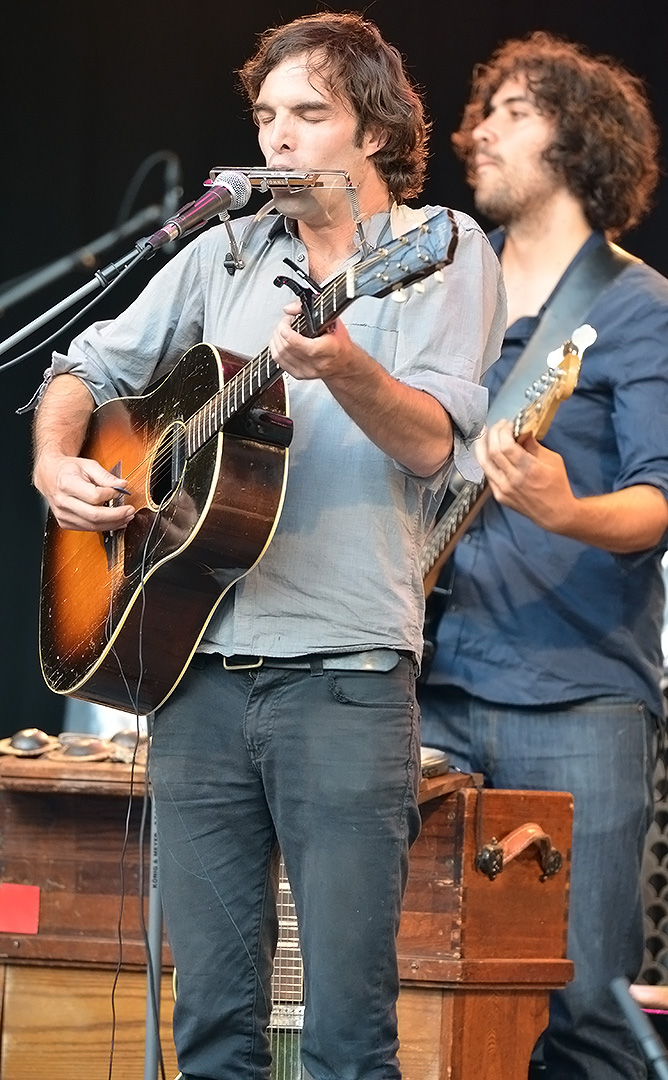
Vintage Guitar Artist Spotlight: Brad Barr and his '51 Gibson J-45

0 comments
I love watching youtube videos and finding within them little vintage gems that somehow don't get mentioned in the comments.  This video was recorded by KEXP in Seattle at the 2012 Pickathon:


That is Brad Barr of the Barr Brothers playing a beautiful 1951 Gibson J-45.  I think that this is where the J-45 really shines.  The mid-range rumble is just about perfect for the singer-songwriter types.  


The fact that the guitar is a beautiful work of art and has played 62 years of wonderful music is what begs the songwriter to do what he or she does best.  I get that feeling when I play these old Gibsons.  I want to play that guitar just because of what is, how it looks and how it sounds.  I am a better guitar player because the instrument begs me to play it

From a GuitarInternational.com interview with Brad:
"I have a J-45 from 1951 that is the sweetest sounding acoustic.  It has a great midrange and a real growl...."
Maybe you have been there before when pen, paper, a bottle of whisky and 3 and a half hours produce nothing but balled up paper in a trash can.  You decide that your done writing tonight because its 1:30 in the morning you aren't really feeling it anyway.  You start playing your favorite chord progressions and licks just because that guitar feels and sounds so good.  After a minute or two you modify that chord progression a mumble a melody without any words.  The next thing you know you are belting out a strong chorus from your couch when you notice the sun peeking through your window.  You've just spent the whole night writing that song but you didn't realize it because it just had to come out.

I don't know if this has been Brad's experience but there is something about a big rumbly Gibson jumbo.  Here are some shots of my current J-45 lineup:


Oops, that J-50 just sneaked in there.  In order they are '46, '43, '54 and '55.  They are all so sweet and have their own special nuances.  They are certainly guitars worthy of staying up all night just to spend time with them.

TVG


A Semi-Rarity: The 1966 Epiphone Wilshire (USA!)

0 comments
Vintage guitars often come with a trade off: the "good ones" got played- hard.  As a result they have lots of character.  I don't mind character- in fact I love it.  I like seeing some scratches in the top of a guitar or the wear marks on the side of the neck from 60 years of first position chords.  Every once in a while however I will come across one that is clean.  This Wilshire, my friends, is CLEAN.


In 1957, Gibson bought a financially failing company that had been their long time competitor.  The Epiphone brand was known for very fine instruments like banjos, archtop electrics and acoustic guitars.  The competition was especially fierce in the large body electric archtop market.  Gibson would come out with a big jazz box and a month later Epiphone would come out with a slightly bigger or more fancy one.  Epiphone manufactured out of New York until about 1953 manufacturing moved to Philadelphia (although the labels still said New York!).  The failing company was at odds with its employees and the name was eventually bought along with a bunch of parts by Gibson.

Gibson began manufacturing Epiphone guitars first with leftover parts and continued by introducing their own Epiphone models.  This was a move by Gibson to get more guitars in stores.  Retailers didn't want 10 Gibson SGs but didn't really have a problem buying 5 SGs and 5 Epiphone Wilshires.  The USA Epiphones were made right along sides of the Gibsons in the factory at 225 Parsons Street, Kalamazoo, MI.  These are very high quality instruments!  The quality of the instruments bearing the Epiphone brand didn't drop to the current level until that unfortunate time in the 70s when the new owners of the Gibson brand (Norlin) shipped all production over seas to Japan.


The Epiphone Wilshire was a bit of a rare model until the its reissue this past year (made in China- sadface).  It has always had a small Mahogany body and neck but had two different editions.  The first was introduced in 1959 with a 3+3 headstock and P-90 pickups.  The second version appeared in mid-1962 that had a funky "batwing"style headstock and two mini humbuckers.  Mine is the second version with the silky smooth mini hums.


I absolutely love these guitars.  They have the coolest 60s styling with quality ingredients to boot.  The mini humbuckers are very versatile and can take you from Guns and Roses to Neo-classical jazz in a real hurry.  The neck joins at the very last fret so the player has full advantage of the fretboard.  Unfortunately the "Vibrola" was a source of frustration for most players so the trem arm is usually taken off and lost.


This is my second mid 60s Epiphone Wilshire.  My first one had seen some playing time and the finish showed it.  It was still original (but was missing the trem arm of course).  I eventually sold it but still had my love of Wilshires.  When I saw the ad for this one I couldn't believe it.  The seller was the original owner and the finish looked like it had just rolled off the assembly line.  I asked him when and by whom it was refinished.  He said that it hadn't been refinished.  Well, I have heard that before.  I always take that kind of thing with a grain of salt.

When I showed up to look at the guitar I still couldn't believe it hadn't been refinished.  We met outside of a Waffle House so I couldn't really take the pickguard off to check.  It looked "right" so I went ahead and bought it.  I took the pickguard off but the wires kind of stuck.  I looked closely to see what was going on.  Yes, the wires were stuck in the lacquer.  I carefully peeled them away to find that I was the first one to ever take the PG off.  This was clearly the original finish.  There was even a little bit of router dust in the electronics cavity.  That was a cool moment but I totally regretted it after!  I knew I had to take the pg off to verify the originality of the finish and electronics but I wish that it had still "never been taken off."  Oh well.


There is no checking on this guitar.  NONE.  It looks like it was made recently.  This thing is as real as it gets.  There are a couple of nicks around the guitar (about 3).  That is all. The original owner was not keen on the original set of tuners so he had them changed to mini Schallers.  He also lost the tremolo arm.  Other than that, this is the way it came from Kalamazoo.  One thing that is weird is that the gold Epiphone silk screen logo was done once, painted over, and done again slightly more centered.  Must have been a new guy at the silk screen booth that day.

The seller said he went into the shop in '67 to buy a Gibson SG.  He saw this one up on the wall and bought it instead.  Good call.  I don't think he played it very much because it has hardly any fret wear or wear on the back of the neck.  It is an absolute joy to play I hope you get a chance to play one of these oddities sometime too.


I took this guitar to the Nashville guitar show and another dealer was interested in it.  He took it over to an amplifier and played it for a while.  When he came back he told me that the pickups were wire out of phase!  That was news to me but I wouldn't have noticed it because I stick mainly to the neck pickup.  I took it out this morning and messed around with it and found that he was probably right.  One other thing I found interesting is that the bridge pup is rotated 180 degrees from where it "should" be.  I asked the original owner why he swapped it and he said that he didn't.  That is the way that it came from the factory.

Peter Green's 1959 Gibson Les Paul was made this same way in that his pickups are wired out of phase as well.  Apparently it is more common than originally thought but most people probably didn't notice it.  Maybe they just played on the neck pickup too...

TVG


The $200k Les Paul's little brother: 1960 Gibson Melody Maker

0 comments
According to Gibson's website, the Melody Maker was the best selling guitar at the time.  It was cheap and looked cool too.  They produced them on the same line that made Les Pauls, ES-335s and J-200s.


The Melody Maker was a full scale guitar with trimmed down features. The body is solid Mahogany but is much thinner than a standard guitar at 1 3/8ths" thick.  It has only one single coil pickup made specifically for this model.  The neck is a full size standard neck except the headstock doesn't have the "wings" glued on the side like a standard Gibson.  


This guitar was owned by a blues player and you can tell!  He played and played it.  It has a nice aged patina but still fully playable and has all the original parts.  I bought this guitar and two others from the brother-in-law of the blues player.  The other guitars I bought from him were a 1964 Fender Duo-Sonic and a 1946 Gibson J-45.  They all have a distinctive wear mark where he put his arm and shoulder over the guitar.  This wear doesn't photograph well but this picture shows it the best.  


The guitar is all original but the case is clearly not.  It is from the late 60s/early 70s.  It fit the guitar well and protected it much better than the chipboard case that it probably came in.  That case is long gone.


 This guy must have been a hell of a player!  He played these things all the way through the finish on the neck.  It feels good- very good.  I guess he figured they needed to be broken in before they played well.  He may have been right!  Many people would pay big money to have their guitar "relic"ed like this.  Now I know why.

The neck retains the 50s style big full neck.  It has the standard width with just enough depth to feel full.  The is the same neck shape that would be on a Les Paul from the same year.  The fretboard is Rosewood but is flat-sawn instead of quarter (like would be on a Les Paul).  I've seen this one some J-45s from the late 50s as well (email guitar).


This simple layout includes a jack, tone, volume and pickup.  You could take all of the electronics out by removing the pickguard if the ground didn't go to the bridge post.  


Some have described the Melody Maker single coil as a cross between a P-90 and a Tele neck pickup.  I would say that it is closer to the Tele pickup but a bit darker.  


 Do you have one of these?  Send me a picture!


Pre-war Gibson Flat-top: 1933 Gibson L-00

0 comments
When I was back in school I was lucky enough to find a guy with an early 50s J-45 and a mid to late 30s L-00.  I knew the J-45 was for me so I quickly sold off the L-00.  Mistake.  The thing had been played and played and needed a neck reset but it felt so good.  Sounded even better.  When I got word of this one for sale I was ecstatic.


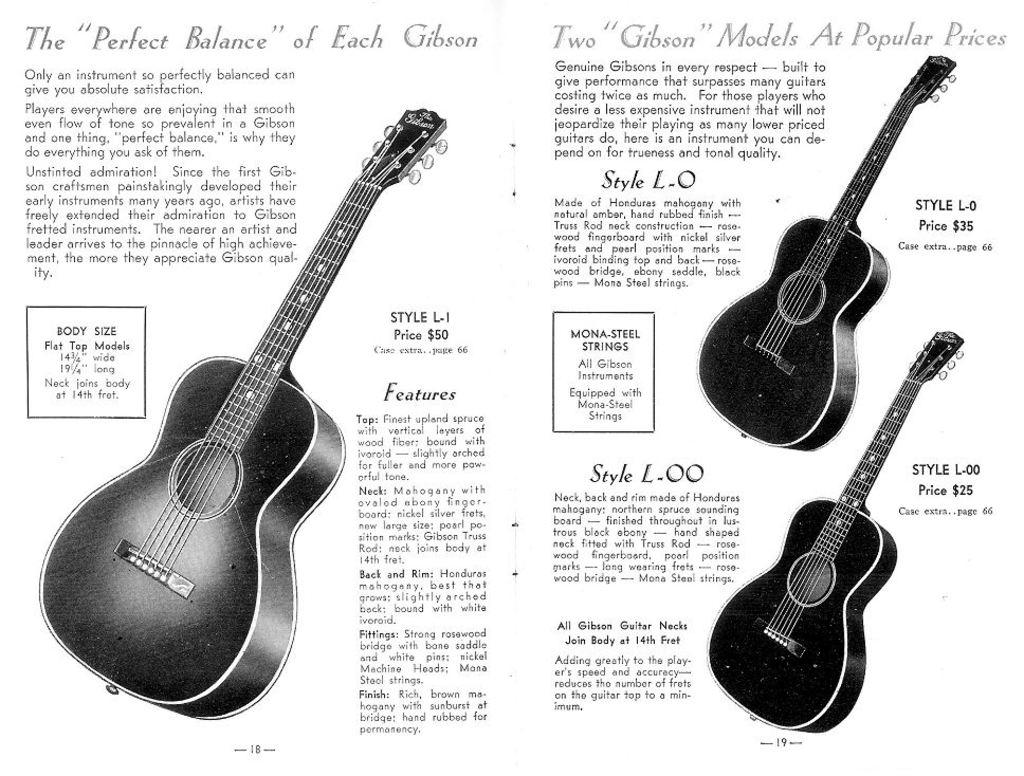
The L-00's first catalogue appearance was in 1932 but supposedly they had been making them since 1929.  They were Gibson's budget model flat-top guitar.  They were lightly built cheapies that were made out of whatever they had around at the time.  Consequently, the features tend to be a bit sporadic.  They all feature Adirondack Spruce tops and Mahogany back and sides.  The L-00 began as a 12 fret guitar but changed to 14 in '33.


This advertisement is kind of interesting.  The 00 is on the lower left and just beside the body of the guitar is a short paragraph about how they are using 14 fret necks for more comfort and fret board access.  You may have noticed that none of the guitars picture have 14 fret necks.  This is typical of Gibson I guess, sigh.


This particular L-00 has a bit of a story attached to it.  Before I had seen it in person I saw a few pictures from the owner.  One showed the back of the headstock.  I could see a little impression in the lacquer that I recognized as a "Made In USA" stamp.  This was the marker that Gibson used on all export instruments that went outside of the US.  But I found this guitar in Tennessee??  I was a bit perplexed because almost all of the instruments that come my way are "finds" as in not from a dealer so how did this guy get this thing anyway?


After talking with the owner for a bit I got the story on how he came to own the guitar.  His uncle was housing a drifter for a while but the drifter had no way to pay him.  All he had was this guitar so he used it as payment.  The uncle had no use for the instrument so when his nephew showed an interest in music he gave it away.  That was a long time ago.  The owner had made his way to the states by way of Canada- the missing link in the story.


This guitar was easy to date as far as vintage Gibsons go.  I saw from the pictures that it had a small burst so I knew it was early to mid 30s.  The Factory Order Number was easy to read: 876 which appeared in the ledgers in 1933.


The neck on this old guitar has a wide 1 3/4" nut width with a fairly defined "V" shape that I find very comfortable.  I'm not sure why this shape has fallen out of vogue.  Fingerstyle blues just feels "right."  The neck is straight, frets properly dressed and the action is very comfortable.  I was looking for signs of a neck reset but I couldn't find them.  I believe that this is the original neck angle.  The saddle is kind of low but not as low as I would expect.  There is still a bit of room to come down if needed.


Some of the guitars from this era have some kind of ugly wood.  They have been seen with three piece tops and backs and off center seams.  Supposedly this was the reason for the small burst: most of the wood was not very aesthetically pleasing so the burst served to cover it up.  For some reason this guitar was spared of ugly wood.  The top is a nice 2 piece book matched Spruce and the back is a solid piece of close-to-quarter sawn Mahogany.  The sides are both quarter sawn.  I say close to quarter because it looks like this piece was very close to the center of the tree.  Here is what I mean by quarter sawn vs. flat sawn:


Quarter sawn wood has a higher strength to weight ratio but wastes more wood.  It is considered higher quality because of its features and scarcity.


The Tone Report:  Open, woody, Americana.  If you closed your eyes and just listened to it you might mistake it for a much larger guitar.  However, it is much different than a dreadnought.  It is more nuanced and sweet.  They are fantastic for fingerpicking.  The notes are clearly defined as well as balanced.  If you plan on strumming away your Nickleback chords then you may want to stay away from a 00.  The boom and sparkle probably won't be enough for you (as well as other obvious problems with that situation).


Dating this Gibson L-00 was relatively easy with the features and Factory Order Number.  The number is 867 which according to Spann's Guide to Gibson means 1933.  The other features were the small burst which was done in the early 30s and the solid kerfing on the interior of the guitar.  This is the lining that provides a solid glueing surface for the rims to the top and back.  This was mostly used in the late 20s and very early 30s.  There are some exceptions such as my friend's '32 L-00 that has standard cut pieces of Mahogany.  Here is a shot of the solid kerfing:


And the FON:


I'm really excited to have another L-00.  I really love fingerstyle blues and this is the guitar to have for that (except for maybe an L-1?).  I thought I liked the larger burst of my last one better but I've changed my mind.  The small burst is unique and the reasons behind it are representative of the times in which it was built.