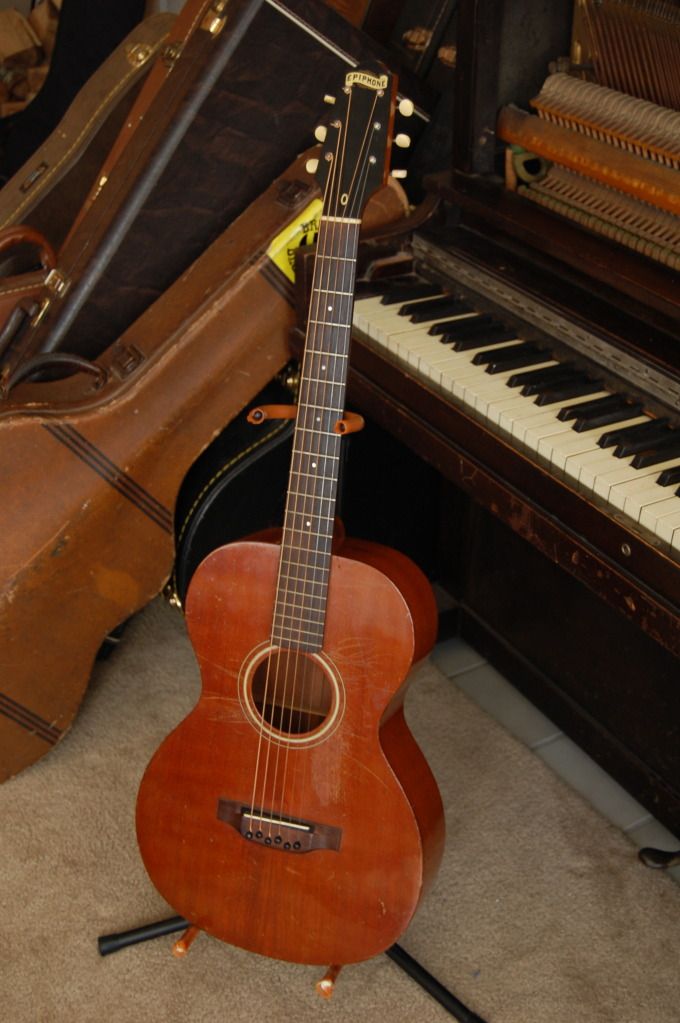
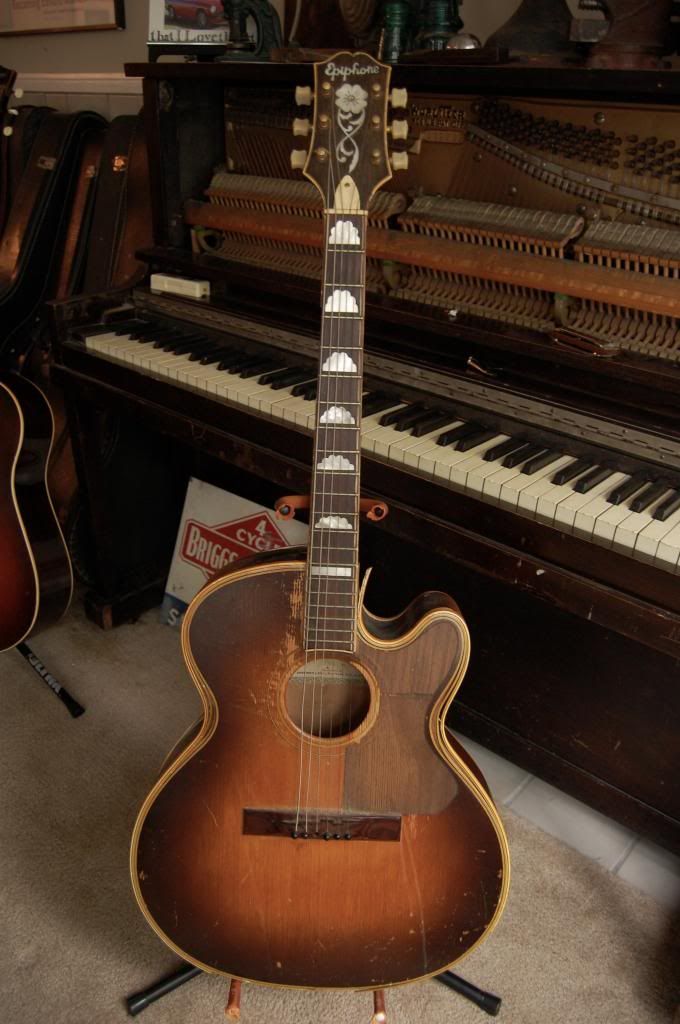
Here's a very cool 1954 Epiphone FT-210 Deluxe Cutaway. This was Epiphone's competition to the Gibson J-200 and was actually 3/8" wider at 17 3/8" at the lower bout. This ladder braced, long scale flat-top featured flame Maple back and sides and beautiful inlays on the neck and headstock. The compensated Rosewood saddle would not have been my choice but is certainly an interesting addition by Epiphone.
Tone
This flat-top derives much of it's construction and aesthetics from Epiphone's line of archtop guitars. The arched back of laminated flame Maple lends a punchy response when plucked and strummed. The large, ladder braced top adds a dark and open timbre with medium volume.
The compensated Rosewood saddle attempts to improve intonation problems with straight saddles. This guitar currently needs a neck reset so I can't remark how much it helps. Theoretically, the compensation is a good idea. The Rosewood, however, doesn't seem to transfer vibrations to the top as well as a traditional bone saddle.
I hope you enjoyed the quick look at this rare guitar. Do you have any more information on this model? I'm all ears: Email me
Maybe that wasn't the best way I could have worded that. How about:
1. What guitar have you not been able to get off of your mind? 2. If any guitar could suddenly appear in your hands, what would it be?
Both of those questions should be qualified with "right now."
It may have looked like I was trying to start a twitter fight about brands, models, etc. but that was not my intent. The question stemmed from a discussion I had with a friend over guitars a couple of weeks ago. He recently started working at Gibson 5 star dealer and so began his dream of a Gibson J-200 True Vintage. It was the pinnacle of tone and nothing else would do (paraphrased). This was after he was really digging the weird 1930 Epiphone Model 0 I loaned him to record his debut album (Pete's Debut Album). I had felt the same way about that guitar before as well. There is still a soft spot in my heart for the huge tone that comes from a lightly picked fingerstyle blues on the old Epiphone.
In My Opinion
the best guitar is always the next guitar and I think that Pete would say the same thing. There is nothing like the anticipation of an old guitar coming in the mail. What will it sound like? What weird features will it have that I didn't see in the pictures?
I recently bought a 1954 Epiphone FT-210 Deluxe Cutaway from a fellow in NY. I had only seen pictures of these and could not wait to have it in my hands. I knew that it needed work but I just didn't care. It was the pinnacle of vintage guitars for the three and a half days that UPS had it, at least in my mind. When it arrived I was ecstatic. Among guitar forum geeks (such as myself) this is called an NGD or New Guitar Day.
What did it sound like? Terrible at first, I'll admit. I was so in love with it that I couldn't put it down. After about two days of playing it, it really opened up and the tone was unique. I love it now.
What weird features did it have? It was ladder braced and had a weird compensated rosewood bridge/saddle.
The next guitar?
The Epiphone is still extremely cool only a week later but I've already got my sights set on another. There is an eBay auction ending tomorrow on a Kalamazoo KG-12 with rare Maple back and sides. It is a sickness! The forum term for this sickness is GAS- Guitar Acquisition Syndrome.
My dad quoted a "statistic" the other day about how 1/3 of kids these days primarily get their news from Facebook. "That's crazy" I said, not feeling convicted at all. Then I thought to myself that isn't that bad, after all, Facebook is what brought on the musical- albeit one-sided love affair between myself Shovels and Rope. Exhibit A:
If you have just spent the past thirty minutes watching other S&R youtube videos then you are not alone. Shovels and Rope are a husband and wife duo out of Charleston, SC. "Rowdy" is how I described their sound to my brother as he reluctantly listened to me ramble about how much I enjoyed their music. Cary Ann Hearst and Michael Trent also have a inclination towards old Gibson acoustic guitars. This pair of multi-generational Kalamazoo- born six strings frequent both the videos and live performances of Shovels and Rope.
Cary Ann's Gibson LG-0
Cary Ann is playing a Gibson LG-0 made most likely between '58 and '62, judging from the straight bridge missing its pearl dots. This was Gibson's most affordable model from about '58 to '67 (in this general configuration). The LG-0 was ladder braced and made from solid Mahogany. The model didn't receive a Spruce top until around '68. These guitars have that great old guitar feel and don't commonly need repair other than a bridge reglue. The tone is usually less desirable than one would expect from an old Gibson but with an average retail price of about $550 for one in good condition, they are a pretty good deal. They are also good stage guitars since the bodies are a bit less resonant and therefore a bit less prone to feedback. Cary Ann's LG-0 sports a refinished (or maybe unfinished?) headstock. She doesn't seem to mind all that much.
Michael's Gibson ES-150
Michael Trent is often seen playing his Gibson ES-150 made between about 1940 and 1942. I've been trying to come across this version of the 150 because of that single "P-90-esque" pickup in the bridge position. Gibson started used this pickup on the 150 around about 1940 but discontinued it sometime in '42. A similar pickup appears in '55 on the Silvertone Espanada. I've seen this pickup called the Gibson "P13" pickup, which was supposedly a precursor to the P-90.
The ES-150 features an arched, solid Spruce top with tone bar bracing. Some say that the tone bars are a bit heavier than normal Gibson archtops of the time to limit feedback. I doubt that it is enough to tame this feedback beast. That pickup is hot and full of tube saturating power. I have never had the honor of playing one of these but maybe one is in my future.
"Oh, Be Joyful"
Look for for the first Shovels and Rope full length album, "Oh, Be Joyful" and give it a listen. You may enjoy the first single of that album titled "Birmingham" which happens to be the name of my home town. I'm quite taken with this oldie, "Hell's Bells."
Most of the guitars that I buy are finds- as in they have been in a closet or under the bed for 30 years. That means that they usually need a fair amount of repair like loose braces, neck sets, lifting bridges, etc. When they need these kind of structural repairs I can't play them before buying. I can't always hear how they will sound after being fixed up before I buy them. It can be a bit of a gamble. Here are a couple of those gambles.
This was probably the biggest gamble of all. This is a 1943 Gibson J-45. This has the fabled "banner" gracing the headstock that was only present during the war years. I bought it from the grandson of the original owner. The back braces, tone bars and finger braces were all loose. The owner could not be convinced of this fact for some reason. He had strings on it at full tension which caused the action to be very high. I bought it anyway because I wanted a banner.
This was a GREAT bet. I figured it would need a neck set but after the braces were glued tight the neck set was perfect. It has almost factory saddle height. The tone is warm, dry and very responsive. You can feel the pluck of each string deep in your chest. Suffice it to say they were right about the banners.
This 1955 Gibson J-50 was a recent gamble. It was listed as a '54 and was about an hour and a half from Birmingham. I could tell from the pictures that while the tuners were there the buttons were not. I just happened to have bought an old Kay with period Klusons for next to nothing the week before! When I got the guitar in my hands I could tell that the bridge had been shaved meaning that it probably needed a neck set. I bought it anyway.
This is a very special guitar and probably the best gamble of all. I took it straight to my local shop where my friend Keith works. We put the extra set of Klusons on and strung it up. As he was winding the strings I could hear that familiar hollow thump typical of the round shoulder Gibsons. At full tension we immediately knew that this was not just an average 50s Gibson. It was loud, nuanced, responsive and most of all LOUD. I'm talking bluegrass loud. We couldn't hear each other talking over the rumbling E chord. Then we took it into the acoustic room to compare it to some new guitars. We soon realized that this was guitar of myth and that it could never leave our circle of pickers.
This is a 60s Silvertone (Harmony Sovereign), I can't remember the Silvertone number designation. I bought it from a different local shop needing a neck set. When they got it in the called me because they knew I love the American made solid wood guitars. They just said it was a Silvertone. When I walked in I immediately recognized the distinctive bean shape and pinless bridge as a rebranded Sovereign. I was ecstatic. They thought I was crazy for buying a hard case for it.
The neck set was easy because the dovetail had already shifted in the joint. I strung it up and started strummed some cowboy chords and fell head first in love with Sovereigns. The J-45s sat in their cases for a few days while I became acquainted with it. It had the rumble of a J-45 but sounded more bluesy- no, boxy. This was probably a result of the ladder bracing. Sometimes I just want to strum my favorite chord progression and belt out the lyrics. This guitar was just about perfect for that. It had the magic and can be had for less than $500. Don't be fooled by the price, this is a professional instrument. I sold it to a big time session player in Nashville. It is a safe bet to say that you have heard him play.
It is a special feeling to strum an old guitar for the first time. It is even more exhilarating when you have a bunch of time and money invested in it! Maybe I have just gotten lucky but I have never had a bust- yet. If you find one of these for a good deal then don't be afraid. Take the plunge.
I saw an old amp on Craigslist in Tuscaloosa the other day. It was a Silvertone 1472 sporting about 10 watts or so and a 12" speaker. I was heading to Tuscaloosa on business that day so I figured I would inquire about it. Unfortunately I was about 10 minutes too late.
The seller was very nice and asked what else I was interested in. I told him I like anything old and made in America. He said he had an old Kay flat top that had a body made by Gibson. I thought to myself, "I've heard that before."
The body was not made by Gibson but that didn't matter to me. This is a mid 1950s Kay (Harmony) Jumbo (actual model? I dunno. Maybe just Kraftsman). It was made in Chicago and features a solid Spruce top, solid one piece flame Maple back and veneer sides. It has 17" wide hips (a regular dreadnought is 16") and has ladder bracing. It is original save for the Guild bridge added sometime long ago. It even came with the original Kluson tuners!
I was drawn to this guitar for three reasons: the size, appointments and the FLAME MAPLE BACK! This is an absolutely beautiful slab of maple. They didn't even cut it in half and book match it. It is just one solid piece of sexy Maple.
She came to me in pretty good shape except that the neck was falling out and there was no nut or saddle. I was very excited to have another neck reset project. My last one didn't go so well but I learned a lot from it. You can read all you want about it but there is not substitute for just doing it. I highly suggest it if you are so inclined and have a suitable subject (ie not Gibson).
This is a dovetail joint. It requires skilled craftsmanship to make and fit the neck to the guitar at just the right angle. It takes a lot more time and human attention than a bolt on neck. Dovetail joints are not easily made by machines. They are a sign of old world craftsmanship. Do you own a Taylor? Your guitar probably does not have one of these.
I was really excited to see no gaps when I was done! These are crappy cell phone shots. I forgot to take real pictures. I didn't want any good evidence in case it went bad.
The wife was kind enough to let me turn the apartment into a repair shop. It was a mess and still kind of is. This is a shot of me cutting the me bone nut. It was my first full nut made from scratch. I was happy with the result since it was my first try. I will definitely do some things differently next time.
This is an interesting guitar because it has a 26" scale length. That is the distance from the saddle (the white piece on the bridge) to the nut (the white piece at the top of the neck). The standard scale length for a Gibson is 24 3/4" and the standard Martin scale is 25 1/2". This is significant in both the way it plays and sounds. A longer scale means that the strings must be tighter in order to sound the note. This usually makes for a louder and more difficult to play instrument (on average). The tighter the string is the more difficult it is to push the string down to the fret. Needless to say, this thing is a hoss to play and sounds great!
Another interesting feature (or lack thereof) is the absence of a truss rod. Maybe it was just an attempt to save money. They accounted for this by making the neck a monster. It is by far the biggest neck I have ever seen. It really gives it that 40s and 50s feel. The neck is straight as an arrow so I guess they called Time's bluff.
I really like the peghead overlay on this one. They used a celluloid overlay and carved and painted the detail and logo with white and gold paint. I was talking with a friend about this guitar and he made a good point about how the peghead is very underused and plain on most guitars. I agreed and thought that this was one of the most beautiful headstocks I have ever seen.
 RSS Feed
 Twitter