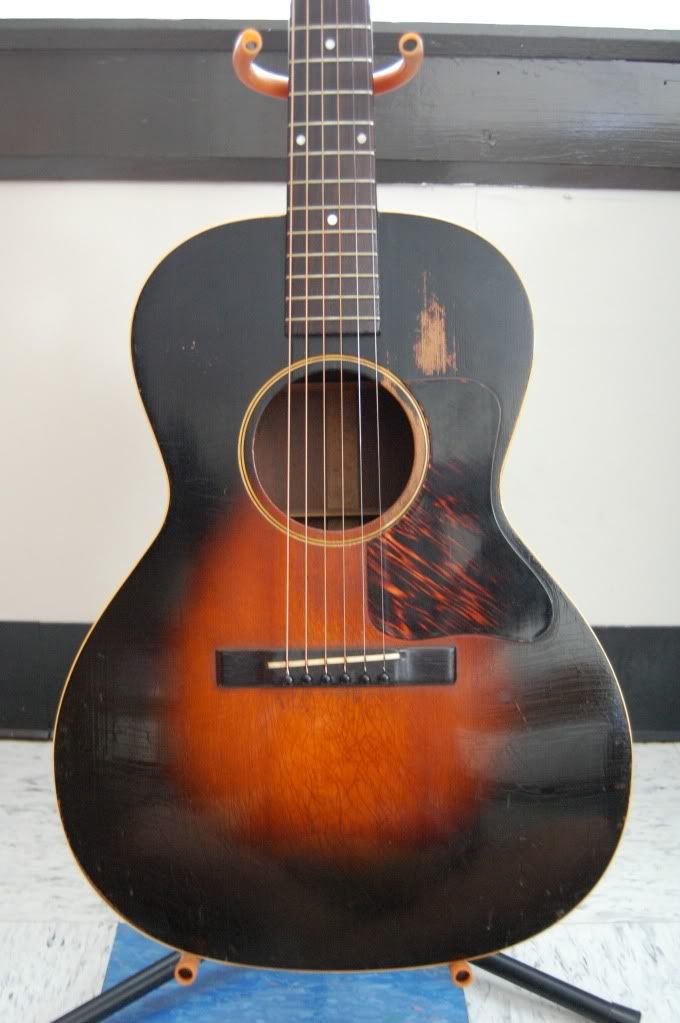
Showing posts with label round shoulder dreadnought. Show all posts

On buying old, broken guitars before you can hear them

0 comments
Most of the guitars that I buy are finds- as in they have been in a closet or under the bed for 30 years.  That means that they usually need a fair amount of repair like loose braces, neck sets, lifting bridges, etc.  When they need these kind of structural repairs I can't play them before buying.  I can't always hear how they will sound after being fixed up before I buy them.  It can be a bit of a gamble.  Here are a couple of those gambles.


This was probably the biggest gamble of all.  This is a 1943 Gibson J-45.  This has the fabled "banner" gracing the headstock that was only present during the war years.  I bought it from the grandson of the original owner.  The back braces, tone bars and finger braces were all loose.  The owner could not be convinced of this fact for some reason.  He had strings on it at full tension which caused the action to be very high.  I bought it anyway because I wanted a banner.

This was a GREAT bet.  I figured it would need a neck set but after the braces were glued tight the neck set was perfect.  It has almost factory saddle height.  The tone is warm, dry and very responsive.  You can feel the pluck of each string deep in your chest.  Suffice it to say they were right about the banners.


This 1955 Gibson J-50 was a recent gamble.  It was listed as a '54  and was about an hour and a half from Birmingham.  I could tell from the pictures that while the tuners were there the buttons were not.  I just happened to have bought an old Kay with period Klusons for next to nothing the week before!  When I got the guitar in my hands I could tell that the bridge had been shaved meaning that it probably needed a neck set.  I bought it anyway.

This is a very special guitar and probably the best gamble of all.  I took it straight to my local shop where my friend Keith works.  We put the extra set of Klusons on and strung it up.  As he was winding the strings I could hear that familiar hollow thump typical of the round shoulder Gibsons.  At full tension we immediately knew that this was not just an average 50s Gibson.  It was loud, nuanced, responsive and most of all LOUD.  I'm talking bluegrass loud.  We couldn't hear each other talking over the rumbling E chord.  Then we took it into the acoustic room to compare it to some new guitars.  We soon realized that this was guitar of myth and that it could never leave our circle of pickers.


This is a 60s Silvertone (Harmony Sovereign), I can't remember the Silvertone number designation.  I bought it from a different local shop needing a neck set.  When they got it in the called me because they knew I love the American made solid wood guitars.  They just said it was a Silvertone.  When I walked in I immediately recognized the distinctive bean shape and pinless bridge as a rebranded Sovereign.  I was ecstatic.  They thought I was crazy for buying a hard case for it.

The neck set was easy because the dovetail had already shifted in the joint.  I strung it up and started strummed some cowboy chords and fell head first in love with Sovereigns.  The J-45s sat in their cases for a few days while I became acquainted with it.  It had the rumble of a J-45 but sounded more bluesy- no, boxy.  This was probably a result of the ladder bracing.  Sometimes I just want to strum my favorite chord progression and belt out the lyrics.  This guitar was just about perfect for that.  It had the magic and can be had for less than $500.  Don't be fooled by the price, this is a professional instrument.  I sold it to a big time session player in Nashville.  It is a safe bet to say that you have heard him play.


It is a special feeling to strum an old guitar for the first time.  It is even more exhilarating when you have a bunch of time and money invested in it!  Maybe I have just gotten lucky but I have never had a bust- yet.   If you find one of these for a good deal then don't be afraid.  Take the plunge.

TVG


1953 Gibson J-45 nicknamed the "Workhorse"

0 comments

Introducing my favorite guitar ever made- the Gibson J-45.


This guitar came out of the Appalachian foothills of north Georgia.  It had been posted for months along with a 1936 Gibson L-00 and had not sold.  I snatched them both up as soon as I could get in contact with him.  Here is a shot of the L-00 (dorm room photo).


The first J-45s came out in 1942 when Gibson was producing only six models because of the war shortages.  It was a bare bones blues powerhouse that continues to be in production today with no end in sight.  The J-45 is one of Gibson's flagship models that is commonly referred to as "The Workhorse".  They were all made the Jumbo body size with X-bracing using hide glue to keep it all together.  During WWII, many substitutions were made including Maple backs and sides, Mahogany tops and the absence or presence of a truss rod.

This one features a Sitka Spruce top and Honduran Mahogany back, sides and neck.  Both the back and top are two piece, book matched quarter-sawn solid spruce an mahogany.  It has the pre-'55 style 19 fret neck, belly-up drop in saddle and finely scalloped tone bars.


But how does it sound??  With light strings, this one sings with rich, balanced lows and acutely defined highs.  The woody, Americana tone is undeniable when flatpicking chords or playing fingerstyle blues.  The action is medium to low with a little room on the saddle to come down.  The bridge pin holes have been lightly ramped to allow for good break angle over the saddle.

This example has all of the original parts (except for strings!).  The only repairs that done were a couple of reglued loose braces done by Jason Burns of Burns Instrument Repair at Homewood Musical Instrument Co. (Burns Banjos and Repair  Homewood Music).  Jason is an extremely talented open back banjo maker as well as a true-to-the-original repairman.  He used hide glue when regluing the braces.  Other than that, only simple set up work was required.  You can see that the plastic on the original Kluson tuners has gassed and shrunk over the years.  I should put new tuners on there but I really like the way the old ones look.  I am very very careful when tuning and luckily, it never needs much!

These are two pictures of the underside of the top of this guitar.  They show the two braces called "Tone Bars."  These braces have a huge influence on the tone and structural integrity of the guitar.  You may notice the tones bars are "scalloped."  This means they were shaped for strength in one way and tone in the other.  The beginning and end of the bars are tall while the middle is short.  This is where some would say we get in to the "religion" aspect of vintage instruments.  Many boutique luthiers and hand builders shave braces and tap tune their tops to focus the tone towards bass or treble response.  I'll let you be the judge on whether this has a big impact on tone.

One reason I like these old Gibson guitars is because they are very "lightly built."  This one is no exception.  What do I mean by lightly built?  Well, I guess it is a bit hard for me to explain.  It refers to the thinness of the braces and the overall weight of the materials used.  It would be better explained by holding an inspecting two guitars: one pre-1955 Gibson and one recent Epiphone Masterbilt.  Have you ever played a Masterbilt?  I love these guitars but they are heavy as lead!  They have big thick tops, backs and braces.  They are both built with all solid woods however they had two separate goals.  The former, to be the best sounding guitar possible with the materials, techniques and budgets that were available.  The latter, to avoid warrantee costs but also make a guitar out of all solid woods because that term sells guitars.  A lightly built guitar booms with vibrating resonance that you can feel in your gut when you strike an E chord.  A "tank" simply reflects the sound of the barely vibrating top off of the back and out the sound hole.  Maybe it would be better explained if we were sitting down with these two guitars and a glass of cool, straight Tennessee whisky.


Dating a vintage Gibson guitar can often be quite a process.  Someone that looks at these guitars a lot could notice a few indicators of what time period this one came from.  All years are model specific and should be taken with a grain of salt:


1.  Block "Gibson" Logo (1947-current).


2.  19 Fret neck, small "teardrop" pickguard and tall thin and scalloped tone bars (1942-1954)


3.  Upward belly, drop in saddle (1953-1955)


4.  Here's the kicker: the Factory Order Number and letter designation.  From 1952 to 1961 Gibson used the alphabet (backwards) to indicate what year the guitar was produced (only flattops, sometimes).  Why did they go backwards and randomly decide to quit in 1961?  Not sure.  Here is a breakdown of what it looks like through the years: (from the website Vintage Guitars Info)


1952= Z
1953= Y
1954= X
Etc. until 1961


Here are a couple more shots that highlight some cool aspects of this J-45:

Original Kluson keys have shrunk

Beautiful dark grain line in the Brazilian Rosewood fingerboard

This was before they stamped anything on the back of the headstock

There is some glare on the back.  Couldn't get a clear shot without some glare.

I have two more J-45s to blog about.  The '46 will be coming soon but the '43 is in Jason's shop and it may take a while.  Feel free to leave me some feedback or follow this blog for more cool guitars.


Follow my Instagram photos for up to date shots on the guitars I am currently looking at (you don't have to have a smarty pants phone to do it!):