Showing posts with label guitar. Show all posts

1965 Fender Jaguar in Olympic White

0 comments

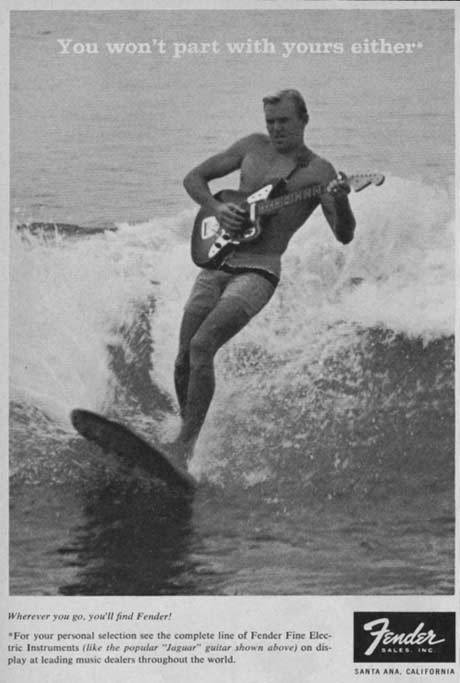
And I don't!  Want to part with mine, that is.  I will certainly not take it surfing, although I don't have to worry about that here in Birmingham, AL.  My 1965 Fender Jaguar will not be cruising the waves anytime soon.

The Jaguar was introduced in 1962 as Fender's new top-of-the line model.  It's shiny chrome plates, clawed single coils and abundance of switches were supposed to make it more desirable than the Telecaster, Stratocaster and Jazzmaster.  The public didn't quite see it that way and went on buying the strats and teles like it was going out of style.  People didn't really like the shorter 24" scale.  The Jaguar didn't sell as well as Fender hoped but became popular for a lot of different styles starting with of course, surf rock.


This 1965 Fender Jaguar was purchased by the parents of the original owner for their 16 year old son.  He had played a little bit and wanted a nice guitar for his birthday.  The price on the tag of Jaguars at the time was $491 which according to the inflation calculator is about $3526.59 in 2012 dollars.  The custom color was about a 5% upcharge.  The strap, I believe, was purchased sometime in the 70s judging by the style.  


I purchased the guitar from the wife of the owner who said that this was the original case.  This case was sold from '62 to '63 so it is doubtful that this was the original case.  USA sold Fenders came guitar specific cases as in each guitar was shipped in its own case.  Maybe the store had guitars hanging on the wall but didn't organize their cases very well so an earlier guitar sold with a newer case and vice versa.


The Jaguars had a similar circuit to the Jazzmaster in that it had a separate rhythm circuit on the bass horn.  With the slider switch down, the lower controls are activated.  The main volume and tone knob and three slider switches let you dial in the tone desired.  The three switches are: neck pickup, bridge pickup and bass cut, also known as the "strange switch."  When this switch is on it has a very trebly and jangly tone.


You'll notice the interesting looking "claws" on either side of the pickups.  This was to help with the hum problem that plagued the Strats, Teles and Jazzmasters.  The electronics cavities were also heavily shielded which did noticeably reduce hum.  The Jaguar pickups still retain that fender tone but I think are a little stronger, hence the bass cut switch.  I haven't had enough time with it yet but I don't think that this guitar really lends itself to blues but it does the surf/indie rock thing in spades.


The tremolo is very smooth and usable.  This "Floating Tremolo" type does a lot better job keeping the guitar in tune compared to the "Synchronized Tremolo" on the Stratocaster.  Smooth, long weeps of the tremolo are accurate and even easy.  I always felt like I was breaking the strat's tremolo when I really used it, which was not often.  I really enjoy the jaguar/jazzmaster style trem.


TVG

New Vintage: Gibson's 2013 J-35

0 comments
The Gibson J-35 was the precursor to the J-45 from 1936 to 1942.  It had a couple of variations in bracing patterns but was cosmetically a 14 fret jumbo, sunburst or natural with a firestripe pickguard.  This combination made for an absolutely gorgeous instrument.  Gibson has reintroduced the instrument for their 2013 line of Gibson Acoustics from Bozeman, MT.

Then (1939)

Now (2013)
The J-35 has was discontinued in 1942 but was reintroduced in this configuration sometime in the 2000s by Gibson through Fullers Guitar in sunburst.  It closer resembled the Gibson Jumbo (1934) because of its small pearl inlaid Gibson logo.  These are very nice guitars but the 2013 production version is a bit different.

Cosmetically the only differences between old and new are the natural finish, Kluson repro tuners, unfortunate banner headstock and the addition of the LR Baggs Element pickup.  I questioned Gibson's decision to put a gold banner logo on the headstock but I think I know what really happened.  These guitars are largely designed in Bozeman, MT however sometimes the Nashville guys sink their claws into the design, hence the banner.  One Nashville guy in particular thought this would be a good idea and had the unfortunate superiority for it to stick.  This is purely hypothetical of course.  Don't get me wrong, I love banner headstocks on wartime period Gibsons however the J-35 was decidedly prewar and never had a banner.  The Bozeman guys almost got away without putting the banner on there as you can see from the NAMM prototype:


But the production version's headstock had this logo:

Why would you do this HJ?
The original J-35 had 4 main bracing patterns: 3 tone bar scalloped, 3 tone bar unscalloped, 2 tone bar scalloped and 2 tone bar unscalloped.  "Scalloping" refers to the careful shaving of mass away from the parts of the brace where extra mass is less needed, such as the very center.  It appears that Gibson scalloped seemingly at will during this time period.  Some say that it depended on whether or not the builder though it was necessary on a certain top.  If they felt the top was too strong and would inhibit tone then they scalloped the braces.  This is just hearsay though, I was not there in 1939.  The 3 tone bar versions are largely seen from '36 to '39 and 2 tone bars until '42.


Gibson's new production version uses a 2 scalloped tone bar style bracing closely resembling what would have been in a '39-'42 J-35.  They call this their "1930s Advanced X Bracing."  This is the same bracing used in the current Advanced Jumbo and the J-45 TV with the only difference being that they use different glue.  The AJ and J-45 TV use hot hide glue to brace the top while Titebond is used to brace the top on the J-35.  Titebond is easier to work with and still provides a great bond.  Hide glue dries very hard and brittle.  This seems to transfer energy better than a Titebond joint.  Guitar nerds such as myself will swear that hide glue sounds better but the difference is marginal at best.  Hide glue is still used on the neck joint of all Gibson acoustics because is it much easier to reset the neck in the future.

I have played two 2013 J-35s and both were phenomenal instruments.  The J-35 was positioned (price wise) to compete with the Taylor range of prices so they can be had for much cheaper than the J-45 standard.  I have heard a lot of people say that they just weren't as good as the 45 standard but I must disagree.  Don't be fooled by the price point.  These guitars were priced and built by two different sections of the company.  The price is basically a marketing trick.  


In my opinion, the J-35 is a "better" guitar and not just because of the price.  The only structural difference between the 45 standard and the 35 is the bracing.  The 30s advanced bracing in my opinion results in a more resonant guitar.  I liked the sound of the 35s better than the 45 standard.  What do you think?  Which model did you like better?  Keep in mind that the J-35s will probably have fresher strings than the 45 standards.

I do not work for Gibson and have no affiliation with anyone in that company.  I don't care if Henry sells guitars or not.  I normally would not consider new guitars because they usually don't do it for me but for some reason this one does!  I was pumped about their reintroduction and I think Gibson did a great job with the exception of the banner.  If finances permit then I may get one!

TVG


1944 Gibson J-45 "Only a Gibson is good enough"

0 comments
The banner on Gibson's wartime flat-tops appeared around June of 1942 and disappeared sometime in 1946.  It is still a but unclear why but we may know more about the banner after this book comes out: Kalamazoo Gals.  Maybe it had something to do with national pride during the war years since the Martin guitar company was still family owned and the original CF Martin was in fact, a German immigrant.  This is solely speculation though, It may have had nothing to do with Martin.


This guitar was probably made in 1944 but again, that is just a guess.  It bears no visible factory order number and may have never received one which is common for the late war years.  It was constructed of a two piece Spruce top and a solid, one piece flat-sawn Mahogany back.  The one piece back is of note because it is evidence that wood stock piles were low so "lower quality" wood was used.  The Mahogany should have been quarter sawn for appearance and strength however this process wastes more wood than the flat sawing method.  Also of note, the Kalamazoo Gals that built this guitar were told to put "back strips" on the interior of the guitar to help the two joined quarter sawn pieces of Mahogany.  Yet this guitar has a one piece back.


I mention this because the people that built this guitar were probably not men who had worked in the factory for many years.  More than likely they were "Rosie the Riveters" that filled the empty positions of men who had gone to support the war effort.  In John Thomas' book, "Kalamazoo Gals," an argument is made that these guitars were somewhat superior to other Gibsons because of the nature of the women who made them.  These women had been working with their hands all of their lives.  They may not have been making guitars but they were very skilled nonetheless.  Since the book is not out yet I cannot say that this is the exact point or argument made.  I am very excited about the book as you can imagine!


One thing that I have noticed as a pattern of the banner Gibsons is that they have a distinctive percussive "thump" that vibrates throughout the entire instrument when a string is struck.  My experience is limited since I have played only as many banners as you can count on two hands but it is certainly a pattern.  A friend once described the thump of this exact instrument to be akin to a "lapping", as if from the tongue.  I thought that was a great way to describe it since thump would indicate a bit bass heavy, which these guitars are not.  I am worthless when it comes to describing tone with words so just bear with me.


I have three banner J-45s: one spruce and mahogany, one all mahogany and one in the mail that is spruce and flame maple.  The maple banner is still in the mail and should arrive in a couple of days.  I'll be doing two more posts on the other two banners later this month.  Do you have a banner Gibson?  Send some pictures to my email at tvguit at gmail.  I don't want to post the actual email for fear of bots.

TVG

Pre-war Epiphone Flat-top: 1940 Epiphone FT-50

0 comments
I say 1940 but I don't really know.  A friend on the Unofficial Martin Guitar Forum concluded that this was built by Epiphone in 1940 or '41.  There were very few of these ever made.


This one popped up on the local Craigslist.  I don't think that many people on there knew what it was.  Of course, this is no asian made Epiphone.  This was made before Gibson purchased the Epiphone brand in 1957.  They moved the production of Epiphone branded instruments overseas in the 70s tarnishing the name.  The American made Epiphones were very fine instruments.


This Epiphone lived a sordid life.  It came to me covered in soot with two stickers and a name carved right in the top.  The seller was the nephew of the schizophrenic aunt that owned it (last).  The soot and stickers came up fairly easily with some Naptha and elbow grease.  The name, "Kelsi" is there to stay.  It features an Adirondack Spruce top, Walnut back and sides, and what looks like a very dark Rosewood fingerboard.  It has feaux tortoise shell binding and a very nice pearl inlay on the headstock. The tuners have been changed.  It still has 4 of the original Bakelite bridge pins.


 The FT-50 started showing up in the 1941 but it says that they had Mahogany backs and sides.  It also shows a model FT-45 that had Walnut but also white binding.  This may have been pre-catalogue before they really nailed down what was what.  The label with the model number and serial number is badly torn so we may never know if this was a 45 or 50.


The Epiphone researcher that I spoke with on the forum said that since this was X braced and lacked the metal cover for Epiphone's "thrust rod"then this was probably pre-war.  His research indicates that the model line was reduced during the war and this was one that was cut.  They start reappearing a couple years later with serial numbers indicating 1945.  After that, the FT-50 was cut for good.  

He is currently compiling serial numbers, pictures and catalogues into a database so he can offer a better understanding of Epiphone's past.  Do you have a guitar like this?  Please email me and I will pass the information along to him.  


Pre-war Gibson Flat-top: 1933 Gibson L-00

0 comments
When I was back in school I was lucky enough to find a guy with an early 50s J-45 and a mid to late 30s L-00.  I knew the J-45 was for me so I quickly sold off the L-00.  Mistake.  The thing had been played and played and needed a neck reset but it felt so good.  Sounded even better.  When I got word of this one for sale I was ecstatic.


The L-00's first catalogue appearance was in 1932 but supposedly they had been making them since 1929.  They were Gibson's budget model flat-top guitar.  They were lightly built cheapies that were made out of whatever they had around at the time.  Consequently, the features tend to be a bit sporadic.  They all feature Adirondack Spruce tops and Mahogany back and sides.  The L-00 began as a 12 fret guitar but changed to 14 in '33.


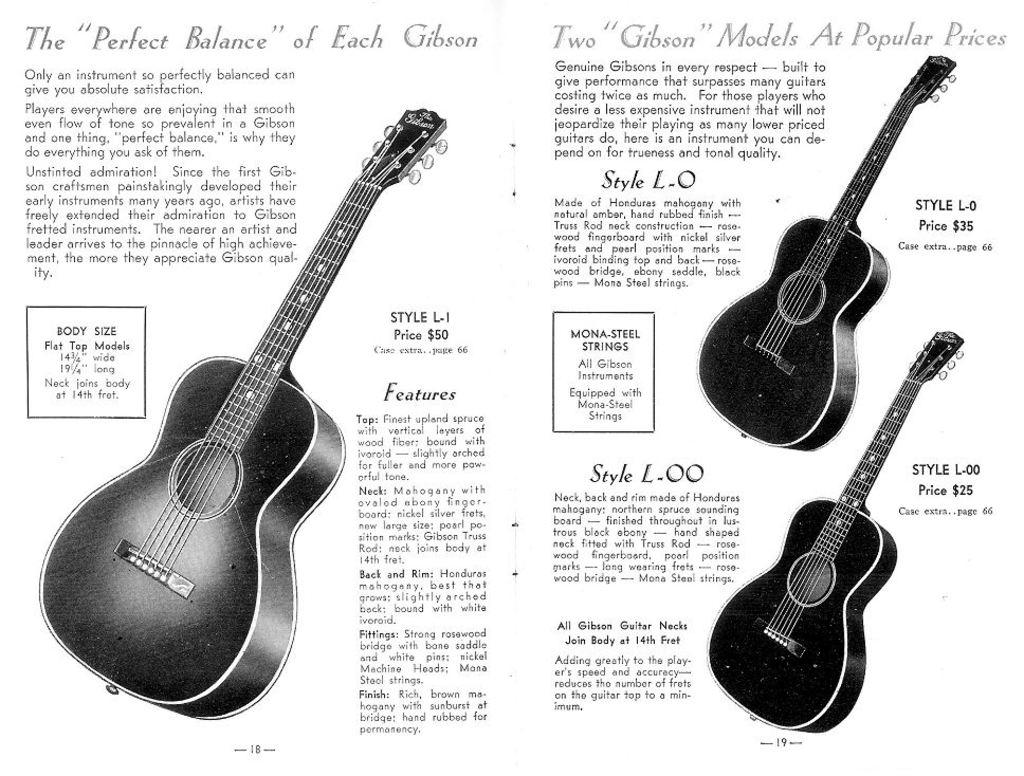
This advertisement is kind of interesting.  The 00 is on the lower left and just beside the body of the guitar is a short paragraph about how they are using 14 fret necks for more comfort and fret board access.  You may have noticed that none of the guitars picture have 14 fret necks.  This is typical of Gibson I guess, sigh.


This particular L-00 has a bit of a story attached to it.  Before I had seen it in person I saw a few pictures from the owner.  One showed the back of the headstock.  I could see a little impression in the lacquer that I recognized as a "Made In USA" stamp.  This was the marker that Gibson used on all export instruments that went outside of the US.  But I found this guitar in Tennessee??  I was a bit perplexed because almost all of the instruments that come my way are "finds" as in not from a dealer so how did this guy get this thing anyway?


After talking with the owner for a bit I got the story on how he came to own the guitar.  His uncle was housing a drifter for a while but the drifter had no way to pay him.  All he had was this guitar so he used it as payment.  The uncle had no use for the instrument so when his nephew showed an interest in music he gave it away.  That was a long time ago.  The owner had made his way to the states by way of Canada- the missing link in the story.


This guitar was easy to date as far as vintage Gibsons go.  I saw from the pictures that it had a small burst so I knew it was early to mid 30s.  The Factory Order Number was easy to read: 876 which appeared in the ledgers in 1933.


The neck on this old guitar has a wide 1 3/4" nut width with a fairly defined "V" shape that I find very comfortable.  I'm not sure why this shape has fallen out of vogue.  Fingerstyle blues just feels "right."  The neck is straight, frets properly dressed and the action is very comfortable.  I was looking for signs of a neck reset but I couldn't find them.  I believe that this is the original neck angle.  The saddle is kind of low but not as low as I would expect.  There is still a bit of room to come down if needed.


Some of the guitars from this era have some kind of ugly wood.  They have been seen with three piece tops and backs and off center seams.  Supposedly this was the reason for the small burst: most of the wood was not very aesthetically pleasing so the burst served to cover it up.  For some reason this guitar was spared of ugly wood.  The top is a nice 2 piece book matched Spruce and the back is a solid piece of close-to-quarter sawn Mahogany.  The sides are both quarter sawn.  I say close to quarter because it looks like this piece was very close to the center of the tree.  Here is what I mean by quarter sawn vs. flat sawn:


Quarter sawn wood has a higher strength to weight ratio but wastes more wood.  It is considered higher quality because of its features and scarcity.


The Tone Report:  Open, woody, Americana.  If you closed your eyes and just listened to it you might mistake it for a much larger guitar.  However, it is much different than a dreadnought.  It is more nuanced and sweet.  They are fantastic for fingerpicking.  The notes are clearly defined as well as balanced.  If you plan on strumming away your Nickleback chords then you may want to stay away from a 00.  The boom and sparkle probably won't be enough for you (as well as other obvious problems with that situation).


Dating this Gibson L-00 was relatively easy with the features and Factory Order Number.  The number is 867 which according to Spann's Guide to Gibson means 1933.  The other features were the small burst which was done in the early 30s and the solid kerfing on the interior of the guitar.  This is the lining that provides a solid glueing surface for the rims to the top and back.  This was mostly used in the late 20s and very early 30s.  There are some exceptions such as my friend's '32 L-00 that has standard cut pieces of Mahogany.  Here is a shot of the solid kerfing:


And the FON:


I'm really excited to have another L-00.  I really love fingerstyle blues and this is the guitar to have for that (except for maybe an L-1?).  I thought I liked the larger burst of my last one better but I've changed my mind.  The small burst is unique and the reasons behind it are representative of the times in which it was built.


From the Bailey Brothers' VAULT: 1960 Gibson ES-355

0 comments
You have heard of it happening.  Most guitar shops will have somewhere that they keep the "good stuff."  You are standing in your favorite local guitar shop.  You overhear another customer say something like "have you gotten in anything good lately?" while he is standing next to Custom Shop Les Pauls, Gretsch White Falcons or CS black guard Teles and what not.  As if those were not good.


This customer is talking about the stuff in the back room, upstairs, or maybe even right behind the counter and out of sight of the average dude walking in to for the sole reason of playing "Stairway To Heaven" for everyone to hear.


You might be asking yourself "what do they have back there?"  This is one of the things they might have.  But probably not.


1960 Gibson ES-355 with the original brown Lifton case.


The ES-355 was officially introduced in 1959 but supposedly a couple were shipped in '58.  It is constructed of a laminated Maple body with a solid block down the center and a neck of their standard, Mahogany.  It also features 2 humbucking pickups- just like a 335.  Where it differs from the 35 is in the fretboard (Ebony instead of Rosewood) and all that sexy bling, binding and gold hardware.  Oh, and the factory Grover tuners (the good ones) and Bisgby tailpiece.


This example made it out of the factory with some cool features.  The serial number says that it was manufactured in 1960 so it must have been early in 1960 because it has the longer pickguard as well as 19 frets to the body (instead of 20).  In 1960 they shortened the pickguard so that it would not go past the bridge pickup.


The best part of these 355s is that they featured gold plated hardware.  PAF pickups were made in nickel and gold finishes.  Gibson used nickel hardware on most of their guitars and saved the gold hardware for the really fancy ones.  As a result, the gold covered PAFs lasted well into the early 60s.  This one features PAFs.  They sound damn good too.


Most of the 355s came with a feature that Gibson called "Varitone."  This was a switchable notch filter that cut certain frequencies using a range of different capacitors.  Many players/collectors think that Varitone "kills tone" and therefore it makes a vintage 355 less valuable.  I haven't messed around with a Varitone switch enough to form my own opinion but I do like the simplicity of not having it.  This guitar was spared of that switch.


Here is a shot of a real M-69 pickup ring.  You may be wondering to yourself why this little piece of plastic matters at all.  They are commonly faked and sold for a good bit of money.  If you buy one of those $200k+ '59 Les Pauls you are probably going to want to have all original parts.  But, these pickup rings were prone to crack and break.  Many were replaced throughout the years.  Now you have a market for  little pieces of plastic that apparently go for $500 or so.  Go figure.


This guitar had a little surprise for us when we decided to take out the neck pickup to check out the PAF.  We removed the pickuard in order to get a good look at the PAF (the bridge pickup's lead was too short!).  We had been discussing what kind of person would have bought this instrument new in 1960.  I was thinking a big band guy or a jazz guitarist.  Probably not the standard country western kind of thing that was popular at the time.


When we set the pickguard aside we noticed a name stamped on the underside of the pickguard.  Max Williamson.  I couldn't find anything about him online but maybe you have some information about him?  Here's to you, Max, and your good taste in fine instruments.


This guitar is available from Bailey Brothers Music Company in Birmingham, AL.  Thanks to Clay and Keith for letting me snap a couple of quick pictures of it.

TVG