The $200k Les Paul's little brother: 1960 Gibson Melody Maker

0 comments
According to Gibson's website, the Melody Maker was the best selling guitar at the time.  It was cheap and looked cool too.  They produced them on the same line that made Les Pauls, ES-335s and J-200s.


The Melody Maker was a full scale guitar with trimmed down features. The body is solid Mahogany but is much thinner than a standard guitar at 1 3/8ths" thick.  It has only one single coil pickup made specifically for this model.  The neck is a full size standard neck except the headstock doesn't have the "wings" glued on the side like a standard Gibson.  


This guitar was owned by a blues player and you can tell!  He played and played it.  It has a nice aged patina but still fully playable and has all the original parts.  I bought this guitar and two others from the brother-in-law of the blues player.  The other guitars I bought from him were a 1964 Fender Duo-Sonic and a 1946 Gibson J-45.  They all have a distinctive wear mark where he put his arm and shoulder over the guitar.  This wear doesn't photograph well but this picture shows it the best.  


The guitar is all original but the case is clearly not.  It is from the late 60s/early 70s.  It fit the guitar well and protected it much better than the chipboard case that it probably came in.  That case is long gone.


 This guy must have been a hell of a player!  He played these things all the way through the finish on the neck.  It feels good- very good.  I guess he figured they needed to be broken in before they played well.  He may have been right!  Many people would pay big money to have their guitar "relic"ed like this.  Now I know why.

The neck retains the 50s style big full neck.  It has the standard width with just enough depth to feel full.  The is the same neck shape that would be on a Les Paul from the same year.  The fretboard is Rosewood but is flat-sawn instead of quarter (like would be on a Les Paul).  I've seen this one some J-45s from the late 50s as well (email guitar).


This simple layout includes a jack, tone, volume and pickup.  You could take all of the electronics out by removing the pickguard if the ground didn't go to the bridge post.  


Some have described the Melody Maker single coil as a cross between a P-90 and a Tele neck pickup.  I would say that it is closer to the Tele pickup but a bit darker.  


 Do you have one of these?  Send me a picture!


Pre-war Epiphone Flat-top: 1940 Epiphone FT-50

0 comments
I say 1940 but I don't really know.  A friend on the Unofficial Martin Guitar Forum concluded that this was built by Epiphone in 1940 or '41.  There were very few of these ever made.


This one popped up on the local Craigslist.  I don't think that many people on there knew what it was.  Of course, this is no asian made Epiphone.  This was made before Gibson purchased the Epiphone brand in 1957.  They moved the production of Epiphone branded instruments overseas in the 70s tarnishing the name.  The American made Epiphones were very fine instruments.


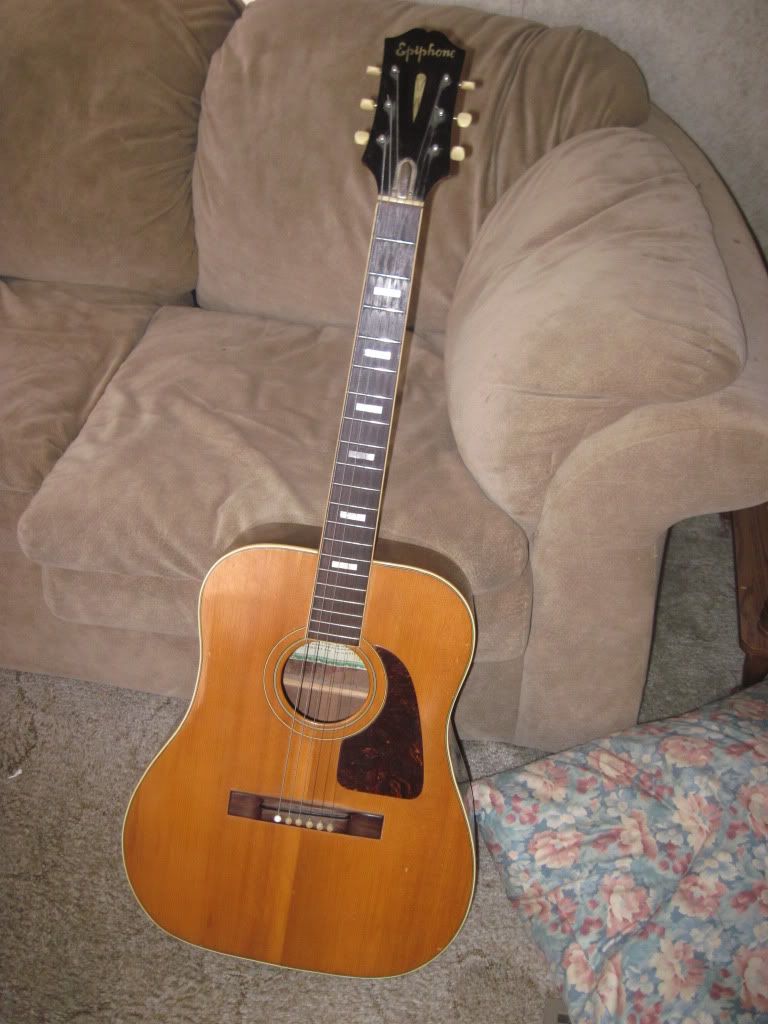
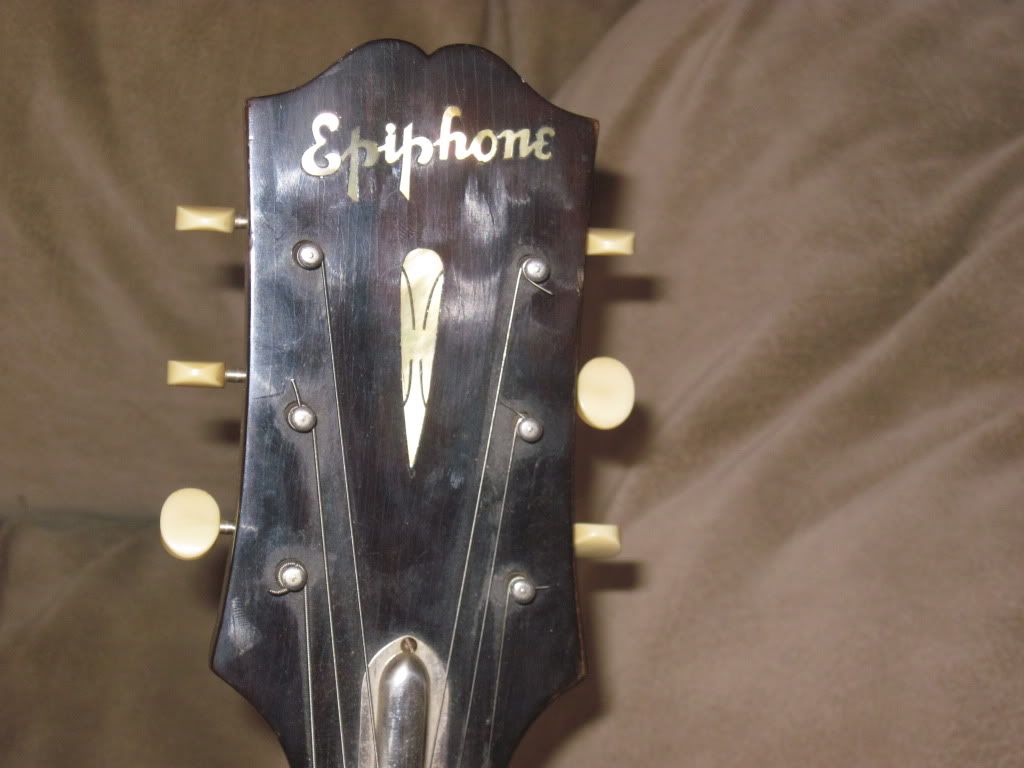
This Epiphone lived a sordid life.  It came to me covered in soot with two stickers and a name carved right in the top.  The seller was the nephew of the schizophrenic aunt that owned it (last).  The soot and stickers came up fairly easily with some Naptha and elbow grease.  The name, "Kelsi" is there to stay.  It features an Adirondack Spruce top, Walnut back and sides, and what looks like a very dark Rosewood fingerboard.  It has feaux tortoise shell binding and a very nice pearl inlay on the headstock. The tuners have been changed.  It still has 4 of the original Bakelite bridge pins.


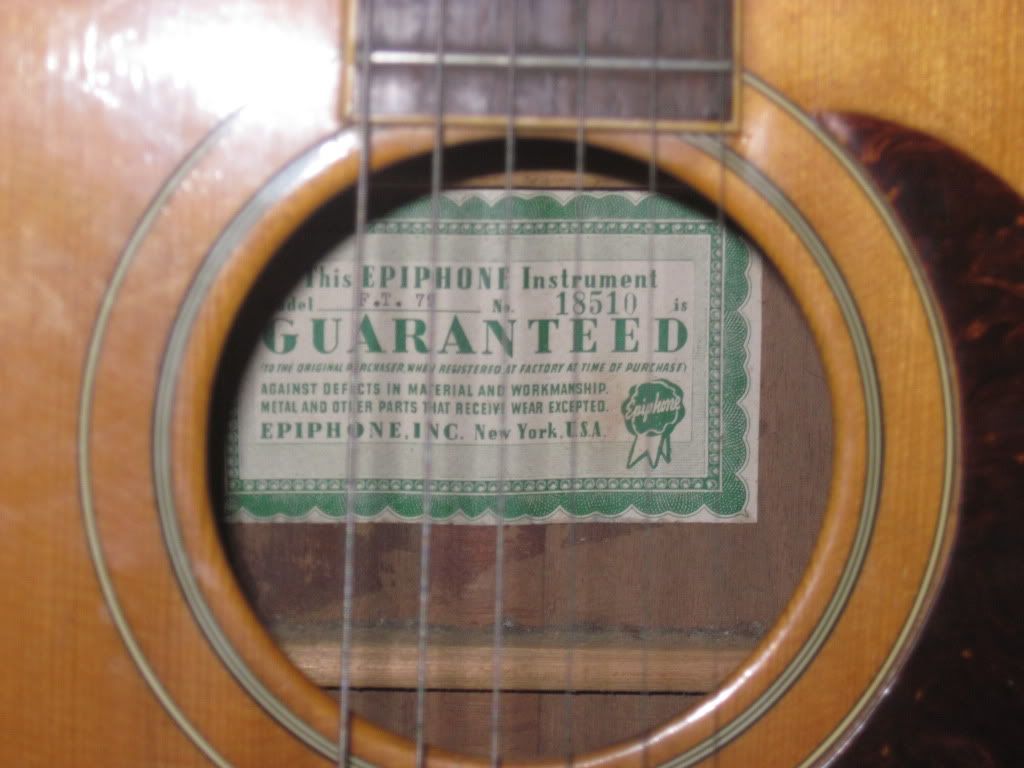
 The FT-50 started showing up in the 1941 but it says that they had Mahogany backs and sides.  It also shows a model FT-45 that had Walnut but also white binding.  This may have been pre-catalogue before they really nailed down what was what.  The label with the model number and serial number is badly torn so we may never know if this was a 45 or 50.


The Epiphone researcher that I spoke with on the forum said that since this was X braced and lacked the metal cover for Epiphone's "thrust rod"then this was probably pre-war.  His research indicates that the model line was reduced during the war and this was one that was cut.  They start reappearing a couple years later with serial numbers indicating 1945.  After that, the FT-50 was cut for good.  

He is currently compiling serial numbers, pictures and catalogues into a database so he can offer a better understanding of Epiphone's past.  Do you have a guitar like this?  Please email me and I will pass the information along to him.  


Pre-war Gibson Flat-top: 1933 Gibson L-00

0 comments
When I was back in school I was lucky enough to find a guy with an early 50s J-45 and a mid to late 30s L-00.  I knew the J-45 was for me so I quickly sold off the L-00.  Mistake.  The thing had been played and played and needed a neck reset but it felt so good.  Sounded even better.  When I got word of this one for sale I was ecstatic.


The L-00's first catalogue appearance was in 1932 but supposedly they had been making them since 1929.  They were Gibson's budget model flat-top guitar.  They were lightly built cheapies that were made out of whatever they had around at the time.  Consequently, the features tend to be a bit sporadic.  They all feature Adirondack Spruce tops and Mahogany back and sides.  The L-00 began as a 12 fret guitar but changed to 14 in '33.


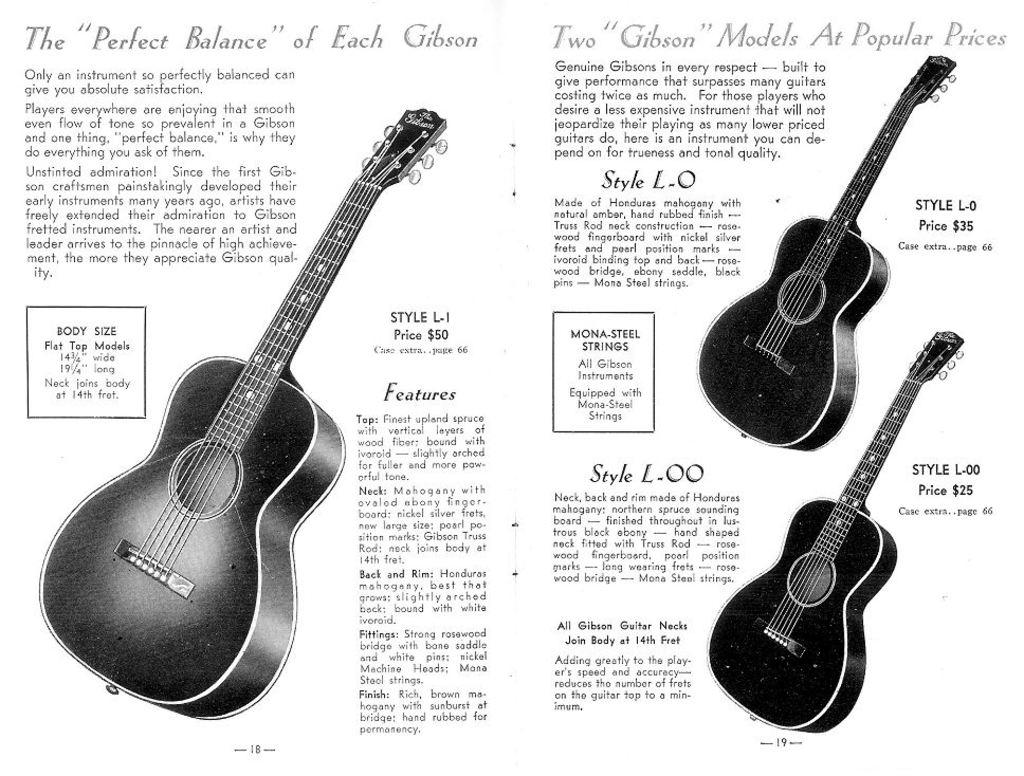
This advertisement is kind of interesting.  The 00 is on the lower left and just beside the body of the guitar is a short paragraph about how they are using 14 fret necks for more comfort and fret board access.  You may have noticed that none of the guitars picture have 14 fret necks.  This is typical of Gibson I guess, sigh.


This particular L-00 has a bit of a story attached to it.  Before I had seen it in person I saw a few pictures from the owner.  One showed the back of the headstock.  I could see a little impression in the lacquer that I recognized as a "Made In USA" stamp.  This was the marker that Gibson used on all export instruments that went outside of the US.  But I found this guitar in Tennessee??  I was a bit perplexed because almost all of the instruments that come my way are "finds" as in not from a dealer so how did this guy get this thing anyway?


After talking with the owner for a bit I got the story on how he came to own the guitar.  His uncle was housing a drifter for a while but the drifter had no way to pay him.  All he had was this guitar so he used it as payment.  The uncle had no use for the instrument so when his nephew showed an interest in music he gave it away.  That was a long time ago.  The owner had made his way to the states by way of Canada- the missing link in the story.


This guitar was easy to date as far as vintage Gibsons go.  I saw from the pictures that it had a small burst so I knew it was early to mid 30s.  The Factory Order Number was easy to read: 876 which appeared in the ledgers in 1933.


The neck on this old guitar has a wide 1 3/4" nut width with a fairly defined "V" shape that I find very comfortable.  I'm not sure why this shape has fallen out of vogue.  Fingerstyle blues just feels "right."  The neck is straight, frets properly dressed and the action is very comfortable.  I was looking for signs of a neck reset but I couldn't find them.  I believe that this is the original neck angle.  The saddle is kind of low but not as low as I would expect.  There is still a bit of room to come down if needed.


Some of the guitars from this era have some kind of ugly wood.  They have been seen with three piece tops and backs and off center seams.  Supposedly this was the reason for the small burst: most of the wood was not very aesthetically pleasing so the burst served to cover it up.  For some reason this guitar was spared of ugly wood.  The top is a nice 2 piece book matched Spruce and the back is a solid piece of close-to-quarter sawn Mahogany.  The sides are both quarter sawn.  I say close to quarter because it looks like this piece was very close to the center of the tree.  Here is what I mean by quarter sawn vs. flat sawn:


Quarter sawn wood has a higher strength to weight ratio but wastes more wood.  It is considered higher quality because of its features and scarcity.


The Tone Report:  Open, woody, Americana.  If you closed your eyes and just listened to it you might mistake it for a much larger guitar.  However, it is much different than a dreadnought.  It is more nuanced and sweet.  They are fantastic for fingerpicking.  The notes are clearly defined as well as balanced.  If you plan on strumming away your Nickleback chords then you may want to stay away from a 00.  The boom and sparkle probably won't be enough for you (as well as other obvious problems with that situation).


Dating this Gibson L-00 was relatively easy with the features and Factory Order Number.  The number is 867 which according to Spann's Guide to Gibson means 1933.  The other features were the small burst which was done in the early 30s and the solid kerfing on the interior of the guitar.  This is the lining that provides a solid glueing surface for the rims to the top and back.  This was mostly used in the late 20s and very early 30s.  There are some exceptions such as my friend's '32 L-00 that has standard cut pieces of Mahogany.  Here is a shot of the solid kerfing:


And the FON:


I'm really excited to have another L-00.  I really love fingerstyle blues and this is the guitar to have for that (except for maybe an L-1?).  I thought I liked the larger burst of my last one better but I've changed my mind.  The small burst is unique and the reasons behind it are representative of the times in which it was built.


The One(s) That Got Away

0 comments
Half the fun of vintage guitars are their history and the path they took to get to me.  Some of the guitars I have bought came with pictures of the original owners and stories about how all those scratches came to be (most have to do with the owner drinking a lot).  Sadly, the sellers are rarely the ones that owned the guitar for so long.


I'm not always successful in my pursuit of vintage flat-tops.  Sometimes it will get snagged by someone else or the owner decides not to sell.  Here are a few of the ones that got away.


I was really upset about this one.  This is a mid forties Gibson Southern Jumbo.  The seller didn't really know what he wanted for it but invited me to come take a look.  It was in Knoxville, TN which is quite a drive from the school I was attending in Tuscaloosa (Roll Tide).  Long drives have rarely gotten in the way of a me and a guitar so I was planning to leave after my last class that day.  I called the seller back after class let out and it was sold.

This was the only picture I had of it but it was all I needed to know this was a real banner Southern Jumbo.  The split parallelogram inlays on the neck told me it was a SJ and not a J-45.  The belly down bridge combined with the lack of binding on the neck told me that this was most likely wartime (meaning is has the desirable banner on the headstock).  I should have skipped class!!


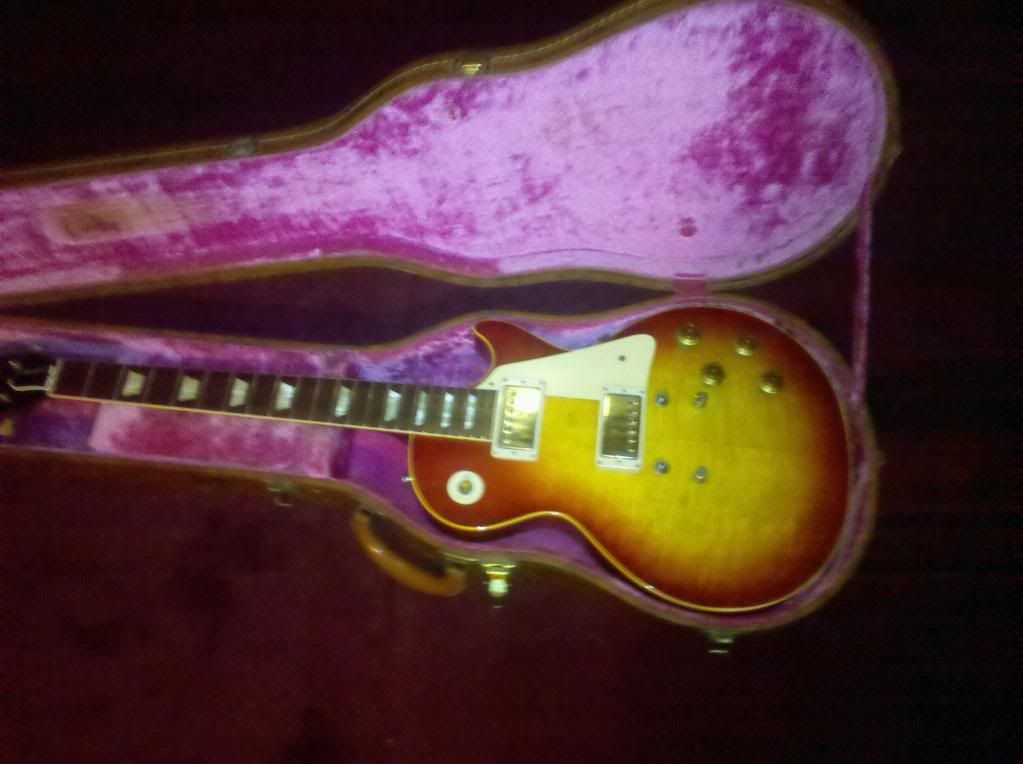
 Yes.  You are seeing this correctly.  This is a 1958 Gibson Les Paul with the original case.  This one was in northern Florida and I couldn't believe my eyes.  Most of the pictures you see of these floating around without a price tag of 200k+ are fakes.  This one was not.  I spoke with the owner and she said that she had already sold it by the time I even saw the ad.  She was working on taking the ad down and was having trouble.  Figures.


There was a musician who passed away in Cullman, AL in 2008.  His family was ready to sell off his collection of 10 instruments but they didn't know anything about any of them.  I had found a picture of this guy online that showed him holding a late 30s Gibson J-35:


I was a bit disappointed when I showed up to take a look at the collection.  It was pretty much all junk.  There was no J-35 or anything close.  There was a jacked up parts telecaster, a squire strat, a plywood parlor guitar.  That was the best of the lot and I was not really interested.  I thanked old lady that survived the man and on my way out the door she handed me this picture:


I turned to her and asked politely, "Where is this guitar?  We need to find it."  She didn't know anything about it.  Supposedly there was a blackface deluxe too but it wasn't there.  I figured that all this stuff had been picked over long ago and I was too late.  WRONG.  I was too ill-informed!  A year or two later I found this picture that I had taken:


With the help of my buddy Keith we came to the conclusion that this is that blackguard tele!!!  But how, you ask?  The neck is changed, the pickguard, hardware, all changed.   Take a look at the screws.  There are 5 old screws and one new one.  The holes are in the right place for a black guard Telecaster.  The body has been poorly refinished but I would be willing to bet that this was that telecaster- right before my eyes and I missed it!  Who knows what parts of the electronics were original.  Maybe none, maybe all.  I called the lady back and she said she had sold it a while back.  Still kicking myself.  The moment that you think you know what you are doing is when you find out that you really don't!


I would be impressed if you knew what this was just from the picture.  I sure didn't.  All I knew was that this was not your typical Asian made Epiphone.  This was a pre-Gibson buyout Epiphone flat top which have been aptly described as "rare as hen's teeth."  After a bit of research I found that this was the presursor to the Gibson-made Epiphone Texan.  This was a 1943 Epiphone F.T.-79.  Good luck finding another one of these at any price.


Having little knowledge of Epiphone flat-tops, I posted this picture on the Gibson guitar forum that I am a part of.   There was a guy on there that is a fellow vintage guitar guy that told me what it was and how uncommon they really are.  They are especially uncommon in this good of shape!


A buddy of mine agreed to come with me on the road trip but I decided to call the seller one more time before we left.  He had just sold it to a buyer in California.  I posted on the forum on how it had sold and the guys were giving their condolences when all of the sudden there was a new member on the forum.  It was the buyer in California!  He was a very cool guy and certainly deserved this fine, rare bird. 


Of course, there were a few scores that I didn't expect.  One of them was this little number:


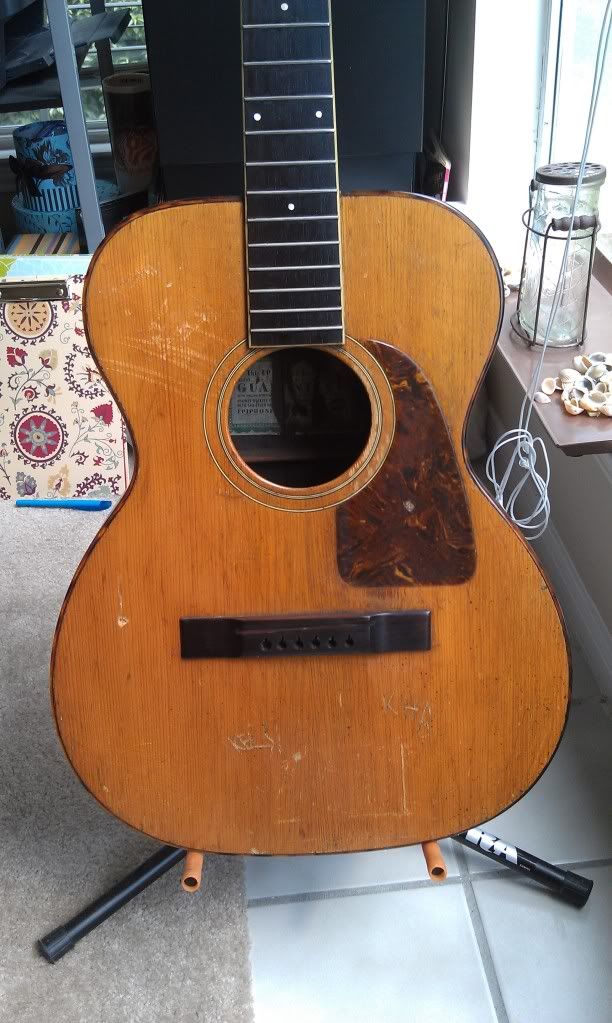
This Epiphone is from roughly the same time period (WWII).  It sort of fell into my lap.  It had been through a house fire and ownership by a someone who decided to carve her name into the top.  She apparently like stickers and glue as well.  Strangely enough her name was "Kelsey".  This happens to be my wife's first name.  Strange how that works out.

From the Bailey Brothers' VAULT: 1960 Gibson ES-355

0 comments
You have heard of it happening.  Most guitar shops will have somewhere that they keep the "good stuff."  You are standing in your favorite local guitar shop.  You overhear another customer say something like "have you gotten in anything good lately?" while he is standing next to Custom Shop Les Pauls, Gretsch White Falcons or CS black guard Teles and what not.  As if those were not good.


This customer is talking about the stuff in the back room, upstairs, or maybe even right behind the counter and out of sight of the average dude walking in to for the sole reason of playing "Stairway To Heaven" for everyone to hear.


You might be asking yourself "what do they have back there?"  This is one of the things they might have.  But probably not.


1960 Gibson ES-355 with the original brown Lifton case.


The ES-355 was officially introduced in 1959 but supposedly a couple were shipped in '58.  It is constructed of a laminated Maple body with a solid block down the center and a neck of their standard, Mahogany.  It also features 2 humbucking pickups- just like a 335.  Where it differs from the 35 is in the fretboard (Ebony instead of Rosewood) and all that sexy bling, binding and gold hardware.  Oh, and the factory Grover tuners (the good ones) and Bisgby tailpiece.


This example made it out of the factory with some cool features.  The serial number says that it was manufactured in 1960 so it must have been early in 1960 because it has the longer pickguard as well as 19 frets to the body (instead of 20).  In 1960 they shortened the pickguard so that it would not go past the bridge pickup.


The best part of these 355s is that they featured gold plated hardware.  PAF pickups were made in nickel and gold finishes.  Gibson used nickel hardware on most of their guitars and saved the gold hardware for the really fancy ones.  As a result, the gold covered PAFs lasted well into the early 60s.  This one features PAFs.  They sound damn good too.


Most of the 355s came with a feature that Gibson called "Varitone."  This was a switchable notch filter that cut certain frequencies using a range of different capacitors.  Many players/collectors think that Varitone "kills tone" and therefore it makes a vintage 355 less valuable.  I haven't messed around with a Varitone switch enough to form my own opinion but I do like the simplicity of not having it.  This guitar was spared of that switch.


Here is a shot of a real M-69 pickup ring.  You may be wondering to yourself why this little piece of plastic matters at all.  They are commonly faked and sold for a good bit of money.  If you buy one of those $200k+ '59 Les Pauls you are probably going to want to have all original parts.  But, these pickup rings were prone to crack and break.  Many were replaced throughout the years.  Now you have a market for  little pieces of plastic that apparently go for $500 or so.  Go figure.


This guitar had a little surprise for us when we decided to take out the neck pickup to check out the PAF.  We removed the pickuard in order to get a good look at the PAF (the bridge pickup's lead was too short!).  We had been discussing what kind of person would have bought this instrument new in 1960.  I was thinking a big band guy or a jazz guitarist.  Probably not the standard country western kind of thing that was popular at the time.


When we set the pickguard aside we noticed a name stamped on the underside of the pickguard.  Max Williamson.  I couldn't find anything about him online but maybe you have some information about him?  Here's to you, Max, and your good taste in fine instruments.


This guitar is available from Bailey Brothers Music Company in Birmingham, AL.  Thanks to Clay and Keith for letting me snap a couple of quick pictures of it.

TVG

Just a good, southern late 50s Gibson J-45.. and a quick video of my 1964 Gibson B-25

0 comments
Carl posted about this guitar in the comments section of the post of my 1953 J-45:


I love getting these emails.  You never know what you are going to come across.  This one has 20 frets to the body, larger pickguard and non-adjustable bridge.  That would put it between 1955 and 1961 (about).  I don't have a picture of the FON so I can't nail down the year.  I have an up close picture of the fretboard and it looks to be flat-sawn Rosewood instead of quarter-sawn.  My 1960 Gibson Melody Maker has that same kind of ugly flat sawn Rosewood.  Could be 1960?

This was Carl's dad's guitar that was bought second hand from an old lady who had listed in the local paper.  I won't tell you how much he paid but it was less than 3 digits.  Good deal!!  Carl's dad never learned to play so it hasn't seen much playing time.  Hold on to that one, Carl!!


On a separate note, here is a video I took today of a Gibson I am currently selling on eBay:


Subscribe to my YouTube channel if you want to see some more videos of vintage guitars!  I'll be uploading some videos of my J-45s and other guit-fiddles soon (hopefully).


This is a 1964 Gibson B-25.  Despite the total refinish, it really is a nice guitar.  I haven't played many Gibsons with ADJ bridges and I had always been told how bad they sound.  Maybe my expectations were low but I really like the way it sounds.  The high "e" string really rings true and loud.  It still has that little percussive "thump" in the body when you strike a string.

I am also very fond of this tune called "Murder In the City" by the Avett Brothers.  I did you the favor of not singing it in the video.  You're welcome.


Why this is probably not a 1961 Gibson ES-125- what do you think?

0 comments
Gibson is consistent in only one thing: inconsistency.  As a result it can be very difficult to date some vintage Gibsons.  When I say Gibson here, I mean Kalamazoo era Gibson (up until about 1977 give or take).  Dating vintage Gibsons is sometimes an art rather than a science.  Take for instance this guitar from the Music City Pickers out of Nashville, TN.  I have met these guys and they are top notch.  They always have great guitars coming and going and it is a joy to see.  That being said, this one may deserve a second opinion: "1961 ES-125" at Music City Pickers.

Silver covered P-90s?

Straight sides, script logo

Why is this not an ES-125??  We know that this is at least something odd right off the bat because of the combination of the headstock and the P-90s.  The headstock pictured has straight sides and a pearl script logo (as opposed to block logo- see picture below).  This headstock was discontinued in 1941 and was never used again in the Kalamazoo factory.  As per the write up on their website, it also have a V shaped neck.  This was not popular in the 60s.  The P-90 pickups it has were not produced until 1946.  The math does't add up.


This is what the headstock should look like.  See the sides how they are bent in?  See the block logo?

Gibson is known for inconsistency so why couldn't this have been a old neck laying around that was put on a 125 body?  It could have been, but I doubt it.  Here is why.


This picture shows the top of the instrument.  See those vertical lines?  Classic evidence of a carved Spruce top.  So what did ES-125s have?
Here is the best shot I can come up with.  ES-125s all had laminated Maple tops.  This is cheaper to make.  Why would you make a student model guitar out of expensive solid Spruce?  Also, electric guitars with solid Spruce tops tend to feed back more. This guitar does not show nice straight vertical lines.  That is because it is an ES-125 and they are made of Maple- not Spruce.


We know the neck is not from 1961.  It looks bad for the body to be for an ES-125.  The Pickers said that they think that it was original and from the factory in 1961 because the body and the neck both have the same serial number.  Here is a shot of that serial number:


The number is "613."  This one is very strange and also not correct for 1961.  It needs at least one more digit to be in the ballpark.  

This picture gives us another piece of evidence- the Grover Sta-Tite tuners.  These were used in the 30s but not in the 60s.  If  a random neck was found in the factory left over from the 30s it would not have had tuners.  It would have been unfinished.  Therefore probably no tuners.

So what is this thing?

In my opinion, this guitar was produced in the mid to late 30s by Gibson in their Kalamazoo, MI. factory.   By the time the 60s came around this was just an old guitar.  There was no real value to "vintage" guitars.  Few people cared about vintage.  The first vintage guitar stores started in the late 70s (Gruhn).  After 30 years of playing this thing looked kind of rough compared to the shiny new electrics that Gibson was producing.  The owner sent the guitar back to the factory where the finish was stripped, body was drilled for modern electronics then a new finish was applied.  The electronics were reinstalled and the guitar was sent back to its owner.

We can even make a good guess as to when the guitar was rebuilt/refinished.  The Picker's advertisement for this guitar says that the potentiometers date to 1967.  And the truth shall set you free!  In my opinion, this is a mid to late thirties Gibson acoustic archtop that was sent back to the factory in 1967/8 and refinished/fitted with modern electronics.

But- Joe Glaser (Glaser Instruments), Todd Money (Gibson repair) and Gibson Customer Service all agree that this is a 1961!  Joe Glaser is unrivaled in what he does- repair.  Todd Money is right up there with Joe (in repair).  Gibson Customer Service is well, they try.  My point is that these guys are great but why should they be experts in dating Gibsons?  Why should they care about someone else's guitar when they have thousands of others they need to attend to?

Dating vintage Gibson guitars is often an art.  It is open for discussion.  There are things in this article that are potentially incorrect.  I welcome your opinions.  

TVG