1967 Gibson ES-330

0 comments
No, this is not the little brother of your ES-335, although the general look at model designation might lead you to think so.  The ES-330 was the next step after the ES-225 and was not supposed to be a more accessible 335.  The 330 differs from the 335 in three main ways: fully hollow instead of semi, P-90 pickups instead of humbuckers, and the neck meets at the 16th fret instead of the 19th.


This ES-330 came from a gentlemen in California who had bought it new in '68.  The serial started with a 0 and combined with the other features indicated a manufacture date of late '67.  This guitar was spared of the gigging lifestyle and was played lightly throughout its years.  It was brought along with the owner while he was in the Navy.  The guitar accompanied him on the USS Hornet to the Apollo 11 splashdown.  The original owner was a communications officer and was chosen to go on the trip.


Undervalued in the vintage guitar market

In my opinion, the ES-330 is very undervalued in the vintage guitar marketplace.  A '59 Gibson ES-335 retails around 30 grand while a similar condition ES-330 would retail for about 6 grand.  It doesn't seem fair does it!  I think the reasons for the value differences are:

1.  More prone to feedback at high volume since it is fully hollow and has P-90s
2.  Less celebrity appeal
3.  Outdated design when it came out compared to the center block semi-hollow 335

This model is more prone to feedback at high stage volumes because of the fully hollow design.  This was more of an issue in the 60s with the PA technology that was available.  A small club would rely on large amplifiers cranked way up instead of micing a smaller amp through the PA.  With modern technology this is less of an issue but still something to consider.  Since the stage volumes at my couch are much lower I don't have this problem.  In fact, the fully hollow design is one reason I love this guitar so much.  It is very light and comfortable on the couch.  Even the acoustic tone is to die for.  The P-90s are all I'll ever need to drive my tube radio/guitar amp conversion to the brink of blues bliss.


TVG


Mahogany Topped Blues Guitar: 1930 Epiphone Model 0

0 comments
Pre-Gibson Epiphones have weighed heavy on my mind lately.  I bought this one off the Craigslist in my parent's hometown of Galatin, TN from a bluegrasser.  He didn't have much use for a guitar like this.  I didn't even haggle!


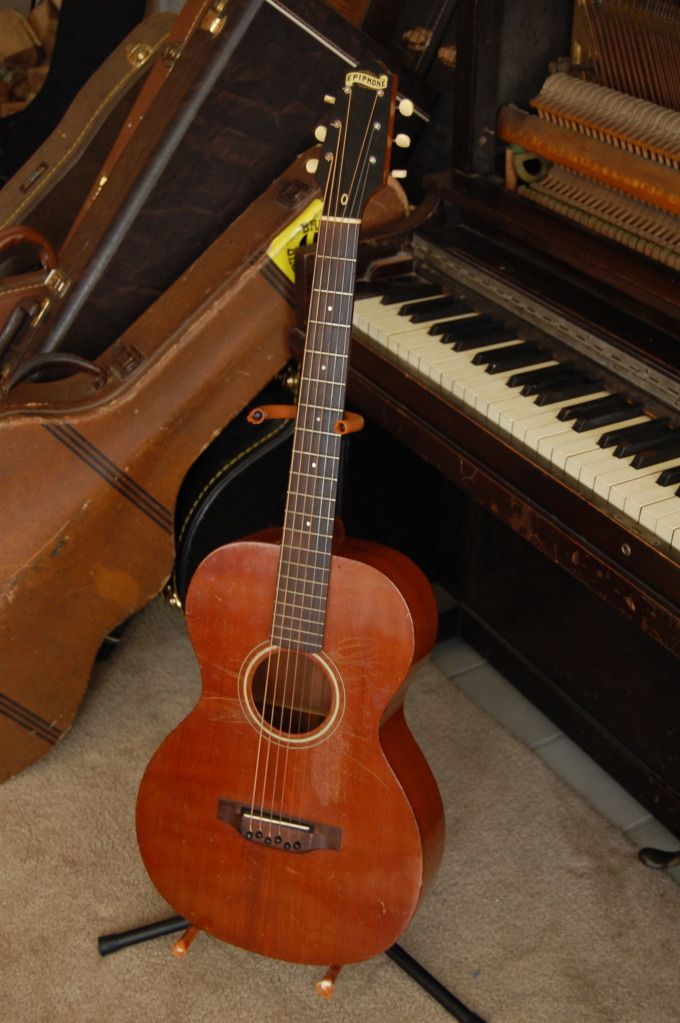
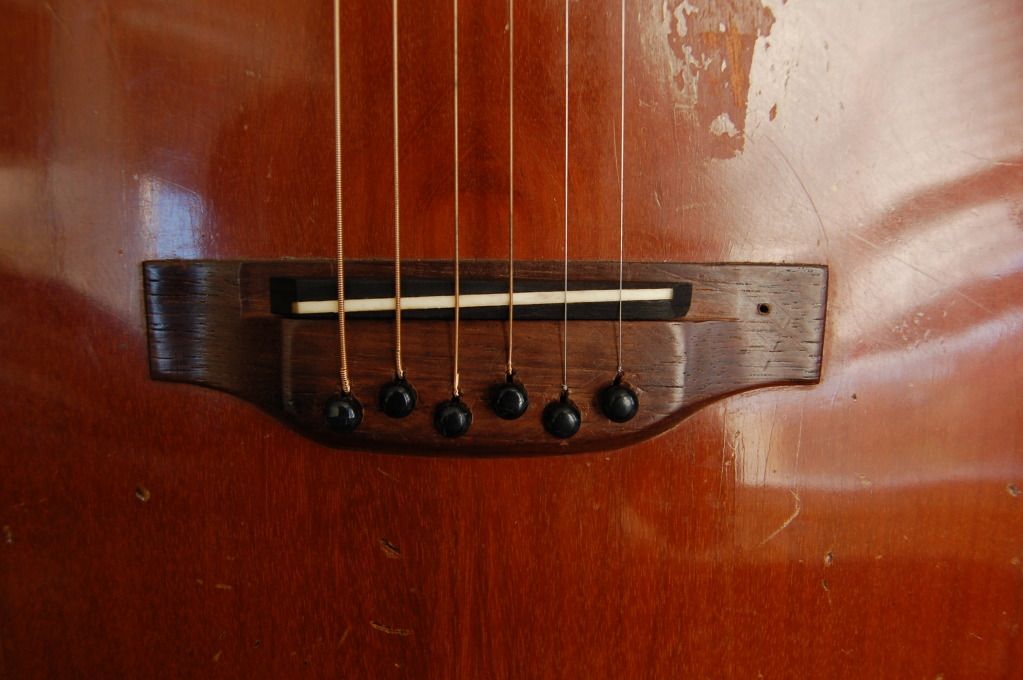
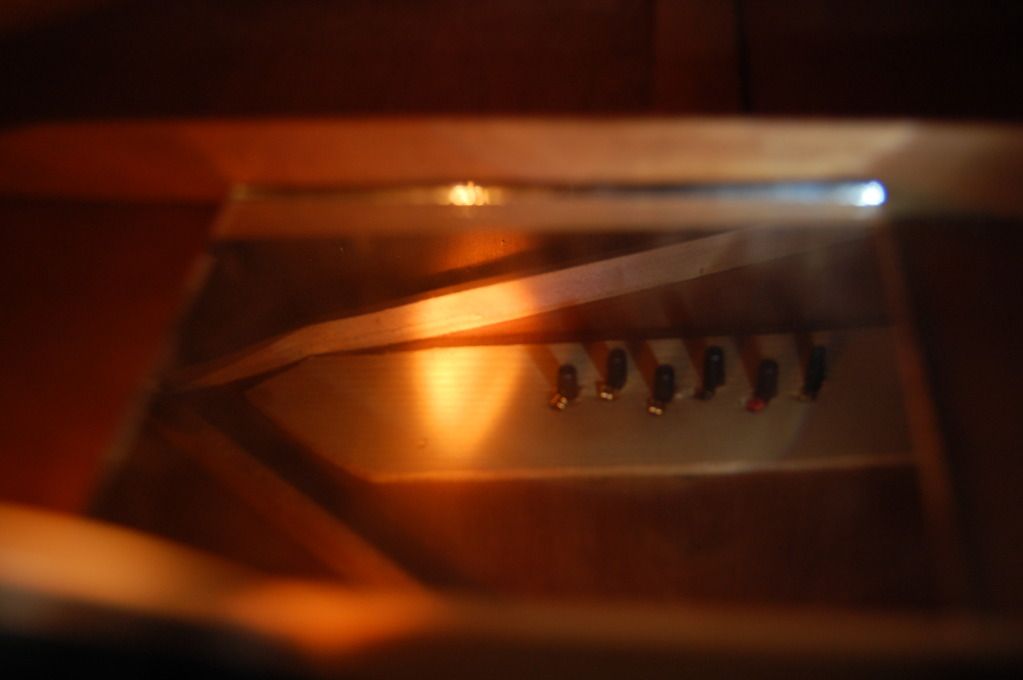
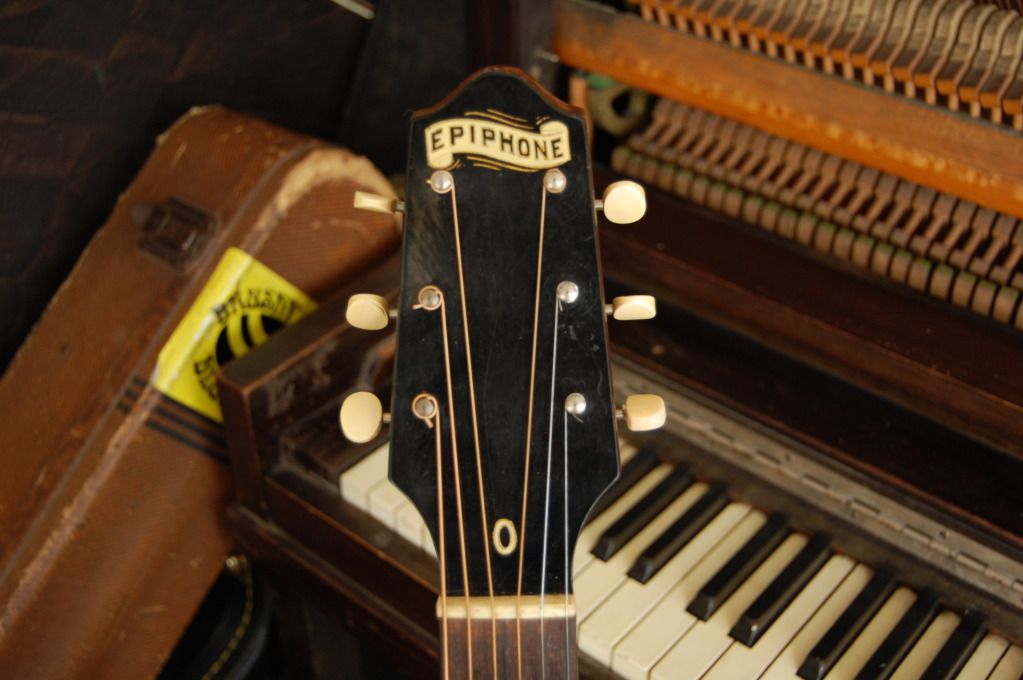
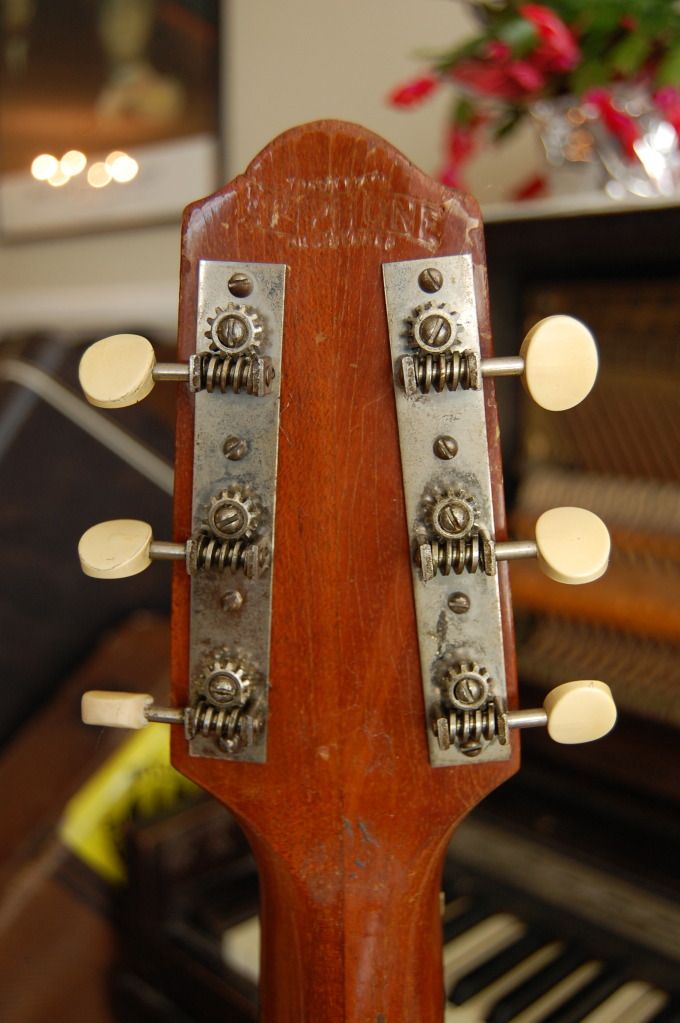
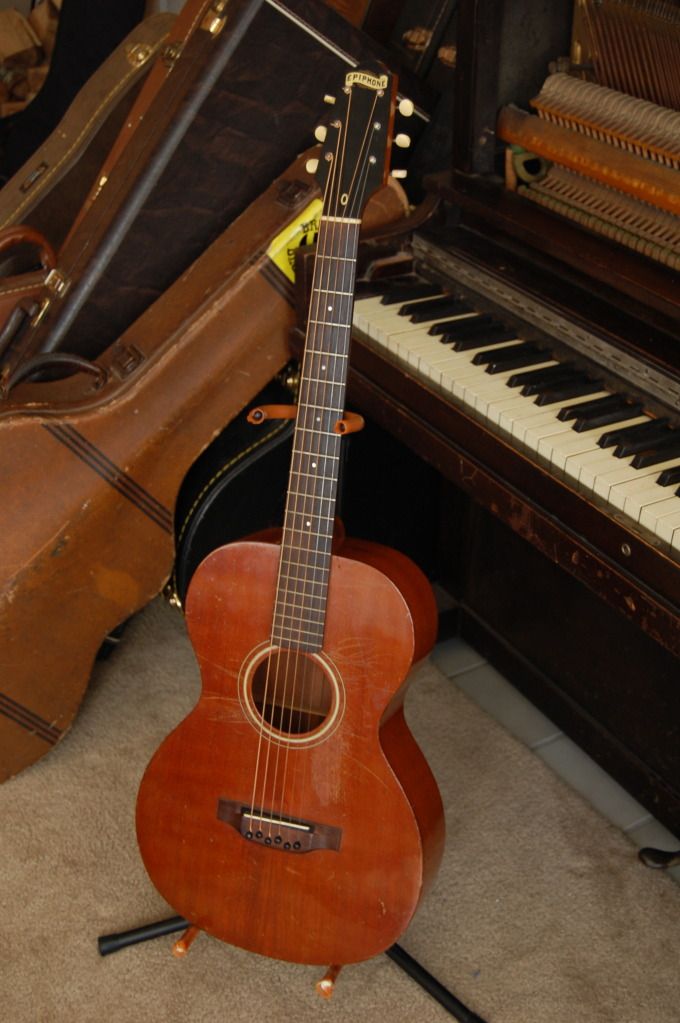
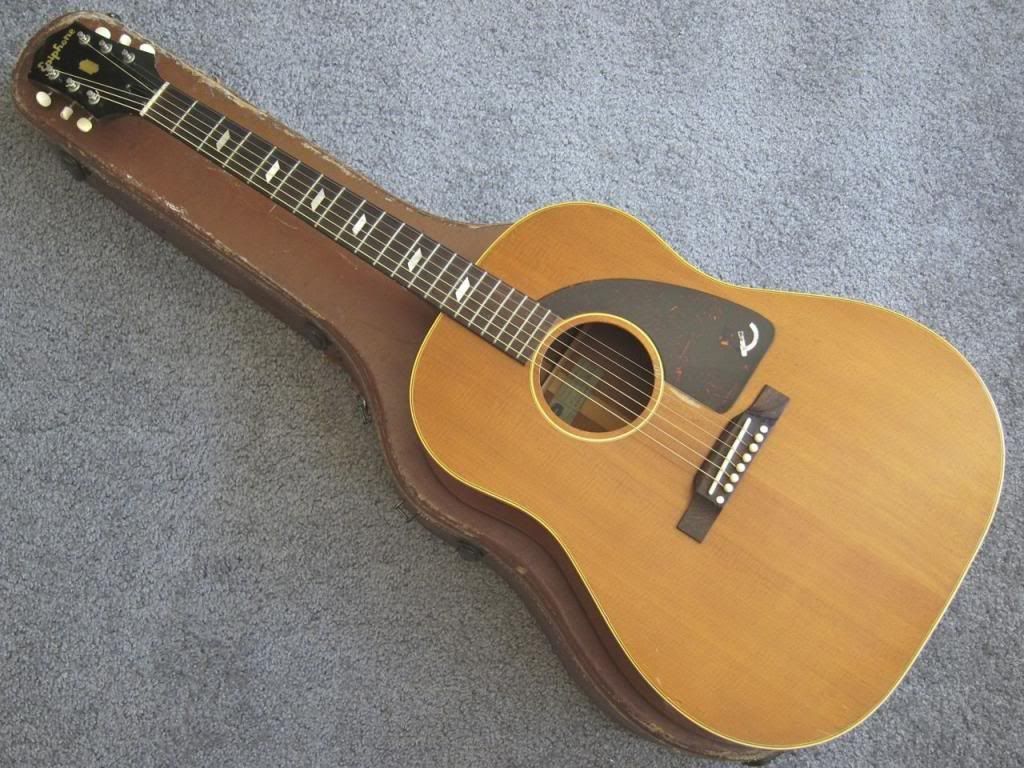
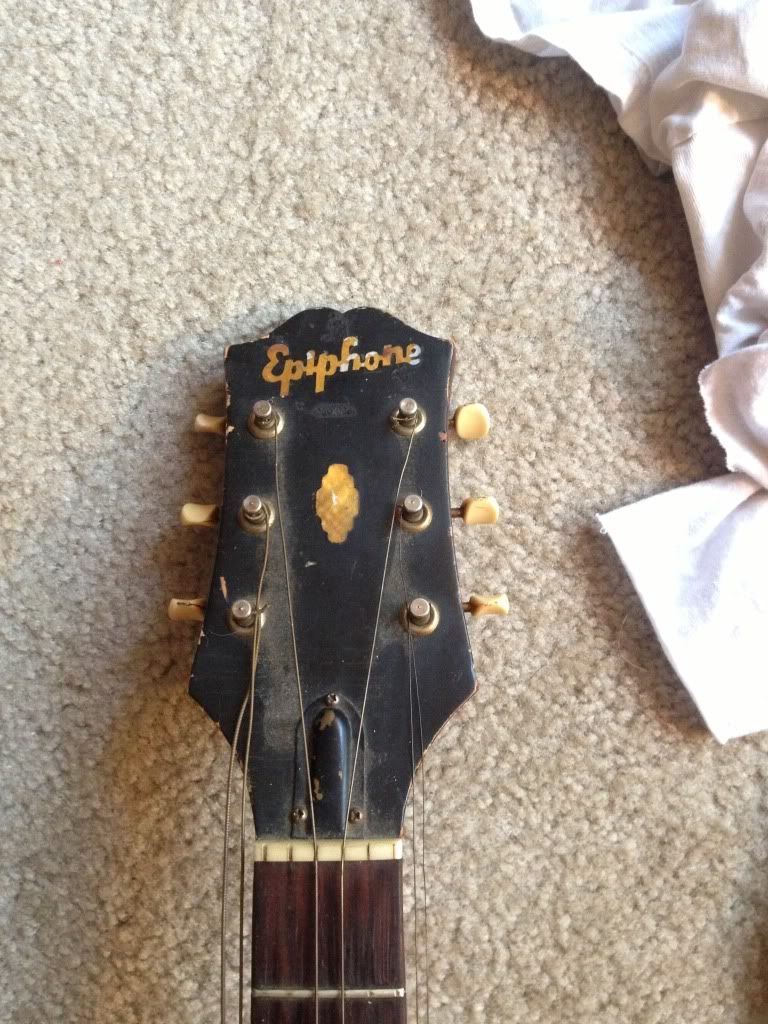
This is a C. 1930 Epiphone Model 0.  If it is the first one that you have seen then that makes two of us.  It is constructed of solid Mahogany throughout and features X-bracing with a single tone bar, 13 frets to the body and a deep V shaped neck.  It has a light build and is very resonant.  The bridge design is interesting but works very well.  It makes sense to be able to move the saddle around to adjust for intonation.


Dating an early Epiphone flat-top

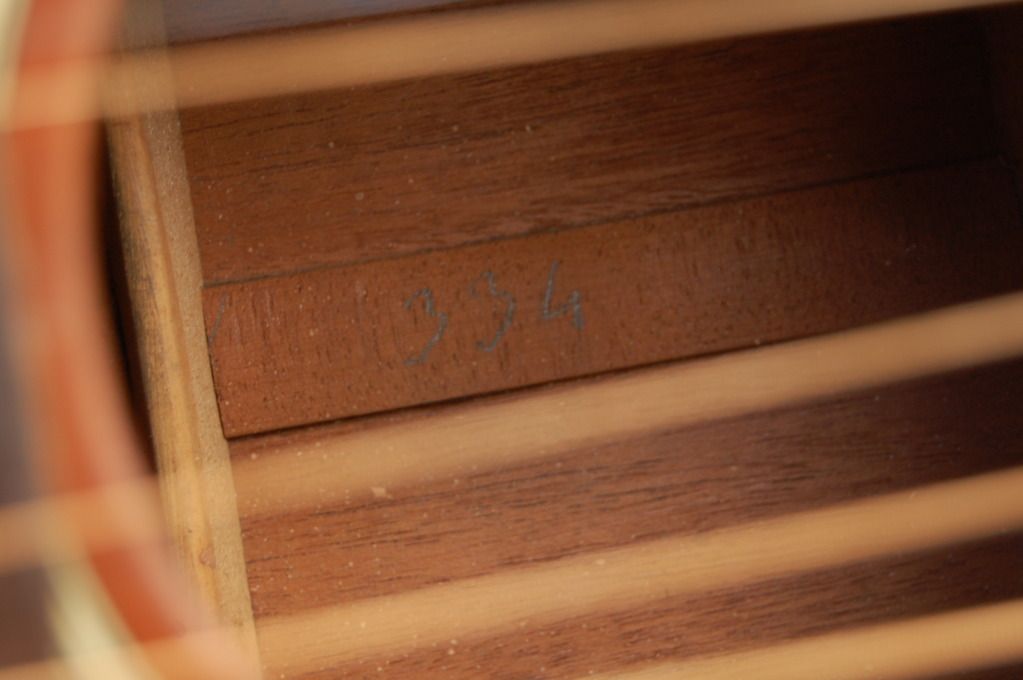
...can be difficult.  To be honest, I don't know the exact build year but I have had some help narrowing it down.  It doesn't have a label but does have a hand written serial number.  There are a pair of fellers that are cataloging pre-Gibson Epiphone flat-tops and working on a good way to date them.  They've contacted me regarding a couple of other Epis that I've had and I am excited to hear that they are working on publishing their findings.  

It seems like only super guitar nerds (like myself) end up liking these guitars.  I think that it is a shame that they aren't held in high regard by the general guitar public because they are of very high quality and rarity.  Maybe the information gathered by these Epi fellows will spark some well deserved interest in New York and Philadelphia (pre-Gibson) Epiphones.


How does this guitar record?

I have a friend who is working on his first full length album.  He has a 1951 Gibson J-50 that I am fond of and is kind enough to bring it over every once in a while to drink beer and play the blues.  This Epiphone is a good sidekick for his recording because it can do the fingerpicking (without picks) much better than a larger guitar.  Since you don't have to use picks to get great tone from her then you also don't get the pick slap or click.


Question for Twitter: What is the best guitar?

0 comments

Maybe that wasn't the best way I could have worded that.  How about:


1. What guitar have you not been able to get off of your mind?
2. If any guitar could suddenly appear in your hands, what would it be?

Both of those questions should be qualified with "right now."

It may have looked like I was trying to start a twitter fight about brands, models, etc. but that was not my intent.  The question stemmed from a discussion I had with a friend over guitars a couple of weeks ago.  He recently started working at Gibson 5 star dealer and so began his dream of a Gibson J-200 True Vintage.  It was the pinnacle of tone and nothing else would do (paraphrased).  This was after he was really digging the weird 1930 Epiphone Model 0 I loaned him to record his debut album (Pete's Debut Album).  I had felt the same way about that guitar before as well.  There is still a soft spot in my heart for the huge tone that comes from a lightly picked fingerstyle blues on the old Epiphone.


In My Opinion

the best guitar is always the next guitar and I think that Pete would say the same thing.  There is nothing like the anticipation of an old guitar coming in the mail.  What will it sound like?  What weird features will it have that I didn't see in the pictures?

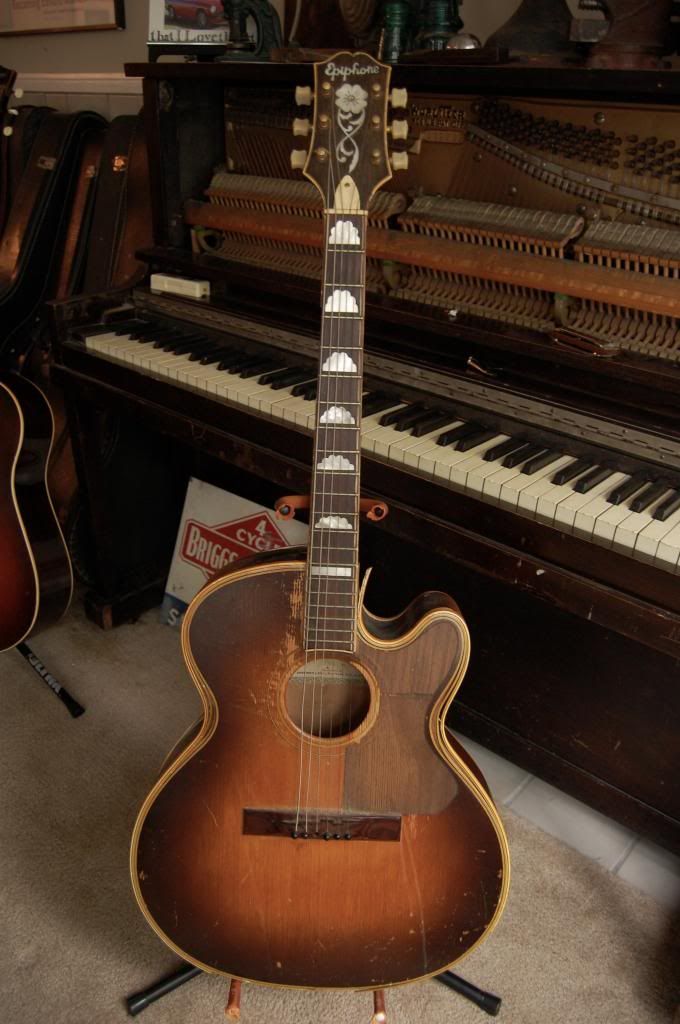
I recently bought a 1954 Epiphone FT-210 Deluxe Cutaway from a fellow in NY.  I had only seen pictures of these and could not wait to have it in my hands.  I knew that it needed work but I just didn't care.  It was the pinnacle of vintage guitars for the three and a half days that UPS had it, at least in my mind.  When it arrived I was ecstatic.  Among guitar forum geeks (such as myself) this is called an NGD or New Guitar Day.

What did it sound like?  Terrible at first, I'll admit.  I was so in love with it that I couldn't put it down.  After about two days of playing it, it really opened up and the tone was unique.  I love it now.

What weird features did it have?  It was ladder braced and had a weird compensated rosewood bridge/saddle.


The next guitar?

The Epiphone is still extremely cool only a week later but I've already got my sights set on another.  There is an eBay auction ending tomorrow on a Kalamazoo KG-12 with rare Maple back and sides.  It is a sickness!  The forum term for this sickness is GAS- Guitar Acquisition Syndrome.


"Buyout" Period Epiphone Texans: Parts Guitars?

0 comments
By the dawn of the 1950s, the Epiphone company was struggling with problems in both the accounting and labor departments.  The company's product line hadn't kept up with the changing trends in guitars such as the new solid body electric (Gibson's Les Paul model?).  It had moved the production facilities from New York to Philadelphia in an attempt to avoid a problem with the labor union.  By 1957, the company's doom seemed imminent which forced its sale to their biggest competitor, Gibson, for the sum total of only $20,000.


American made Epiphone guitars (both during and before the Gibson buyout) are fantastic instruments.  Their relative obscurity and high standard of quality is a recipe for a very inspiring guitar.  I recently came across an immediate post-buyout Texan that has me intrigued (1959 Epiphone Texan with strange features).  The description states:

"Gibson FON on the neck block indicating 1952 manufacture, starts with a "Z"; solid, un-kerfed linings (no one has ever seen this on any modern Gibson instrument); the word GUITAR rubber-stamped on the inside of the back, between the neck block and the first back brace; black paint on the heel underneath the clear coat, which has been seen many times on various Gibsons in the 1960's."

 1952?

The body is easily dated using Gibson's backwards letter prefix used from 1952-1961.  They started with Z in '52 and ended with Q in '61.  These letters were stamped on the interior neck block and were proceeded by a batch number (usually 4 digits) then a unique rack number (the Xth number in that rack).  This guitar received a Z indicating that it was made in 1952.

Easy, right?  Not quite.  The description also states that this guitar has solid lining (as opposed to kerfed).  Lining is what gives the body's joints (top to rims and rims to back) a solid gluing surface.  Usually this lining is kerfed, meaning that it has small cuts vertically to make it bend without needed to be soaked in hot water and bent over a hot pipe.

Kerfed Lining

Solid Lining

Gibson phased out solid lining in favor of the kerfed style from 1933-1934.  I have never seen any flat-top Gibson guitar that used solid lining after 1934.  I would venture to say that Gibson did not build guitars using this kind of lining after 1934.  This is my opinion based on my experience so feel free to prove me wrong.  Edit:  I just acquired one of these guitars.  The lining is made of laminated Poplar.  The only other place I have seen this is on my 1954 Epiphone FT-210 Deluxe Cutaway.  I'm assuming Gibson got leftover strips of lining from Epiphone and used it?  Not sure.

(Edit)  At least Gibson phased out the use of solid lining made of Mahogany in 1934.  After acquiring a buyout period Texan I determined that this "solid lining" wasn't really solid.  In fact, it is made of laminated strips of what looks like Poplar.  The only other place I have seen this is on my 1954 Epiphone FT-210 Deluxe Cutaway.  Perhaps Gibson also acquired strips of unused lining from Epiphone as well as necks?

Gibson "J" body surplus

In the early 50s Gibson was selling some of their jumbo bodies to National.  National would manufacture a neck and bolt it on to a Gibson body calling it the National 1155.  These are great guitars for the vintage player on a budget but I am told that the necks are a bit difficult to get used to.  You'll have to decide that for yourself.


Since National ordered a bunch of J bodies from Gibson, they had more bodies than necks.  When a bunch of Epiphone necks showed up at Gibson's doorstep in 1957, the answer was simple.  They went downstairs to the parts basement and grabbed a bunch of J sized bodies.  That is how I would explain this guitar having a Z (1952) factory order number.

(Edit) .....but I'd be wrong.  After acquiring one of these, the tops were definitely made post 1955 judging by the bracing.  My next theory would be that Gibson needed finished bodies to sell to National.  Since National was bolting on the necks, Gibson needed bodies with uncut neck blocks (instead of cut for a dovetail joint).

When the Epiphone necks showed up in 1958 they were already cut for a dovetail joint.  Since the dovetail extension on the neck and the neck block were cut by two different manufacturers they differed to the point that they wouldn't fit right.  Gibson would need to use a body with an uncut neck block and cut it to fit the Epiphone neck.


So you have one of these short headstock Texans?  Send me some shots of yours.  Here is @guitaristo's (Instagram) 1958 Epiphone Texan that has recently been sold.  The serial on the blue label was an A-XXX number but he can't remember what was on the neck block.  I wonder if it was an earlier FON?


Why do these features even matter?

Although these Texans look like weird J-45s they are certainly not.  The main difference in a standard Texan and J-45 is the scale length.  Epiphone was using a 25.5" scale length so the necks were manufactured to this spec.  Gibson's traditional scale length and that of the J-45 is 24.75".  This alone makes for a tone that is probably louder and more piano-like than a J-45.  It also doesn't bend strings as well and may wear out your fingers a bit quicker.

This '58 Texan has more than just the scale length to set it apart from a J-45.  The body was probably manufactured in '52 which means that it differs from a '57 by the bracing.  The pre-'55 J bodies were made with scalloped braces while the post-'55s had straight braces.
(Edit):  Wrong again, TVG.  While the FON prefix was Y, the tops were definitely made in the late 50s.  The bracing is short and straight (unscalloped).

These buyout era features make for an interesting guitar.  Mine needs some braces reglued before it is playable again.  It was covered in 50 years of sweat and tar until I hit it with some Virtuoso cleaner.  Here are some shots of the clean up.


TVG


A Banner Gibson J-45 Cloaked in Rare Flame Maple

0 comments


The word "rare" gets tossed around a lot on Craigslist and eBay so I contemplated not using it in the title.  In my opinion, this one deserves it.  This is a 1943 Gibson J-45 made from a laminated flame Maple back, solid flame Maple rims and a bear claw Spruce top.  Well, at least one half of the top has some bear claw figure but it's mostly obscured by the sunburst.


Quality wood was difficult to come by during the war, especially Adirondack Spruce planks wide enough for tops.  The Gibson company had slimmed their product line down to just 6 models, only two of which were archtop style that commonly used Maple.  Because of the shortage of quality materials Gibson started using parts of guitars from the basement to piece a guitar together.  This is one of those examples.


The Maple is stained dark in an attempt to make it blend better with the Mahogany backed J-45s.  The neck on this guitar is a 5 piece Maple-Walnut lamination, also intended for use on an archtop guitar.  The bear claw figure on the top is very rare for a Gibson.  Undoubtedly this piece of Adirondack Spruce was originally tossed aside until there were no more unfigured Spruce planks left.  The bear claw figure is mostly covered by the burst but is still easily seen if you look close.  Gibson considered this figure a lower grade than the standard straight-grained Spruce.


This guitar was owned by Gladys Atkins from Porterville, Ca until her death about a decade ago.  It is unknown how it received such a great knock as to cause the headstock to break, or who did the repair.  All I know is that it is a very solid repair but boy, is it ugly!  I haven't decided what I want to do with the front.  I can't bring myself to refinish the entire front and lose the original banner.  I also don't feel confident that the lower half could be finished and blended very well with the top.  I intend to leave it as is for now at least.


The Tone

In short: loud, articulate and very unlike a typical J-45.  The Gibson J-45 model is know in part for its low-end growl and break up.  They aren't muddy like a D-28 can get in the low end.  They have this distinct overdriven low end.  This one substitutes the standard J-45 growl for articulation, note separation and sparkly top end.

This Maple J-45 still retains two tonal aspects common of the Mahogany backed J-45s.  The first is a very balanced mid-range.  It responds well across the figurative EQ curve and would record well.  The other is the Gibson thump, but it is different than the Mahogany thump.  The thump doesn't sound as bass heavy but is still pronounced.  


Gibson used solid rims on J-45s until about 1952.  At this time they started using laminated wood and discontinued using cloth side supports to protect against splitting.  Laminated wood isn't prone to splitting at the grain lines because they layer it with the grain running 90 degrees to the other layers.  I'm partial to solid rims myself, especially when they have nice flamey figure.


Vine?

I am attempting to use the new Vine app to show off the tone of these instruments.  I have neither access to a nice studio or the skills to use one so I think the informality of an iPhone app might be a good way to give a taste of what it sounds like without being terribly unprofessional.  I hope you will look for my account under True Vintage Guitar and take a look at some of the videos I post.


TVG


Artist Spotlight: Shovels and Rope and Old Gibson Guitars

0 comments

Shovels and Rope

My dad quoted a "statistic" the other day about how 1/3 of kids these days primarily get their news from Facebook.  "That's crazy" I said, not feeling convicted at all.  Then I thought to myself that isn't that bad, after all, Facebook is what brought on the musical- albeit one-sided love affair between myself Shovels and Rope.  Exhibit A:


If you have just spent the past thirty minutes watching other S&R youtube videos then you are not alone.  Shovels and Rope are a husband and wife duo out of Charleston, SC.  "Rowdy" is how I described their sound to my brother as he reluctantly listened to me ramble about how much I enjoyed their music.  Cary Ann Hearst and Michael Trent also have a inclination towards old Gibson acoustic guitars.  This pair of multi-generational Kalamazoo- born six strings frequent both the videos and live performances of Shovels and Rope.

Cary Ann's Gibson LG-0

Cary Ann is playing a Gibson LG-0 made most likely between '58 and '62, judging from the straight bridge missing its pearl dots.  This was Gibson's most affordable model from about '58 to '67 (in this general configuration).  The LG-0 was ladder braced and made from solid Mahogany.  The model didn't receive a Spruce top until around '68.  These guitars have that great old guitar feel and don't commonly need repair other than a bridge reglue.  The tone is usually less desirable than one would expect from an old Gibson but with an average retail price of about $550 for one in good condition, they are a pretty good deal.  They are also good stage guitars since the bodies are a bit less resonant and therefore a bit less prone to feedback.  Cary Ann's LG-0 sports a refinished (or maybe unfinished?) headstock.  She doesn't seem to mind all that much.


Michael's Gibson ES-150

Michael Trent is often seen playing his Gibson ES-150 made between about 1940 and 1942.  I've been trying to come across this version of the 150 because of that single "P-90-esque" pickup in the bridge position.  Gibson started used this pickup on the 150 around about 1940 but discontinued it sometime in '42.  A similar pickup appears in '55 on the Silvertone Espanada.  I've seen this pickup called the Gibson "P13" pickup, which was supposedly a precursor to the P-90.

The ES-150 features an arched, solid Spruce top with tone bar bracing.  Some say that the tone bars are a bit heavier than normal Gibson archtops of the time to limit feedback.  I doubt that it is enough to tame this feedback beast.  That pickup is hot and full of tube saturating power.  I have never had the honor of playing one of these but maybe one is in my future.


"Oh, Be Joyful"

Look for for the first Shovels and Rope full length album, "Oh, Be Joyful" and give it a listen.  You may enjoy the first single of that album titled "Birmingham" which happens to be the name of my home town. I'm quite taken with this oldie, "Hell's Bells."


Here is a link to their Tumblr:  http://shovelsandrope.tumblr.com/


TVG


1965 Fender Jaguar in Olympic White

0 comments

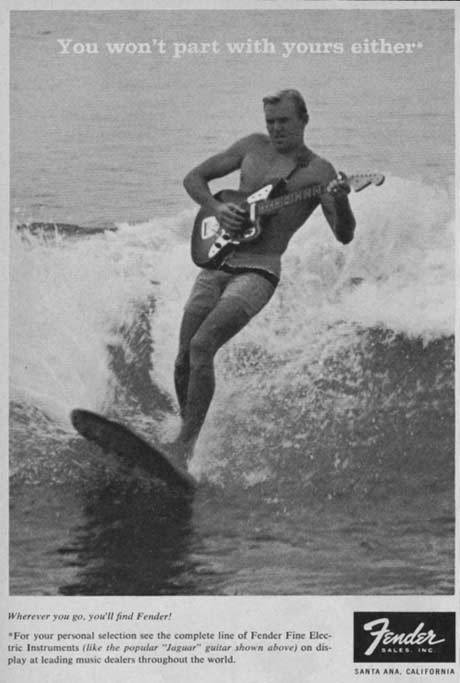
And I don't!  Want to part with mine, that is.  I will certainly not take it surfing, although I don't have to worry about that here in Birmingham, AL.  My 1965 Fender Jaguar will not be cruising the waves anytime soon.

The Jaguar was introduced in 1962 as Fender's new top-of-the line model.  It's shiny chrome plates, clawed single coils and abundance of switches were supposed to make it more desirable than the Telecaster, Stratocaster and Jazzmaster.  The public didn't quite see it that way and went on buying the strats and teles like it was going out of style.  People didn't really like the shorter 24" scale.  The Jaguar didn't sell as well as Fender hoped but became popular for a lot of different styles starting with of course, surf rock.


This 1965 Fender Jaguar was purchased by the parents of the original owner for their 16 year old son.  He had played a little bit and wanted a nice guitar for his birthday.  The price on the tag of Jaguars at the time was $491 which according to the inflation calculator is about $3526.59 in 2012 dollars.  The custom color was about a 5% upcharge.  The strap, I believe, was purchased sometime in the 70s judging by the style.  


I purchased the guitar from the wife of the owner who said that this was the original case.  This case was sold from '62 to '63 so it is doubtful that this was the original case.  USA sold Fenders came guitar specific cases as in each guitar was shipped in its own case.  Maybe the store had guitars hanging on the wall but didn't organize their cases very well so an earlier guitar sold with a newer case and vice versa.


The Jaguars had a similar circuit to the Jazzmaster in that it had a separate rhythm circuit on the bass horn.  With the slider switch down, the lower controls are activated.  The main volume and tone knob and three slider switches let you dial in the tone desired.  The three switches are: neck pickup, bridge pickup and bass cut, also known as the "strange switch."  When this switch is on it has a very trebly and jangly tone.


You'll notice the interesting looking "claws" on either side of the pickups.  This was to help with the hum problem that plagued the Strats, Teles and Jazzmasters.  The electronics cavities were also heavily shielded which did noticeably reduce hum.  The Jaguar pickups still retain that fender tone but I think are a little stronger, hence the bass cut switch.  I haven't had enough time with it yet but I don't think that this guitar really lends itself to blues but it does the surf/indie rock thing in spades.


The tremolo is very smooth and usable.  This "Floating Tremolo" type does a lot better job keeping the guitar in tune compared to the "Synchronized Tremolo" on the Stratocaster.  Smooth, long weeps of the tremolo are accurate and even easy.  I always felt like I was breaking the strat's tremolo when I really used it, which was not often.  I really enjoy the jaguar/jazzmaster style trem.


TVG