1965 Epiphone Frontier

0 comments
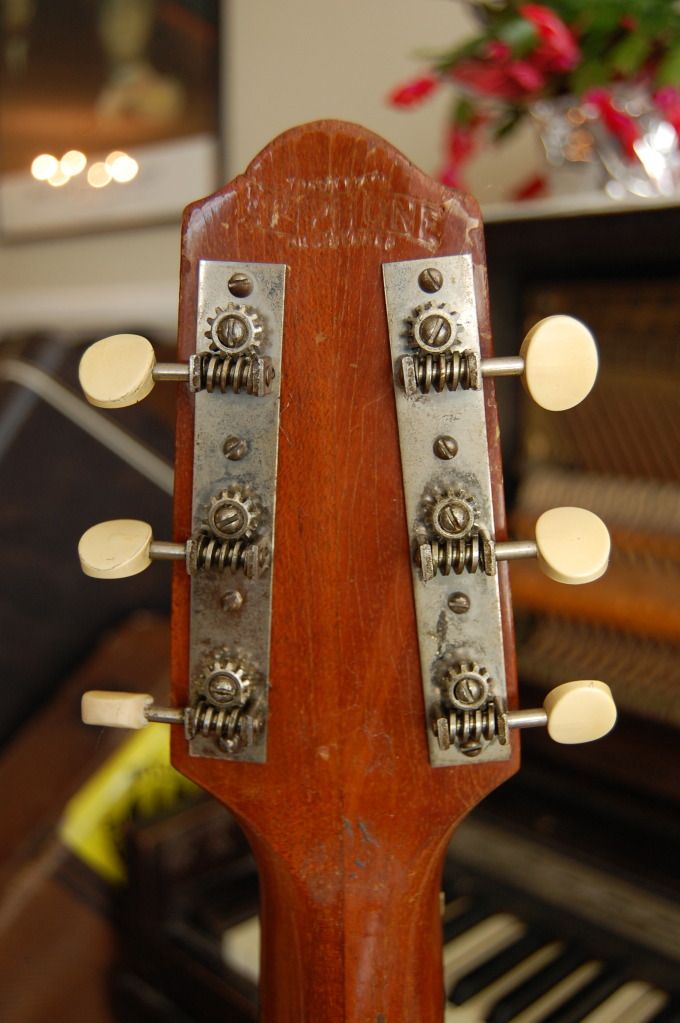
In 1957 Gibson bought a failing manufacturer of musical instruments called Epiphone.  This company had been their biggest rival until management issues started affecting it around the late 40s.  In 1970 they moved the production of the Epiphone brand overseas and made budget instruments.  But, for about 12 years Gibson manufactured guitars in their own factory with Epiphone on the headstock.  The product line was just as high of quality or higher than their own brand.  The Epiphone Frontier (FT-110) was the same build of the Dove but had a different style motif and headstock shape.


I don't normally look for 60s era Gibson acoustics but I fell for this one really bad.  It has flame Maple back and sides, a scale length of 25.4" and of course, a lasso and cacti motif on the pickguard.  The most surprising part of this one was of course, the TONE.


This is a big, rumbly strummer through and through.  I was always told that the ADJ bridge was a tone killer but this one has a couple of secret weapons.  First, the Maple back and sides.  It's a harder wood and seems to reflect volume really well.  Second, the longer scale length.  This takes a little more string tension to get up to pitch resulting in a little more volume.  The downside is that it is a bit more tiring on the fingers.  

If you are a cowboy chord strumming songwriter then string tension is much less of an issue.  What that person needs is a guitar that will make him/her pick it up and strum some chords.  After a morning of fruitless writer's block the only thing left is to play your favorite song.  A subtle twist of a melody or chord change is all it takes to get those creative juices flowing.  


1952 Gibson J-45 previously owned by Johnny Meeks and Bobby Jones of His Blue Caps

0 comments
This one is real special.  I found myself one day jumping in the guitar hauler (read mini van, so rock and roll) and driving to South Carolina.  There was a man selling a 1952 Gibson J-45 and a 1963 Fender Bassman there and we had already agreed on a price.


When I arrived he asked me if I knew who Gene Vincent and His Blue Caps was.  I had no idea I had stepped into the house of Rock and Roll Hall of Fame Member Bobby Jones.  Rolling Stone Magazine bestowed the title of "The first rock and roll band in the world" on the Blue Caps.  Bobby was the bass player for the Blue Caps for about 14 months ('58-'59) and toured the world playing rock and roll.  Bobby's J-45 was stolen around '56 so Johnny sold him his '52.  More on Bobby here


Gibson introduced the J-45 in 1942 sporting a solid Adirondack Spruce top and Honduran Mahogany back and sides.  It had a scale length of 24.75", featured scalloped X bracing and the bridge was rectangular.  In 1944 they switched to Sitka Spruce for the tops.  In 1950 the "belly up" bridge was introduced with a slot saddle.  The sides were solid Mahogany until 1952 and in 1953 the saddle changed to the drop in style.  In 1955 the fretboard went from 19 frets to 20, the bracing went from tall/thin and scalloped to shorter and straight, and the pickguard became the larger style.

Since this guitar has the belly up bridge and the slotted saddle then it *should* have been made in 1952.  The Factory Order Number prefix "Z" confirms this.  


The aforementioned '63 Fender Bassman is still at the amp tech's place.  I'm not sure if it is taking a long time to get parts or if he is playin' the hell outa that thing!  Either way I am excited to get it back.  Hopefully that will be soon.

TVG


True Vintage Giveaway!

0 comments


It's here!  The True Vintage Giveaway is on.  Leave a comment and let me know, "what is your favorite vintage guitar?"  It could be one you already have or one you hope to just hold at least once.  Or just leave a comment.  Be sure to leave some way for me to get in contact with you.

I will be giving this prewar Hohner Marine Band harmonica away for free.  I'll ship it right to your door.  I've been doing this blog for almost a year now (August 5th is the 1st anniversary).  I'm glad that there are some other people out there that care about vintage instruments.  I thought it would be nice to give back.

This harp is in new old stock condition.  It would make a great collector or player if you are so inclined.  It is in the key of G which is my favorite key.  For more info on prewar Hohners then check out my previous post: Prewar Hohner Marine Band Harmonicas.

Good luck!!

Prewar Hohner Marine Band Harmonicas

0 comments
I've been on a big harmonica kick lately.  A couple of years ago I happened upon an old Hohner Marine Band with a star in the circle on the back cover.  The ends of the covers were bent in and there were some funky graphics on the box.  After a bit of searching I came across this website: Pat Missin Prewar Hohner Marine Band Changes.  Take a minute to educate yourself on vintage Hohners.  While the star on the back is a cool piece of history that is long gone, the real deal on these old harps is the type of brass used for the reeds that is no longer available.


I'm having a bit of trouble finding some solid info on the specific brass alloy used for the reed plates.  The basic understanding is that this type of brass was used for the reeds and reed plates until around the 50s.  It was only made in a couple of factories world wide and eventually became not economical to make.  Harmonicas only used a very small percentage of brass and the other consumers of raw brass went to a cheaper form.  The prewar brass is thinner but more sturdy allowing for easier manipulation but also lasts longer.  I could easily tell a difference when I got my first prewar Hohner in the way the reed plates reacted under hard and soft playing.


I'm currently building my collection (I've got about 12 now?  I'm hoping to have around 30 of different keys and conditions).  I want to make a fancy display for them and show them off at guitar shows.  They may sell, they may not but I don't care.  I think they are really neat pieces of history and undervalued.  You can't get that kind of brass now anywhere.  Your only chance is finding a good condition Marine Band or Old Standby.  Plus, the boxes are very aesthetically pleasing and would look nice on your desk next to your vintage Gibson J-45.  At least they look nice next to mine.


"Mouse Ear" Marine Band


1947 Gibson J-50

0 comments
The surge in quality Spruce and skilled craftsman that came when the boys returned home in 1946 prompted the reintroduction of the Gibson J-50.  This model was simply a natural finished version of a J-45 and had previously been in production in 1942.  Aesthetically pleasing Spruce became progressively more scarce during the war so it was discontinued in 1943 until late 1946.


1947 happened to be the first year of the new and still current block logo.  Few other changes were made from 1946.  The necks tend to be a bit smaller in both width and girth but not by much.  The bridge remained rectangular, the tuners still open back Kluson and the neck was still tapered in depth near the headstock.

Gibson flat-top guitars of the 40s and earlier tend to be of a much lighter build than that of the 50s and later.  This J-50 in particular is very light.  I don't have a great way of weighing it but it is noticeably lighter than my 1954 J-45 and 1943 (Maple) J-45.  Both the back and sides are made of solid Mahogany.  J-45s and 50s changed to laminated sides at the close of 1950.  The solid side guitars will have Spruce or cloth side supports to aid the sides from splitting.  My '54 J-45 has no side support while this 50 has Spruce sticks and the Maple has blue ribbon-like cloth.


This J-50 has a very early Factory Order Number.  That is the bold black "605" number.  This is basically a unique number that Gibson gave to a batch of guitars.  I can't remember how many are in a because it changed but I think it is around 70.  The red number is the number assigned to the individual guitar.  Essentially there 69 other J-50s out there with this FON but this was the 32nd one in the batch.


This is Gibson's current logo commonly referred to as the "block logo."  Gibson introduced this logo in 1947 so this guitar was from the first year of this logo and the reissue of this model.  This guitar was listed as a "Mid-50s Gibson J-50."  I looked at the picture and saw the straight bridge and had a hunch that it was in fact, late 40s.  The listing said the guitar was in Florida so I called the specific store and they gave me the run around a couple of times.  The next day I called again and they said the guitar had moved to their store in Nashville.  I just happened to be on my way to Nashville right then!  It was fate!

I got to the store an hour later and headed right for the acoustic room.  I didn't even look around because I knew my business was in the "nice acoustic" room.  I opened the door, looked around and was dismayed at the nagging thought that the unhelpful gentlemen in Florida had lied just to get me off the phone.  But then I saw it, all the way in the back corner, leaned up against the wall behind 3 rows of guitars on stands.  You read that right, leaned up against the wall.  I carefully picked it up like a child forgotten by the hourly workers in a nursery (what a sad metaphor!).  A quick check revealed an all original finish, no cracks, original tuners with replaced buttons, FON: 605 and the same stupid description (mid-50s).

I went looking for a salesman and when I walked past one he said, "You look like a man on a mission." Ok, I guess my game face isn't as good as I thought.  I asked him to tell me about that J-50.  His knowledge of vintage Gibson acoustics was.... lacking.  He read the tag, talked about the sweet tone, etc.  The poor guy had no idea what to say other than "sweet, sweet tone."  Whether he meant it or not he was right.  We put it on the bench so I could stick my phone inside it.  It revealed a slopily reglued brace under the shrinking pickguard and a tired bridge plate.  I showed it to the salesman and made my case for what I wanted to pay for it.  They accepted after some coaxing.


1967 Gibson ES-330

0 comments
No, this is not the little brother of your ES-335, although the general look at model designation might lead you to think so.  The ES-330 was the next step after the ES-225 and was not supposed to be a more accessible 335.  The 330 differs from the 335 in three main ways: fully hollow instead of semi, P-90 pickups instead of humbuckers, and the neck meets at the 16th fret instead of the 19th.


This ES-330 came from a gentlemen in California who had bought it new in '68.  The serial started with a 0 and combined with the other features indicated a manufacture date of late '67.  This guitar was spared of the gigging lifestyle and was played lightly throughout its years.  It was brought along with the owner while he was in the Navy.  The guitar accompanied him on the USS Hornet to the Apollo 11 splashdown.  The original owner was a communications officer and was chosen to go on the trip.


Undervalued in the vintage guitar market

In my opinion, the ES-330 is very undervalued in the vintage guitar marketplace.  A '59 Gibson ES-335 retails around 30 grand while a similar condition ES-330 would retail for about 6 grand.  It doesn't seem fair does it!  I think the reasons for the value differences are:

1.  More prone to feedback at high volume since it is fully hollow and has P-90s
2.  Less celebrity appeal
3.  Outdated design when it came out compared to the center block semi-hollow 335

This model is more prone to feedback at high stage volumes because of the fully hollow design.  This was more of an issue in the 60s with the PA technology that was available.  A small club would rely on large amplifiers cranked way up instead of micing a smaller amp through the PA.  With modern technology this is less of an issue but still something to consider.  Since the stage volumes at my couch are much lower I don't have this problem.  In fact, the fully hollow design is one reason I love this guitar so much.  It is very light and comfortable on the couch.  Even the acoustic tone is to die for.  The P-90s are all I'll ever need to drive my tube radio/guitar amp conversion to the brink of blues bliss.


TVG


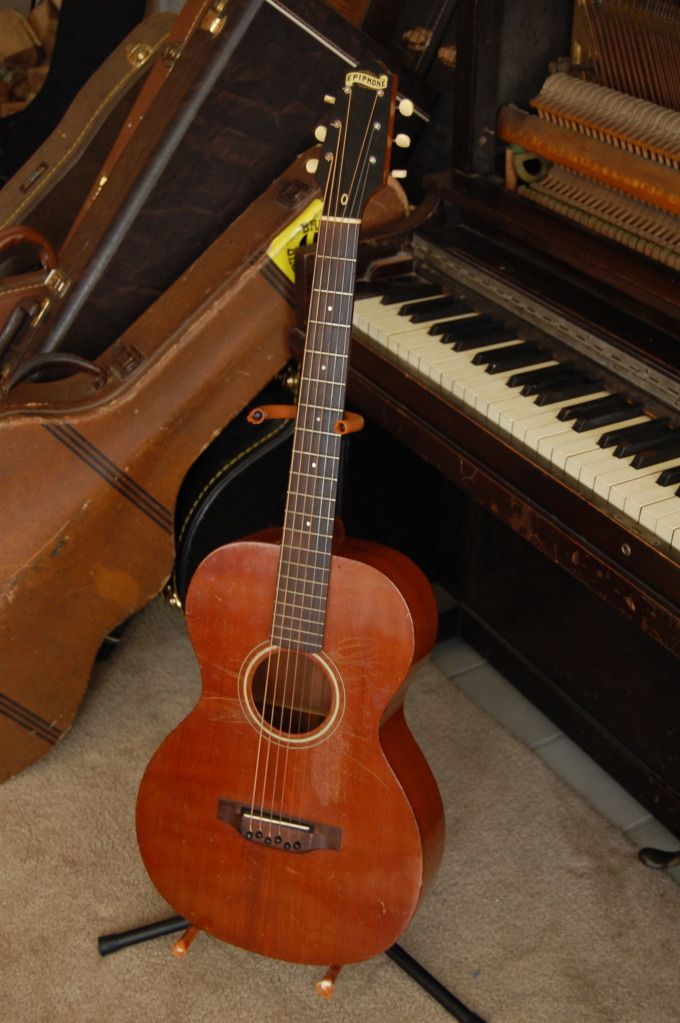
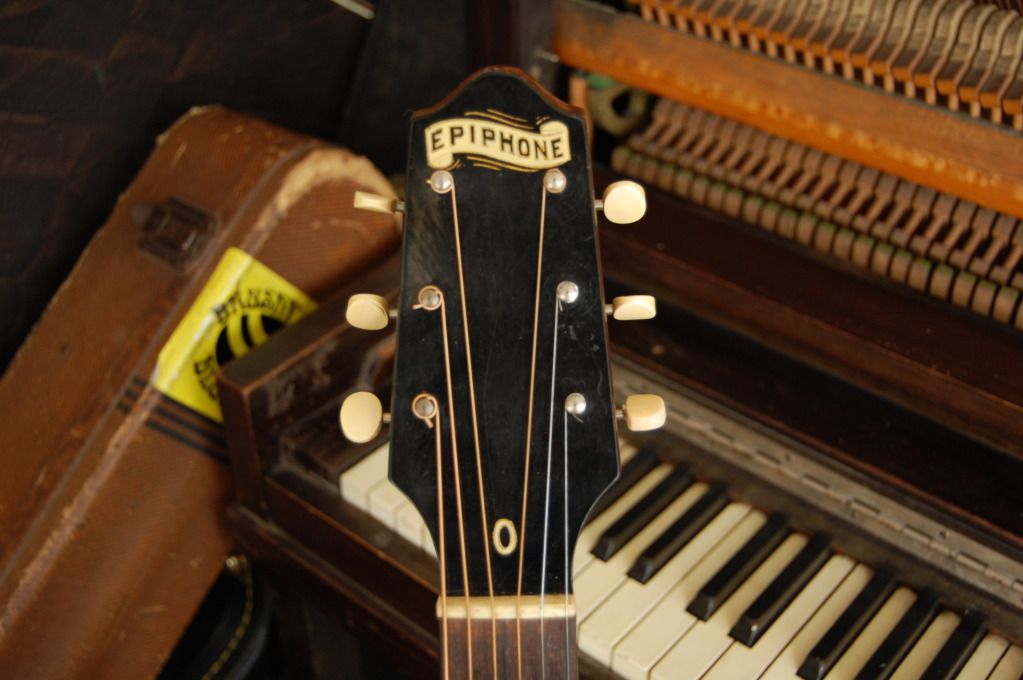
Mahogany Topped Blues Guitar: 1930 Epiphone Model 0

0 comments
Pre-Gibson Epiphones have weighed heavy on my mind lately.  I bought this one off the Craigslist in my parent's hometown of Galatin, TN from a bluegrasser.  He didn't have much use for a guitar like this.  I didn't even haggle!


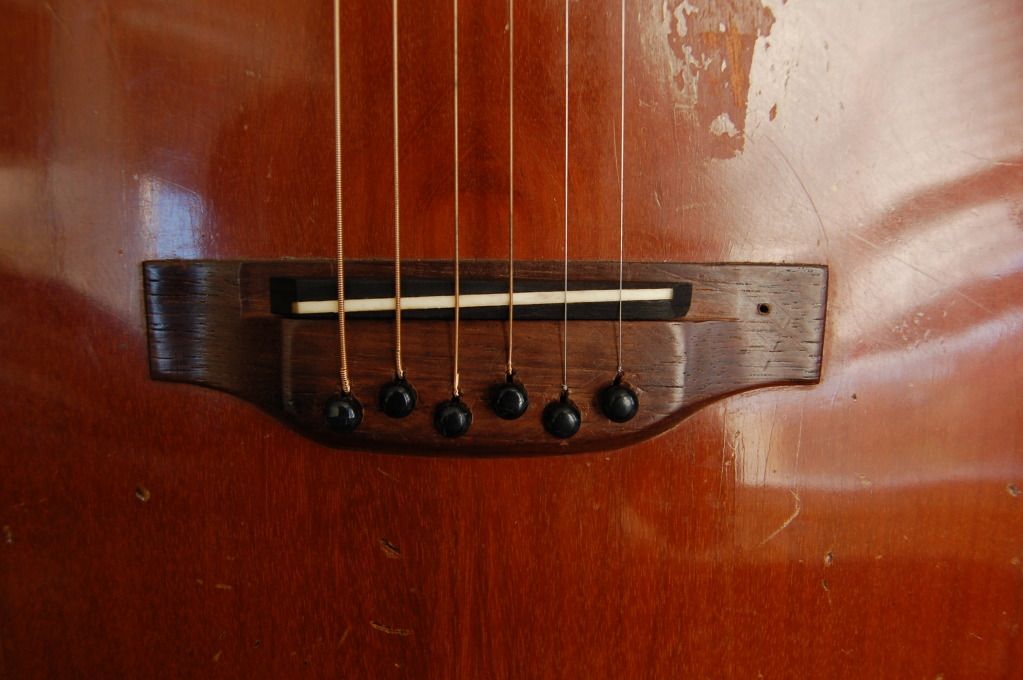
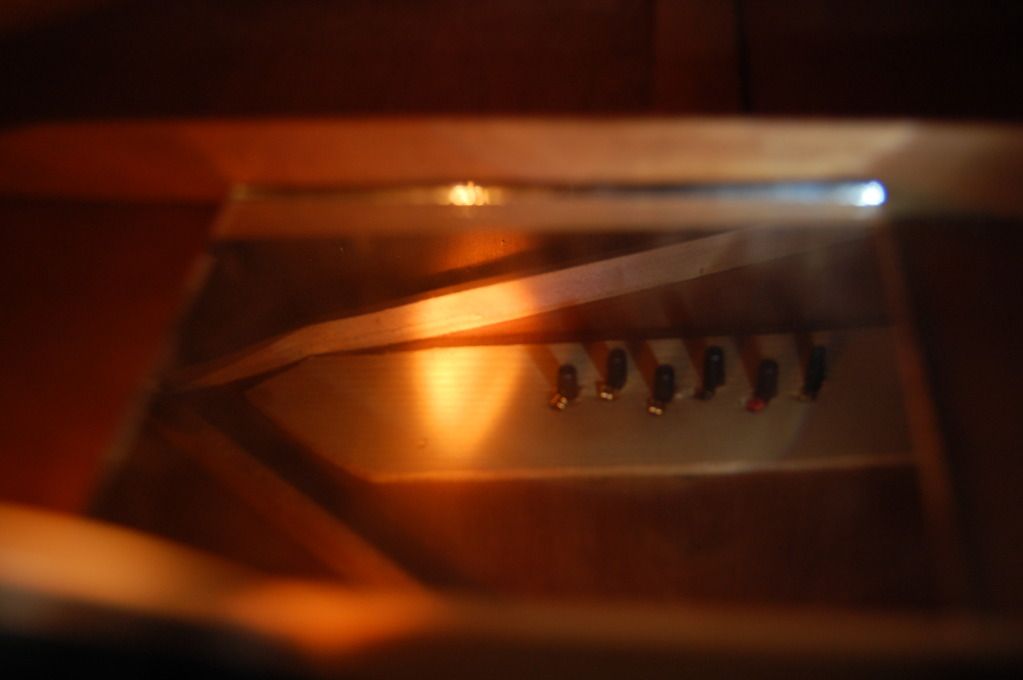
This is a C. 1930 Epiphone Model 0.  If it is the first one that you have seen then that makes two of us.  It is constructed of solid Mahogany throughout and features X-bracing with a single tone bar, 13 frets to the body and a deep V shaped neck.  It has a light build and is very resonant.  The bridge design is interesting but works very well.  It makes sense to be able to move the saddle around to adjust for intonation.


Dating an early Epiphone flat-top

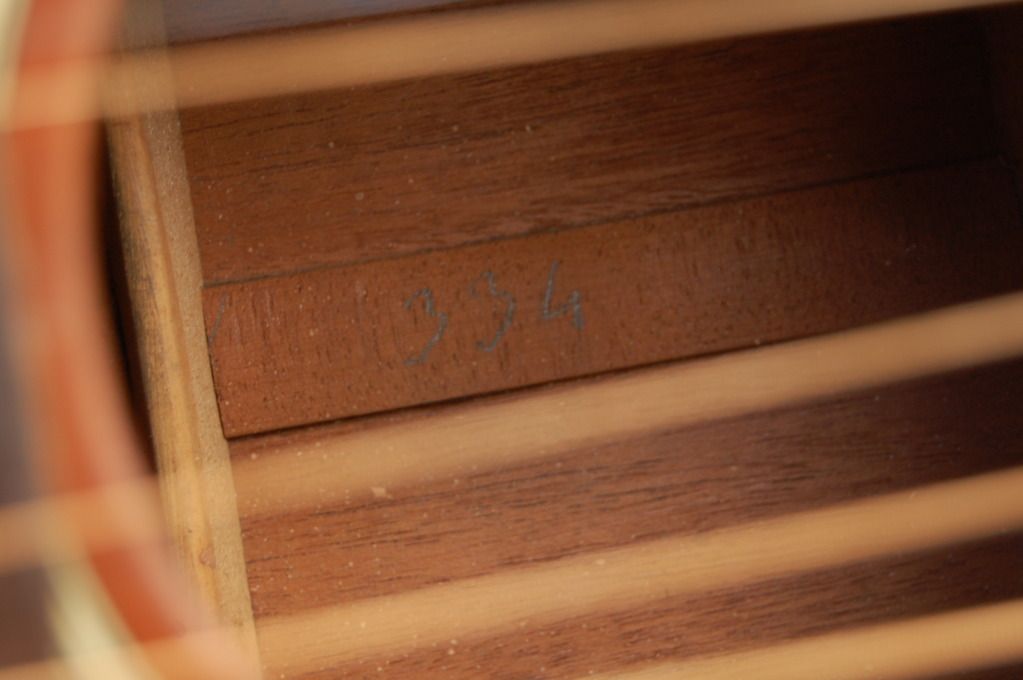
...can be difficult.  To be honest, I don't know the exact build year but I have had some help narrowing it down.  It doesn't have a label but does have a hand written serial number.  There are a pair of fellers that are cataloging pre-Gibson Epiphone flat-tops and working on a good way to date them.  They've contacted me regarding a couple of other Epis that I've had and I am excited to hear that they are working on publishing their findings.  

It seems like only super guitar nerds (like myself) end up liking these guitars.  I think that it is a shame that they aren't held in high regard by the general guitar public because they are of very high quality and rarity.  Maybe the information gathered by these Epi fellows will spark some well deserved interest in New York and Philadelphia (pre-Gibson) Epiphones.


How does this guitar record?

I have a friend who is working on his first full length album.  He has a 1951 Gibson J-50 that I am fond of and is kind enough to bring it over every once in a while to drink beer and play the blues.  This Epiphone is a good sidekick for his recording because it can do the fingerpicking (without picks) much better than a larger guitar.  Since you don't have to use picks to get great tone from her then you also don't get the pick slap or click.