The first appearance of the Epiphone Texan - c.1958

0 comments
These guitars baffled me for some time with their odd features.  I tried to get my hands on one but I just couldn't find an early example.  This 1958 Texan ended up coming to me.


What makes these so special

is the fact that they are an enduring example of Epiphone and Gibson history.  The body and the neck on the early Texans were made in 2 different factories.  When Epiphone sold to Gibson they shipped all the leftover parts to Philadelphia to Kalamazoo.  Gibson began building guitars out of them using everything they could.  This guitar uses two parts from Philadelphia and the rest from Kalamazoo.


The first part from Philadelphia is the mostly finished neck.  The back of the neck shows off the 5 piece laminate construction and subtle V shape found on 1950s era Epiphones.  It appears that Epiphone used Mahogany-Maple-Mahogany for the main neck structure and glued Walnut wings on the sides of the headstock.  The thrust rod cover is direct from Epiphone as well housing the hex nut on the end of the rod.  These covers must have run out early because many of the Philadelphia necked texans have a plastic cover that was most likely made by Gibson.  It's rare to find these with the shaped brass cover.


The second part that Gibson decided to re-use from Philadelphia is the laminate, unkerfed lining.  I had heard stories of solid lined Texans but I had never seen it up close.  My 1954 Epiphone FT-210 Deluxe Cutaway has the same lining so it must have been in the parts shipment from Epiphone.  


The tone

One major tonal difference in these Texans and a similar year J-45/50 is the fact that these necks are designed for a longer scale length.  A longer scale length means that the strings have to be tighter in order to sound the same note.  A higher string tension generally results in 2 things: a slightly stiffer feel and a bit more volume.  

If you haven't played many late 50s J Gibsons then this difference will be unnoticeable.  Even if you have played a lot of them the feel and tone is very familiar.  The biggest difference in player experience is the smaller nut width and subtle V shaped neck.  I found the neck to be very comfortable but a bit smaller than what I'm used too.

Is a buyout era Epiphone Texan for you?

If you interest in vintage guitars find its roots in history, design and the search for great tone then they definitely deserve a hard look.  I joke with friends about how having an American made Epiphone is the quickest test for people who like guitars.  The majority of players will see the name one the headstock and associate it with the current day market.  That guy will keep on walking and buy him a Taylor.  But every once in a while this guitar will stop someone in their tracks and make him question whether it was made in New York, Philadelphia or Kalamazoo.

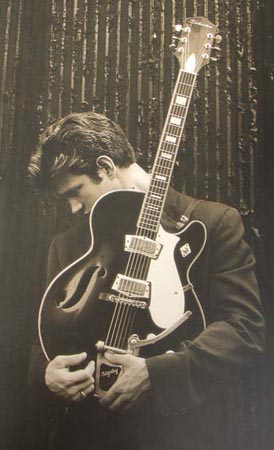
1961 Silvertone 1446L

0 comments


One of the greatest guitars Harmony (Silvertone) ever made was the 1446L commonly referred to as the "Chris Isaak" model.  Chris posed with this model for a couple of advertisements and also named an album "Silvertone."  What makes this guitar special is a combination of dashing looks, Gibson made and Seth Lover designed mini-humbuckers used only on this model and the Bigby vibrato.


The Gibson made miniature humbuckers really are the big attraction to this guitar.  If you want a guitar with these pickups you must buy this model or find some loose pups for sale (good luck!!).  Early production 1446 pickups came with the same "Patent Applied For" stickers as the highly sought after "PAF" pickups that came in 1957-1960 Les Pauls.  The PAFs in those Les Pauls are worth about $2000 each in good shape.  I think the 1446L is very undervalued at $1500 for one in great condition from a big vintage dealer.

The rest of the electronics are good, solid American made just like what came in an LP from that time period.  It has the same setup as well with two pickups, 2 volume and 2 tone knobs, and a 3 way switch.  The whole guitar just seems so solid even though it was manufactured by a budget company.  


I'm a big fan of the Bigsby B3 vibrato that came on these guitars.  The subtle, wavy, almost dreamy vibrato is a lot of fun to play around with.  I naturally lean towards blues licks when I'm playing so I haven't sought after guitars with vibratos.  I did seek out these pickups and I'm glad I was introduced to a good solid vibrato as a result.


If there was one drawback to this guitar it would be in the neck construction.  It does have a truss rod but doesn't taper in width from the heel to the nut.  It seems a little "cheap" at first but I got used to it very quickly and grew to really like it.  The nut width is small but I haven't measured it.


Bottom line:

This is a professional grade vintage instrument at a "prosumer" grade price.  It has the tone and feel of the early 1960s and the looks certainly don't disappoint.  This model shows no sign of declining in popularity and therefore value so it would likely be a good investment as well.  However, because of the nut width and neck construction this guitar may not be the answer for the player looking to own just one guitar.  


1954 Epiphone FT-210 Deluxe Cutaway

0 comments

Here's a rare bird!


Epiphone's Deluxe Cutaway

Here's a very cool 1954 Epiphone FT-210 Deluxe Cutaway.  This was Epiphone's competition to the Gibson J-200 and was actually 3/8" wider at 17 3/8" at the lower bout.  This ladder braced, long scale flat-top featured flame Maple back and sides and beautiful inlays on the neck and headstock.  The compensated Rosewood saddle would not have been my choice but is certainly an interesting addition by Epiphone.


Tone

This flat-top derives much of it's construction and aesthetics from Epiphone's line of archtop guitars.  The arched back of laminated flame Maple lends a punchy response when plucked and strummed.  The large, ladder braced top adds a dark and open timbre with medium volume.  

The compensated Rosewood saddle attempts to improve intonation problems with straight saddles.  This guitar currently needs a neck reset so I can't remark how much it helps.  Theoretically, the compensation is a good idea.  The Rosewood, however, doesn't seem to transfer vibrations to the top as well as a traditional bone saddle.  


I hope you enjoyed the quick look at this rare guitar.  Do you have any more information on this model?  I'm all ears:  Email me


1965 Epiphone Frontier

0 comments
In 1957 Gibson bought a failing manufacturer of musical instruments called Epiphone.  This company had been their biggest rival until management issues started affecting it around the late 40s.  In 1970 they moved the production of the Epiphone brand overseas and made budget instruments.  But, for about 12 years Gibson manufactured guitars in their own factory with Epiphone on the headstock.  The product line was just as high of quality or higher than their own brand.  The Epiphone Frontier (FT-110) was the same build of the Dove but had a different style motif and headstock shape.


I don't normally look for 60s era Gibson acoustics but I fell for this one really bad.  It has flame Maple back and sides, a scale length of 25.4" and of course, a lasso and cacti motif on the pickguard.  The most surprising part of this one was of course, the TONE.


This is a big, rumbly strummer through and through.  I was always told that the ADJ bridge was a tone killer but this one has a couple of secret weapons.  First, the Maple back and sides.  It's a harder wood and seems to reflect volume really well.  Second, the longer scale length.  This takes a little more string tension to get up to pitch resulting in a little more volume.  The downside is that it is a bit more tiring on the fingers.  

If you are a cowboy chord strumming songwriter then string tension is much less of an issue.  What that person needs is a guitar that will make him/her pick it up and strum some chords.  After a morning of fruitless writer's block the only thing left is to play your favorite song.  A subtle twist of a melody or chord change is all it takes to get those creative juices flowing.  


1952 Gibson J-45 previously owned by Johnny Meeks and Bobby Jones of His Blue Caps

0 comments
This one is real special.  I found myself one day jumping in the guitar hauler (read mini van, so rock and roll) and driving to South Carolina.  There was a man selling a 1952 Gibson J-45 and a 1963 Fender Bassman there and we had already agreed on a price.


When I arrived he asked me if I knew who Gene Vincent and His Blue Caps was.  I had no idea I had stepped into the house of Rock and Roll Hall of Fame Member Bobby Jones.  Rolling Stone Magazine bestowed the title of "The first rock and roll band in the world" on the Blue Caps.  Bobby was the bass player for the Blue Caps for about 14 months ('58-'59) and toured the world playing rock and roll.  Bobby's J-45 was stolen around '56 so Johnny sold him his '52.  More on Bobby here


Gibson introduced the J-45 in 1942 sporting a solid Adirondack Spruce top and Honduran Mahogany back and sides.  It had a scale length of 24.75", featured scalloped X bracing and the bridge was rectangular.  In 1944 they switched to Sitka Spruce for the tops.  In 1950 the "belly up" bridge was introduced with a slot saddle.  The sides were solid Mahogany until 1952 and in 1953 the saddle changed to the drop in style.  In 1955 the fretboard went from 19 frets to 20, the bracing went from tall/thin and scalloped to shorter and straight, and the pickguard became the larger style.

Since this guitar has the belly up bridge and the slotted saddle then it *should* have been made in 1952.  The Factory Order Number prefix "Z" confirms this.  


The aforementioned '63 Fender Bassman is still at the amp tech's place.  I'm not sure if it is taking a long time to get parts or if he is playin' the hell outa that thing!  Either way I am excited to get it back.  Hopefully that will be soon.

TVG


True Vintage Giveaway!

0 comments


It's here!  The True Vintage Giveaway is on.  Leave a comment and let me know, "what is your favorite vintage guitar?"  It could be one you already have or one you hope to just hold at least once.  Or just leave a comment.  Be sure to leave some way for me to get in contact with you.

I will be giving this prewar Hohner Marine Band harmonica away for free.  I'll ship it right to your door.  I've been doing this blog for almost a year now (August 5th is the 1st anniversary).  I'm glad that there are some other people out there that care about vintage instruments.  I thought it would be nice to give back.

This harp is in new old stock condition.  It would make a great collector or player if you are so inclined.  It is in the key of G which is my favorite key.  For more info on prewar Hohners then check out my previous post: Prewar Hohner Marine Band Harmonicas.

Good luck!!

Prewar Hohner Marine Band Harmonicas

0 comments
I've been on a big harmonica kick lately.  A couple of years ago I happened upon an old Hohner Marine Band with a star in the circle on the back cover.  The ends of the covers were bent in and there were some funky graphics on the box.  After a bit of searching I came across this website: Pat Missin Prewar Hohner Marine Band Changes.  Take a minute to educate yourself on vintage Hohners.  While the star on the back is a cool piece of history that is long gone, the real deal on these old harps is the type of brass used for the reeds that is no longer available.


I'm having a bit of trouble finding some solid info on the specific brass alloy used for the reed plates.  The basic understanding is that this type of brass was used for the reeds and reed plates until around the 50s.  It was only made in a couple of factories world wide and eventually became not economical to make.  Harmonicas only used a very small percentage of brass and the other consumers of raw brass went to a cheaper form.  The prewar brass is thinner but more sturdy allowing for easier manipulation but also lasts longer.  I could easily tell a difference when I got my first prewar Hohner in the way the reed plates reacted under hard and soft playing.


I'm currently building my collection (I've got about 12 now?  I'm hoping to have around 30 of different keys and conditions).  I want to make a fancy display for them and show them off at guitar shows.  They may sell, they may not but I don't care.  I think they are really neat pieces of history and undervalued.  You can't get that kind of brass now anywhere.  Your only chance is finding a good condition Marine Band or Old Standby.  Plus, the boxes are very aesthetically pleasing and would look nice on your desk next to your vintage Gibson J-45.  At least they look nice next to mine.


"Mouse Ear" Marine Band